We research products independently from specs, manufacturer documentation, warranty terms and owner feedback. When you buy through links on this page, we may earn a commission at no extra cost to you. As an Amazon Associate we earn from qualifying purchases.
Quick answer
The KitchenAid Artisan Series 5-Qt Tilt-Head Stand Mixer KSM150PS is the best stand mixer for most home bakers: a 5-quart bowl that handles most recipes, a huge range of attachments and a reputation for lasting many years. For less money, the Cuisinart SM-50 5.5-Quart Stand Mixer gives you a bigger bowl and 12 speeds. If you mainly want a KitchenAid for cookies and cakes, the Classic 4.5-quart is the value pick.
The best stand mixers take the arm work out of baking. They cream butter and sugar, whip egg whites and knead dough while you measure the next ingredient. Most buyers end up choosing between a tilt-head design, where the motor head lifts back so you can reach the bowl, and a bowl-lift design, where the bowl rises on arms to meet a fixed head. That choice, plus bowl size and how often you make heavy bread dough, decides which mixer fits your kitchen. Our picks are based on specs, manufacturer documentation, warranty terms, independent review consensus and owner-feedback patterns.
Quick picks
| Product | Best for | Our verdict | Typical price |
|---|---|---|---|
| KitchenAid Artisan Series 5-Qt Tilt-Head Stand Mixer KSM150PS | Most home bakers | Buy | about $379–$459 |
| KitchenAid Artisan 5-Quart Stand Mixer | Gifts and color choice | Buy | about $380–$460 |
| KitchenAid Classic 4.5-Qt Tilt-Head Stand Mixer K45SS | Value KitchenAid | Buy | about $249–$329 |
| Cuisinart SM-50 5.5-Quart Stand Mixer | Budget | Buy | about $179–$249 |
| KitchenAid Pro 600 6-Qt Bowl-Lift Stand Mixer | Bread bakers | Consider | about $449–$549 |
Mixer prices swing a lot with color and season, so check the current price before you buy.
The best stand mixers in 2026
Best overall Our verdict: Buy
KitchenAid Artisan Series 5-Qt Tilt-Head Stand Mixer KSM150PS
Typical price: about $379–$459
Most home bakers. Buy it if you bake regularly and want a durable, versatile mixer with dozens of attachments.
- Pros
- ✓ 5-qt bowl handles most recipes
- ✓ Huge range of attachments
- ✓ Lasts for many years
- ✓ Dozens of colors
- Cons
- ✕ Heavy
- ✕ Struggles with very stiff doughs
Check price on Amazon Paid link
The KitchenAid Artisan Series 5-Qt Tilt-Head Stand Mixer KSM150PS is the classic stand mixer for good reason. It does nearly everything a home baker asks of it: cookies, cakes, frosting, meringue, and moderate bread doughs. Its 5-quart bowl handles most recipes, including a double batch of cookie dough, and its 325-watt motor runs across 10 speeds.
The bigger reason to buy it is the ecosystem. KitchenAid’s attachment hub works with a huge range of add-ons, from pasta rollers to meat grinders and spiralizers, so the mixer can grow into other jobs. It is known for lasting many years, and it comes in dozens of colors, which matters if it will live on your counter. The tilt-head design makes everyday baking easy: lift the head, scrape the bowl, add eggs, lower it and carry on.
There are trade-offs. It is heavy, which is good for stability but annoying if you store it in a cabinet. It also struggles with very stiff doughs, such as bagels or large batches of whole-grain bread. Skip it if you knead heavy bread dough every week; the bowl-lift KitchenAid Pro 600 6-Qt Bowl-Lift Stand Mixer is sturdier for that work.
Also great Our verdict: Buy
KitchenAid Artisan 5-Quart Stand Mixer
Typical price: about $380–$460
Home bakers. Buy it if you bake regularly and want a mixer that lasts decades.
- Pros
- ✓ Very durable
- ✓ Huge range of attachments
- ✓ Many colors
- Cons
- ✕ Heavy
- ✕ Struggles with very stiff dough
Check price on Amazon Paid link
The KitchenAid Artisan 5-Quart Stand Mixer is the same Artisan tilt-head mixer as our top pick, listed under a more general name. It shares the 5-quart bowl, the huge range of attachments, the many color options and the reputation for durability. Its typical price of about $380–$460 is nearly identical, so this is not a step up or down.
Why does it appear twice? Retailers often list the same mixer under a model number and under a friendlier name, with colors split across the two. Treat the two listings as interchangeable and compare them on the day you shop. Different colors often sit under different listings and carry different prices, so the cheapest route to the exact color you want may be through either one. Confirm the model and what comes in the box before ordering. It also makes a popular gift, since it’s the mixer many people picture when they think of a stand mixer.
The cons are the same: it is heavy and it struggles with very stiff dough. If you knead heavy bread dough daily, look at a bowl-lift model instead.
Best value KitchenAid Our verdict: Buy
KitchenAid Classic 4.5-Qt Tilt-Head Stand Mixer K45SS
Typical price: about $249–$329
Value KitchenAid. Buy it if you want a KitchenAid for cookies and cakes at a lower price.
- Pros
- ✓ Lower price
- ✓ Works with KitchenAid attachments
- ✓ Durable
- Cons
- ✕ Smaller bowl without a handle
- ✕ Fewer colors
Check price on Amazon Paid link
The KitchenAid Classic 4.5-Qt Tilt-Head Stand Mixer K45SS gives you KitchenAid quality and attachment compatibility for less. Typically about $249–$329, it uses a 4.5-quart bowl and a 275-watt motor, which is plenty for cookies, cakes, frosting and small batches of dough.
It works with the same KitchenAid attachments as the Artisan and shares the brand’s reputation for durability, so you aren’t locked out of the ecosystem by saving money. The compromises are smaller capacity and fewer comforts: the bowl has no handle, which makes pouring and scraping a little clumsier, and there are fewer color choices.
For a first stand mixer in a small kitchen, or for someone who mostly bakes cookies on weekends, the Classic is often all you need, and the money you save can go toward an attachment you’ll actually use. Buy it if you bake a few times a month and want a KitchenAid without paying Artisan prices. Skip it if you bake large batches or make bread often; the 4.5-quart bowl fills up quickly, and the Artisan or the Cuisinart is a better fit.
Best budget Our verdict: Buy
Cuisinart SM-50 5.5-Quart Stand Mixer
Typical price: about $179–$249
Budget. Buy it if you want a capable stand mixer with a big bowl for less than a KitchenAid.
- Pros
- ✓ 5.5-qt bowl
- ✓ 12 speeds
- ✓ Good value
- Cons
- ✕ Fewer attachments
- ✕ Less proven over decades
Check price on Amazon Paid link
The Cuisinart SM-50 5.5-Quart Stand Mixer is the best stand mixer for the money. At about $179–$249 it costs less than any KitchenAid here, yet it gives you a larger 5.5-quart bowl, 12 speeds and a 500-watt motor. For bakers who want capacity and don’t care about the name on the side, it is a strong deal.
The trade-off is the ecosystem. Cuisinart offers fewer attachments than KitchenAid, so if you dream of making fresh pasta or grinding meat with your mixer, the KitchenAid line has more options. The SM-50 also has a shorter track record; KitchenAid tilt-heads have been around for decades, and the Cuisinart is less proven over that kind of time span. Note that motor wattage alone doesn’t tell you how well a mixer handles dough, since gearing and design matter too.
Buy it if you want a capable mixer with a big bowl for less than a KitchenAid. Skip it if a large range of attachments matters to you; the KitchenAid Classic 4.5-Qt Tilt-Head Stand Mixer K45SS is the cheapest way into KitchenAid’s add-ons.
Best for bread bakers Our verdict: Consider
KitchenAid Pro 600 6-Qt Bowl-Lift Stand Mixer
Typical price: about $449–$549
Bread bakers. Buy it if you bake bread, bagels or pizza dough often and want a sturdy bowl-lift mixer.
- Pros
- ✓ Large 6-qt bowl
- ✓ Stable bowl-lift design
- ✓ Handles heavy dough
- Cons
- ✕ Tall
- ✕ may not fit under cabinets
- ✕ Expensive
Check price on Amazon Paid link
The KitchenAid Pro 600 6-Qt Bowl-Lift Stand Mixer is built for heavy work. Its bowl-lift design holds the 6-quart bowl firmly on two arms, which keeps the mixer stable when kneading stiff doughs, and its 575-watt motor is aimed at bread, bagels and pizza dough. If you bake big batches, the larger bowl helps too.
We rate it Consider rather than Buy because it’s a specialist. It is tall, so it may not fit under upper cabinets, and it is expensive at about $449–$549. Bowl-lift mixers are also less convenient for everyday baking: adding ingredients and scraping the bowl is fiddlier than with a tilt-head.
Because the bowl is held on arms rather than sitting under a hinged head, the mixer stays steadier when a heavy dough ball thumps around the bowl. Buy it if you bake bread, bagels or pizza dough often and want a sturdy mixer that won’t strain. Skip it if you mostly make cookies and cakes; the KitchenAid Artisan Series 5-Qt Tilt-Head Stand Mixer KSM150PS is easier to use and costs less.
How to choose stand mixers
Tilt-head vs bowl-lift
Tilt-head mixers, like the KitchenAid Artisan Series 5-Qt Tilt-Head Stand Mixer KSM150PS and the KitchenAid Classic 4.5-Qt Tilt-Head Stand Mixer K45SS, let you lift the motor head back to reach the bowl. That makes adding ingredients, swapping beaters and scraping down the sides easy. Bowl-lift mixers, like the KitchenAid Pro 600 6-Qt Bowl-Lift Stand Mixer, raise the bowl to a fixed head, which is steadier under heavy loads. Rule of thumb: if you mostly bake sweets, buy a tilt-head. If you knead bread dough weekly, buy a bowl-lift.
Bowl size
Bowl capacity decides how much you can make at once. A 4.5-quart bowl handles standard cookie, cake and frosting recipes. A 5-quart bowl gives you room for double batches. A 5.5- to 6-quart bowl suits big families, holiday baking and bread. If you often double recipes, skip the 4.5-quart Classic and choose the Artisan or the Cuisinart SM-50 5.5-Quart Stand Mixer.
Think about the people eating the results. A couple who bakes a cake for birthdays and a tray of cookies now and then will be happy with the Classic. A family that bakes weekly, packs lunches with homemade treats or hosts holidays will appreciate the Artisan’s 5-quart bowl or the Cuisinart’s 5.5 quarts. A home baker chasing sourdough sandwich loaves, bagels and pizza nights should go straight to the Pro 600. Buying for the baking you actually do, rather than the baking you imagine, is the easiest way to avoid overspending.
Motor power and speeds
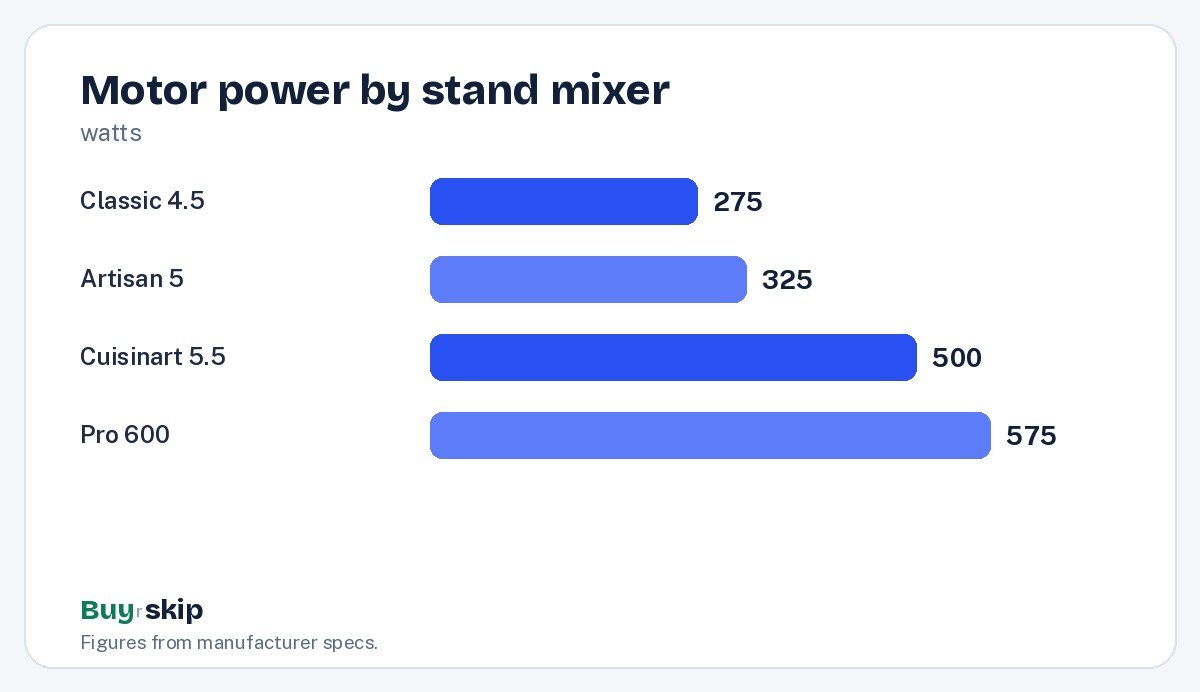
Wattage gives a rough sense of muscle, but it isn’t the whole story. KitchenAid’s tilt-heads have lower listed wattage than the Cuisinart yet have a long record with typical home recipes. What matters most is whether the mixer handles your heaviest dough without straining. Speed count matters less than you’d think: you’ll mainly use a low stir, a medium mix and a high whip. The Cuisinart’s 12 speeds and KitchenAid’s 10 both cover that.
Stand mixer or hand mixer
Before spending a few hundred dollars, be honest about how you bake. A hand mixer is cheap, small and fine for boxed cake mixes, whipped cream and the occasional batch of cookies. A stand mixer earns its counter space when you bake often, make doughs, or want to walk away while it creams butter or whips egg whites for several minutes. It also handles thick cookie doughs that bog down most hand mixers. If you bake at least a couple of times a month, or you want to start making bread and pizza at home, a stand mixer is the better tool. If you bake twice a year, it will mostly gather dust.
Most stand mixers ship with three core tools: a flat beater for batters and cookie dough, a dough hook for kneading, and a wire whip for cream and egg whites. That covers the vast majority of home baking. Check the listing for what’s included with your chosen model, because bundles vary. A pouring shield helps keep flour from puffing out of the bowl when you start mixing, and a second bowl is handy if you bake several components back to back, such as a cake and its frosting.
Attachments and ecosystem
This is where KitchenAid pulls ahead. Its attachment hub supports a wide range of add-ons, so the same mixer can roll pasta, shred vegetables or grind meat. If that flexibility appeals to you, buy any of the KitchenAid tilt-heads. If you only want to mix and knead, the Cuisinart saves money. Common upgrades include a flex edge beater that scrapes the bowl as it mixes, and a pasta roller attachment for fresh noodles.
Size, weight and storage
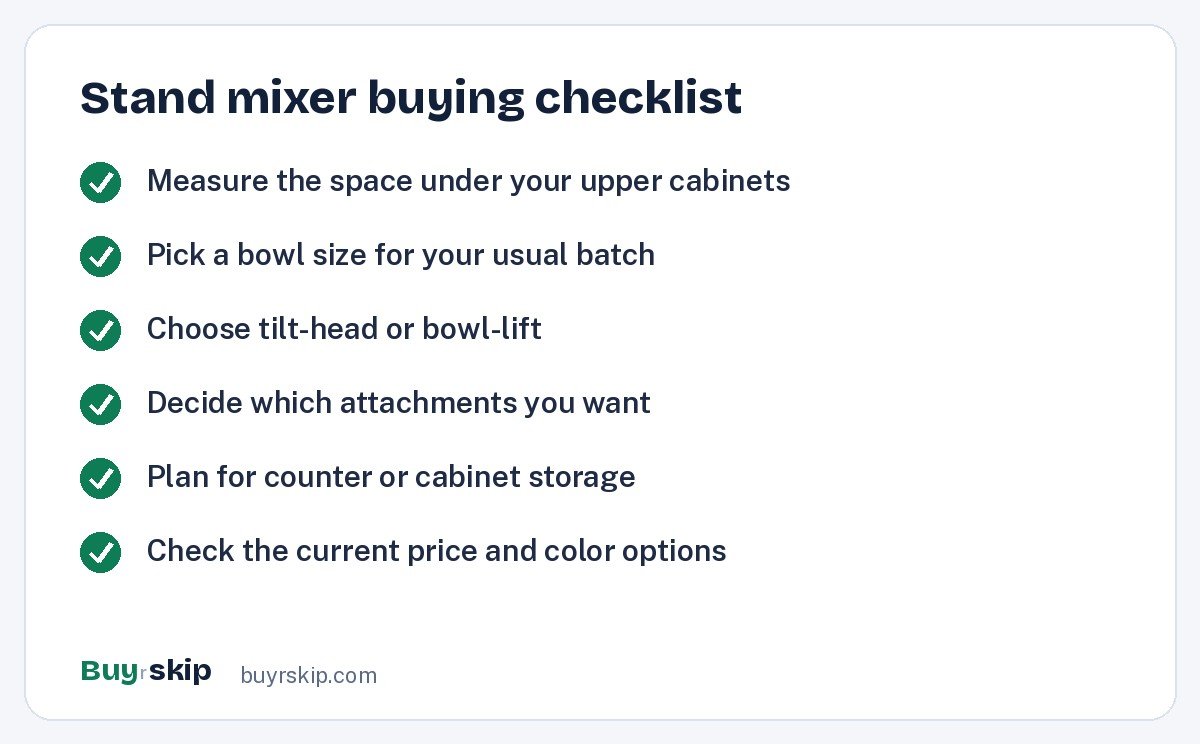
Stand mixers are heavy and tall. Weight keeps them steady, but it makes lifting from a low cabinet a chore, so most owners leave them on the counter. Measure the space under your upper cabinets before you buy, especially for a bowl-lift model like the Pro 600. A tilt-head needs extra clearance when the head is raised, too.
Budget
Under $250, the Cuisinart offers the most capacity. Around $250–$330, the Classic gets you into KitchenAid. Around $380–$460, the Artisan is the all-rounder most bakers grow into. Above that, the Pro 600 is for bread-focused bakers. A good mixer can last a long time, so spending a bit more on the right size is usually worth it. Setting up a baking kitchen? Our best cookware and best blenders picks round things out.
Frequently asked questions
Is a KitchenAid stand mixer worth the money?
For regular bakers, usually yes. KitchenAid tilt-heads have a long reputation for durability, the attachment ecosystem is far larger than rivals’, and parts and accessories are easy to find. If you bake only a few times a year, the Cuisinart SM-50 5.5-Quart Stand Mixer gives you a bigger bowl for less, and you won’t miss attachments you’d never use.
What size stand mixer do I need?
For most households, 5 quarts is the sweet spot. It handles standard recipes and double batches of cookies. A 4.5-quart bowl, like the KitchenAid Classic K45SS, is fine for small households that bake occasionally. Choose 5.5 to 6 quarts if you bake bread often, make large holiday batches or cook for a big family.
Can a tilt-head mixer knead bread dough?
Yes, for occasional loaves and moderate batches. The KitchenAid Artisan handles typical sandwich bread and pizza dough, though it struggles with very stiff doughs like bagels or large whole-grain batches. Keep the speed low when kneading and don’t overfill the bowl. If you knead heavy dough every week, a bowl-lift mixer like the KitchenAid Pro 600 is the sturdier choice.
What is the difference between the two KitchenAid Artisan listings?
They describe the same Artisan 5-quart tilt-head mixer. One listing uses the model number KSM150PS, and the other uses a shorter general name. Typical prices are almost the same. Colors and bundles may vary between listings, so compare both for the color you want and buy whichever is cheaper that day.
Will a stand mixer fit under my kitchen cabinets?
Most tilt-head mixers fit under standard upper cabinets when the head is down, but you need extra clearance to raise it, or you’ll slide the mixer forward to use it. Bowl-lift models like the KitchenAid Pro 600 are taller and may not fit at all. Measure from your countertop to the bottom of the cabinets before buying.
How do I keep a stand mixer working for years?
Start every recipe on the lowest speed so ingredients don’t fly out and the motor isn’t shocked by a sudden load. Don’t overfill the bowl, especially with stiff dough, and let the motor rest if it feels warm during a long knead. Wipe the head and attachment hub after use, and follow the manufacturer’s cleaning guidance for beaters and bowls, since some finishes are not dishwasher safe.
The bottom line
The KitchenAid Artisan Series 5-Qt Tilt-Head Stand Mixer KSM150PS is the best stand mixer for most home bakers: the right bowl size, a huge attachment range and a long track record. If you want to spend less, the Cuisinart SM-50 gives you more bowl for the money, and the KitchenAid Classic is the cheapest way into the KitchenAid ecosystem. Only bread-focused bakers need the Pro 600.
Check price on Amazon: KitchenAid Artisan Series 5-Qt Tilt-Head Stand Mixer KSM150PS
Paid link. Typical price about $379–$459; check the current price on Amazon.