We research products independently from specs, manufacturer documentation, warranty terms and owner feedback. When you buy through links on this page, we may earn a commission at no extra cost to you. As an Amazon Associate we earn from qualifying purchases.
Quick answer
In a small apartment, choose a robot by its footprint, height and noise, not its power. The best fit is a slim robot with a compact dock that tucks beside a couch or under a console table. The eufy Robot Vacuum Omni C20 is our top apartment pick at about $399–$599 because it vacuums and mops from a small station. On a tight budget, a mapped robot with a self-empty base like the Shark AV2501S AI Ultra covers vacuum-only needs.
Shopping for a robot vacuum for small apartments is a different problem from shopping for a house. Almost any mapped robot has the power and battery to cover 500 to 900 square feet. What actually decides whether you love it is where the dock lives, whether the robot fits under your bed and sofa, how loud it is through a shared wall, and whether you can take it with you when your lease ends. Our picks are based on specs, manufacturer documentation, warranty terms, independent review consensus and owner-feedback patterns. This guide focuses on the space, noise and storage questions that general buying advice skips.
What changes with a robot vacuum for small apartments
Most robot advice is written for three-bedroom homes with garages and laundry rooms. Apartments flip the priorities. Here is what matters in a small space, roughly in order.
1. The dock is the real size problem
The robot itself is about the size of a large dinner plate. The dock is the part that eats floor space. A basic charging dock is tiny. A self-empty base is taller and has a bag or bin. An all-in-one station with clean and dirty water tanks can be the size of a small trash can or nightstand.
In a studio, that station is part of your decor whether you like it or not. Before buying, check the listed dock dimensions on the product page and measure the spot you have in mind. Most manuals also ask for open space on each side and in front of the dock so the robot can drive in straight; check the exact clearance in the manual for your model.
Decision rule: if you do not have a corner or wall spot that is out of the walkway, choose a compact station or a self-empty base over a full-size all-in-one dock.
2. Low furniture clearance
Apartment furniture tends to be lower and closer together: platform beds, low sofas, media consoles, dressers with short legs. The dust under them is exactly what you bought a robot to reach.
Measure the gap under your lowest furniture from the floor to the frame. Compare it with the robot’s listed height, including the LiDAR turret on top, since that bump is usually the tallest point. Slim robots (shop low-profile robot vacuums) such as the eufy Robot Vacuum Omni C20 and the premium Roborock Saros 10R are designed to get under lower furniture than typical turret robots. If a robot is a near miss, it may wedge itself under the frame, so leave a margin or set that area as a no-go zone.
3. Noise through shared walls and floors
Your neighbors hear what you hear. Robots are quietest on their lowest suction setting and loudest on max suction and during the self-empty step, which is a short, loud burst at the dock.
A few ways to keep the peace:
- Schedule runs while you are at work, and avoid early mornings and late nights.
- Use a quiet or standard suction mode for daily runs; boost only on rugs.
- Check whether the app lets you delay or disable auto-empty during set hours.
- Put the dock against an interior wall rather than a wall shared with a neighbor.
If quiet operation is your top priority, a slim, quiet basic robot like the eufy RoboVac 11S is one option, and among premium mopping models the Narwal Freo Z Ultra is known for quiet, careful mopping.
4. Hard floors and rugs in rentals
Many apartments have vinyl plank, laminate or tile throughout, with a few area rugs. That combination suits robot mopping well, provided the robot lifts its mop or leaves it at the dock on rugs. Without that, you will be setting no-mop zones around every rug.
Older buildings sometimes have raised door saddles between rooms, especially at bathrooms. Most robots handle thresholds of about 2 cm (roughly three-quarters of an inch). If yours are taller, the robot may not reach the bathroom, which is fine for many renters, or you can use a no-go line.
5. Renter-friendly setup
Look for features that do not require drilling or plumbing: virtual no-go zones in the app instead of magnetic strips, refillable water tanks instead of plumbed water hookups, and a dock that sits freely on the floor. When you move, a mapped robot can save multiple maps on many models, so you simply remap the new place.
6. Storage and maintenance in tight spaces
With a self-empty base, you empty debris rarely rather than after most runs, which matters when your trash can is under the sink and your closet is full. Bagged bases are cleaner to empty indoors without a balcony or yard, since the bag seals. Bagless bases save money on bags but release a little dust when you empty them, which is more noticeable in a small room.
All-in-one docks need fresh water refills and dirty water dumps. In a small apartment with a small kitchen sink, a compact station with smaller tanks is easier to carry and empty, though you will do it more often.
How to choose a robot vacuum for a small apartment, by layout
Here is how to match a robot to your floor plan. Find your layout and follow the rule.
Studio or open-plan one-bedroom, mostly hard floors. You get the most benefit from mopping, and you have the least room for a big dock. Buy a compact all-in-one like the eufy Omni C20, or browse compact robot vacuum and mop stations.
One-bedroom, mostly carpet or large rugs. Skip mopping. A LiDAR robot with a self-empty base, such as the Shark AV2501S AI Ultra Robot Vacuum, is the efficient choice and costs less.
One or two bedrooms with a dog or cat. Pet hair builds up quickly in small spaces. A self-empty base is close to essential. If your pet has accidents or you have lots of cords, consider a robot with stronger obstacle avoidance.
Two-bedroom with mixed floors and a dock spot to spare. You have room for a full all-in-one station. The Roborock Qrevo S Robot Vacuum and Mop gives you a dock that empties the robot and washes and dries the mop pads, which is the most hands-off setup at a mid-range price.
Tiny studio, tight budget, one open room. A basic random-navigation robot is acceptable here, because there are no rooms to miss. It is the one case where we would consider an unmapped robot.
If none of these fit your situation, or you are not sure a robot is right for your space at all, our full robot vacuum buying guide covers every decision in depth, and our robot vacuum vs stick vacuum guide helps if you are considering a cordless stick instead.
Measure before you buy
Five minutes with a tape measure prevents most apartment robot returns. Use this checklist.
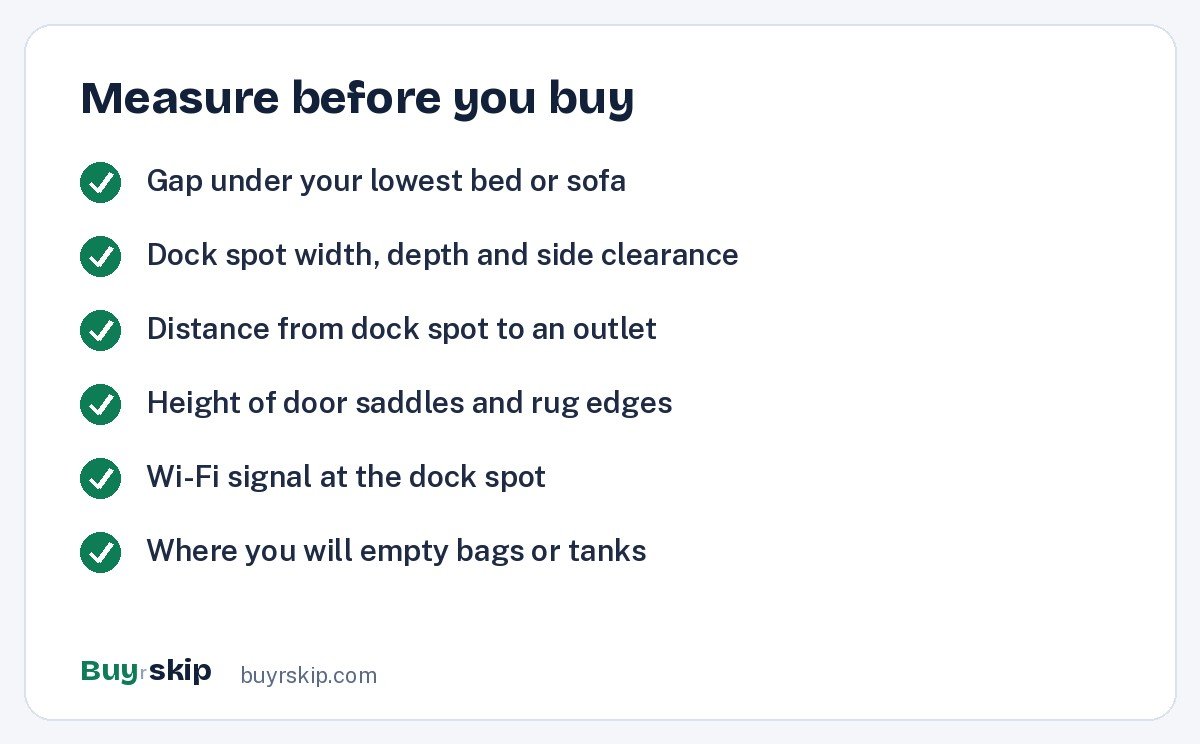
Two tips on placement. First, the dock needs an outlet nearby, and a cord stretched across a walkway is a trip hazard, so pick a spot where the cord runs along the wall. Second, the dock should sit on a hard, level floor rather than on a rug, which helps the robot dock reliably.
Apartment robot comparison
This table compares the robots that make the most sense for small spaces, plus one we would skip. Prices are typical ranges; check the current price before buying.
| Robot | Typical price | Dock type | Why it suits apartments | Watch out for |
|---|---|---|---|---|
| eufy Robot Vacuum Omni C20 | about $399–$599 | Compact all-in-one | Slim body, small station, vacuums and mops | Small tanks need more refills |
| Shark AV2501S AI Ultra Robot Vacuum | about $299–$449 | Bagless self-empty | Mapping and auto-empty for less | No mopping; bagless can be dusty |
| eufy RoboVac 11S | about $149–$249 | Charging only | Slim, quiet, very small footprint | No mapping, random cleaning |
| Roborock Qrevo S Robot Vacuum and Mop | about $499–$799 | Full all-in-one | Most hands-off for mixed floors | Larger dock footprint |
| Roborock Saros 10R | about $1,199–$1,599 | Full all-in-one | Ultra-slim, top obstacle avoidance | Premium price, big dock |
| iRobot Roomba 694 | about $199–$274 | Charging only | Simple | Skip: no mapping or self-empty |
Best robot vacuums for small apartments
These picks are chosen for footprint, clearance and noise first, then cleaning features.
Best for apartments Our verdict: Buy
eufy Robot Vacuum Omni C20
Typical price: $399–$599
Apartment dwellers with hard floors and rugs who want vacuuming and mopping without a bulky dock.
- Pros
- ✓ slim body fits under low furniture
- ✓ compact all-in-one station
- ✓ vacuums and mops in one robot
- Cons
- ✕ smaller tanks mean more frequent refills and emptying
- ✕ less suited to large homes
Check price on Amazon Paid link
The eufy Omni C20 was designed around the exact constraints of small homes. Its slim body reaches under low beds and sofas, and its station is compact compared with full-size all-in-one docks. The tradeoff is smaller tanks, which in a small apartment is usually a fair deal.
Best value Our verdict: Buy
Shark AV2501S AI Ultra Robot Vacuum
Typical price: $299–$449
Renters with carpet or rugs, especially with pets, who do not need mopping.
- Pros
- ✓ LiDAR mapping at a budget price
- ✓ bagless self-empty base
- ✓ handles pet hair well
- Cons
- ✕ no mopping
- ✕ emptying a bagless base releases some dust
Check price on Amazon Paid link
Best budget Our verdict: Consider
eufy RoboVac 11S
Typical price: $149–$249
Studios and single-room spaces where a tiny, quiet robot is enough.
- Pros
- ✓ slim profile for low furniture
- ✓ quiet operation
- ✓ very small footprint with no large dock
- Cons
- ✕ no mapping, so cleaning is random
- ✕ you empty the small bin often
Check price on Amazon Paid link
The eufy RoboVac 11S is the rare case where a basic robot makes sense. In a single open room, random navigation eventually covers the floor, and its slim, quiet design suits a studio. In anything with separate rooms, spend more on mapping.
Best for larger apartments Our verdict: Buy
Roborock Qrevo S Robot Vacuum and Mop
Typical price: $499–$799
Two-bedroom apartments with mixed floors and a spare corner for a full-size station.
- Pros
- ✓ dock self-empties and washes and dries mop pads
- ✓ LiDAR mapping with room selection
- ✓ strong value for an all-in-one
- Cons
- ✕ dock is larger than compact stations
- ✕ basic small-object avoidance
Check price on Amazon Paid link
Best slim premium Our verdict: Consider
Roborock Saros 10R
Typical price: $1,199–$1,599
Apartment owners with very low furniture and a bigger budget who want top obstacle avoidance.
- Pros
- ✓ ultra-slim body for low clearance
- ✓ top-tier obstacle avoidance
- ✓ full self-cleaning dock
- Cons
- ✕ premium price
- ✕ full-size dock needs space
Check price on Amazon Paid link
What we would skip: the iRobot Roomba 694. It has no mapping and no self-empty base, and in a small space the eufy RoboVac 11S is slimmer and quieter for similar money.
What a small-space robot costs
Apartment-friendly robots span a wide price range. The chart shows the typical starting price of each pick above, from the low end of the ranges we track. Check the current price before buying, since robot prices move often.
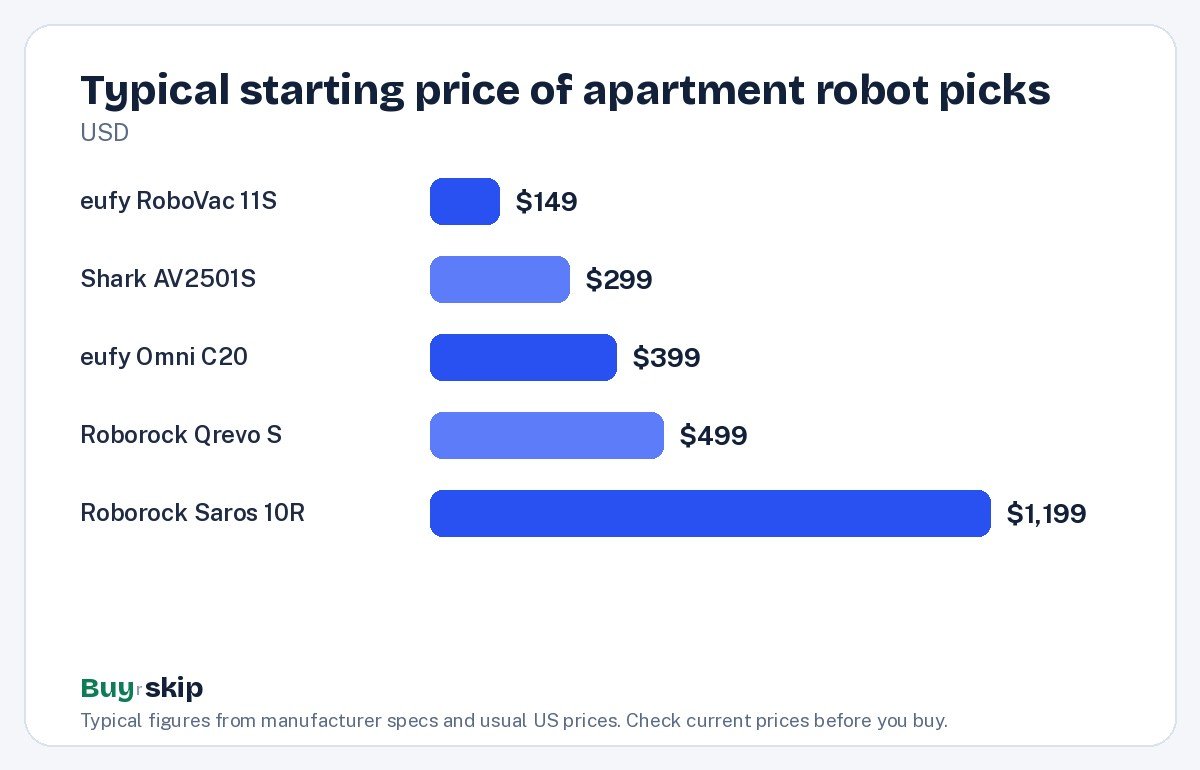
For most apartments, the value sits between about $300 and $600. Spending more buys slimmer bodies and better obstacle avoidance, which matter if your furniture is very low or your floors are cluttered, but not raw cleaning area, which you do not need.
Where to put the dock in a small apartment
Dock placement is the most common apartment frustration, so it is worth a plan.
- Beside the couch or under a console table. These spots are often out of the walkway and near an outlet. Check that the table clears the dock height.
- In a hallway nook. Central hallways let the robot reach every room efficiently, but make sure the dock does not narrow the walkway.
- Not in the bathroom or kitchen corner. Humidity and splashes are not good for electronics, and kitchens are crowded.
- Not behind a door. Doors swing, and the robot needs a clear straight path to dock.
- Not in a closet unless the door stays open. The robot cannot open doors.
When you first set up, keep the dock in one place during the mapping run. Moving it later can confuse the map. Our robot vacuum setup tips cover the first-week routine step by step.
Small-apartment mistakes to avoid
- Buying a flagship for 600 square feet. You pay for battery and power you will never use. Put the money toward a slimmer body or a quieter model instead.
- Ignoring the dock’s size. The robot fits; the station might not.
- Running it at 7 a.m. on a Sunday. The self-empty burst carries through floors.
- Forgetting the rug fringe. Fringe tangles brushes. Flip fringe under or set a no-go zone.
- Skipping a stick vacuum entirely. Robots do not clean stairs, couches or spills. In a small home, a light cordless stick such as the Levoit LVAC-300 Cordless Vacuum fills the gaps and hangs on a wall. Browse wall-mountable cordless stick vacuums if closet space is tight.
Frequently asked questions
Is a robot vacuum worth it in a small apartment?
Usually, yes. Small apartments get dusty fast, especially with pets, and a robot keeps floors clean daily with little effort. The cost of entry is lower too, since you do not need a large battery or a flagship model. The main conditions are a spot for the dock and enough clearance under furniture. If your apartment is mostly furniture with little open floor, a stick vacuum may be simpler.
How much floor space does a robot vacuum dock need?
It varies by type. A basic charging dock is small. A self-empty base is taller with a modest footprint. A full all-in-one station with water tanks takes the most room. Check the listed dimensions for your model, and allow the clear space the manual asks for on the sides and in front so the robot can dock reliably.
Are robot vacuums too loud for apartments?
On standard settings, robots are generally quieter than upright vacuums, but neighbors may hear them, especially the short, loud self-empty step. Schedule runs while you are out during normal daytime hours, use quieter suction modes for daily cleaning, and place the dock on an interior wall. Many apps also let you set do-not-disturb hours.
Do I need a mopping robot in an apartment?
If your apartment has mostly vinyl, laminate or tile, a mopping robot is very useful and small spaces are easy for it to cover. Choose one that lifts or removes its mop on rugs. If your apartment is mostly carpet, skip mopping and buy a vacuum-only robot with a self-empty base to save money and dock space.
Can I use a robot vacuum without a self-emptying base?
Yes. In a small studio, emptying a small bin after runs is manageable, and basic docks take up very little space. With pets, though, the bin fills quickly and a self-empty base saves a lot of hassle. If space is the concern, look for a compact self-empty or all-in-one station rather than going without.
What happens to the map when I move apartments?
You simply create a new map. Most mapped robots let you delete the old map and run a fresh mapping pass in the new home, and many can store more than one map. Take the dock with you, plug it in at the new place, and keep it in one spot during the first mapping run.
The bottom line
The right robot vacuum for small apartments is the one that fits: a slim body for low furniture, a dock you can live with, and quiet enough settings to keep the neighbors happy. You do not need flagship power for a few hundred square feet.
The eufy Robot Vacuum Omni C20 hits that balance best, with vacuuming and mopping from a compact station. Measure your space, check the current price, and schedule it for when you are out.
Check price on Amazon: eufy Robot Vacuum Omni C20
Paid link. Typical price $399–$599; check the current price on Amazon.