We research products independently from specs, manufacturer documentation, warranty terms and owner feedback. When you buy through links on this page, we may earn a commission at no extra cost to you. As an Amazon Associate we earn from qualifying purchases.
Quick answer
In the robot vacuum vs stick vacuum debate, the honest answer for most homes is “both, in that order of usefulness.” A robot keeps floors clean every day without effort but cannot do stairs, cars, spills or upholstery. A cordless stick handles all of those but only cleans when you do. An upright still wins for deep cleaning large carpeted homes. If you can buy only one: pick a robot for daily upkeep in a single-level home, and a stick for stairs, small spaces or quick spot cleaning.
Shopping for a robot vacuum vs stick vacuum (or a good old upright) is less about which machine is “best” and more about which kind of cleaning you actually do. Each type solves a different problem, and buying the wrong one is the most common reason people end up with a vacuum in the closet. Our verdicts are based on specs, manufacturer documentation, warranty terms, independent review consensus and owner-feedback patterns.
This page compares product types. If you have already decided on a robot and want the full feature-by-feature framework, our robot vacuum buying guide covers navigation, docks and mopping in depth.
Robot vacuum vs stick vacuum vs upright at a glance
| Robot vacuum | Cordless stick vacuum | Upright vacuum | |
|---|---|---|---|
| Best at | Daily maintenance with no effort | Quick cleanups, stairs, cars, small homes | Deep cleaning carpet in large homes |
| Effort | Almost none once set up | Low, but you push it | Moderate, heavier to move |
| Stairs | No | Yes | Awkward, needs a hose |
| Cars and upholstery | No | Yes, as a handheld | With attachments |
| Deep carpet cleaning | Good for upkeep | Good, varies by model | Strongest, typically |
| Mopping | Many models mop | Separate tool needed | No |
| Runtime limit | Recharges and resumes | Battery-limited | Unlimited (corded) |
| Storage | Lives on its dock | Wall mount or charging stand | Needs closet space |
| Typical price (our picks) | About $149–$1,799 | About $199–$749 | Varies by brand |
| Ongoing costs | Brushes, filters, bags, pads | Filters, eventual battery | Bags or filters, belts |
The pattern is clear: a robot is a frequency tool, a stick is a flexibility tool, and an upright is a power tool. Most homes need frequency and flexibility more than raw power, which is why robots and sticks have taken over so much of the market.
What each type does best
Robot vacuums: clean floors without thinking about it
A robot’s real advantage is not suction. It is that it cleans every day, on schedule, whether you feel like it or not. Daily light passes stop dust, crumbs and pet hair from building up, so floors look consistently clean instead of swinging between “just vacuumed” and “needs it badly.”
Modern robots map your home with LiDAR or cameras, clean room by room, avoid no-go zones, and on many models empty themselves into a base that holds weeks of debris. Higher-end docks also wash and dry mop pads, which makes robots a genuine hard-floor mopping solution.
Where robots fall short:
- Stairs: They cannot climb them, and cliff sensors keep them away from edges.
- Spills and big messes: Spilled cereal or potting soil needs a vacuum in your hand right now.
- Under-furniture clutter: Cords, socks and toys stop or tangle them, so you have to pick up first.
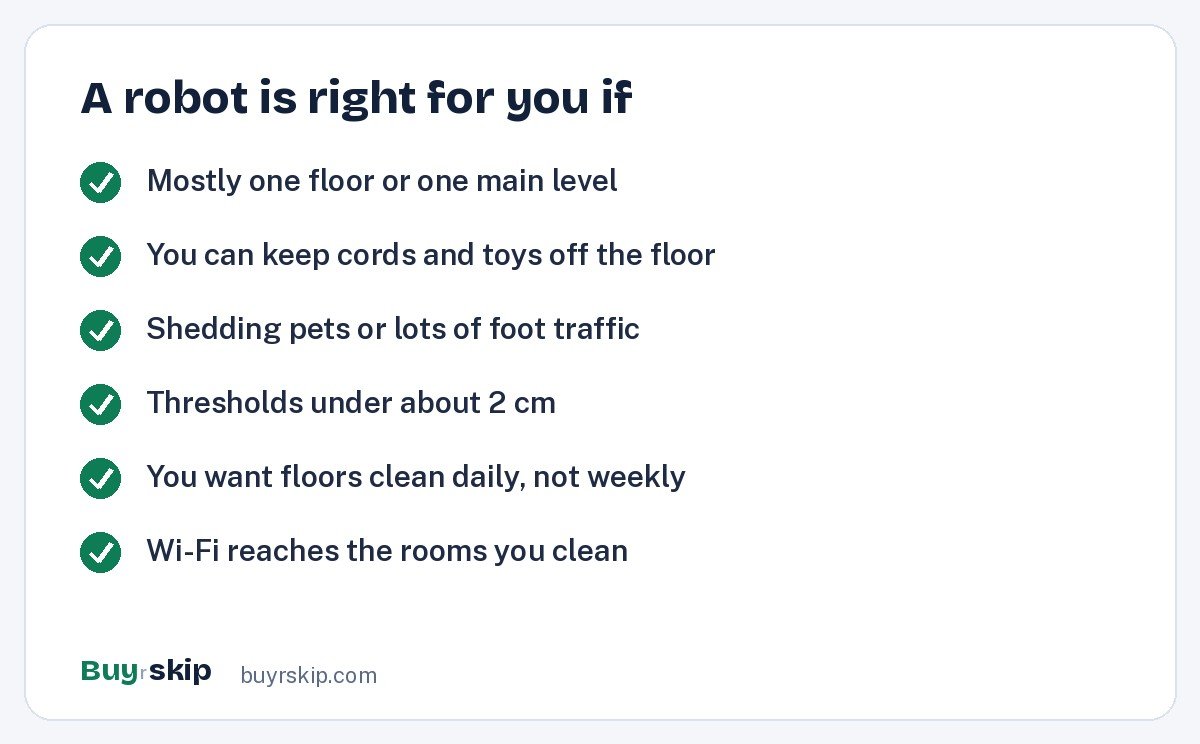
- Tall thresholds and thick rugs: Most robots climb about 2 cm, and very deep shag can stall them.
- Cars, upholstery and corners above floor level: Not their job.
Cordless stick vacuums: the flexible all-rounder
A cordless stick is the vacuum you actually grab. It hangs on the wall, weighs little, converts to a handheld in seconds, and handles stairs, car seats, cobwebs and couch cushions. For apartments and small homes, a good stick can be the only vacuum you need.
The limits are battery runtime and effort. You still do the walking, and a large home may take more than one charge on higher power settings. Batteries also degrade over the years, so check that the model’s battery is replaceable and sold separately.
Upright vacuums: maximum power for carpet
Corded uprights remain the strongest option for deep cleaning wall-to-wall carpet in a large house, and they never run out of battery. They also tend to have large bins or bags, so they handle big jobs without stopping. The downsides are weight, storage space, a cord to manage and awkward stair cleaning. If your home is mostly hard floors or you live in an apartment, an upright is usually more machine than you need. To browse current models, see upright vacuums for carpet on Amazon.
How to choose a robot vacuum vs the alternatives: decision rules
Use these rules to match a vacuum type to your home. They are the core of this robot vacuum vs alternatives buying guide.
- If you live in a single-level home with mostly hard floors, buy a robot first. It will handle most of the work, and a mop dock can replace weekly mopping too.
- If you have pets that shed, buy a robot for daily hair control plus a stick for furniture and stairs. Hair builds up fast, and daily passes are what keep it under control.
- If you have stairs and more than one level, buy a stick first, then add a robot for the main floor. A robot cannot carry itself upstairs, though some models store maps for several floors if you move them.
- If you live in a small apartment, a cordless stick alone may be enough. If you would rather never vacuum, a compact robot fits well; our small-apartment robot vacuum guide covers sizing and storage.
- If you have a large home with wall-to-wall carpet, an upright or powerful stick for deep cleans plus a robot for daily upkeep is the strongest combination.
- If your floors are cluttered with toys and cords and you will not tidy first, skip the robot. It will spend its time stuck.
- If you have mobility limits or back pain, a robot is often the single most helpful cleaning purchase, with a lightweight stick for the rest.
The picks: robots and sticks worth buying
These are the best options from our research for each role. Prices are typical ranges, so check the current price before you buy.
Best robots to pair with (or replace) a stick
Best overall robot Our verdict: Buy
Roborock Qrevo S Robot Vacuum and Mop
Typical price: $499–$799
Most homes that want a robot to handle both daily vacuuming and hard-floor mopping
- Pros
- ✓ LiDAR mapping for efficient room-by-room cleaning
- ✓ self-emptying dock
- ✓ dock washes and dries mop pads
- Cons
- ✕ Dock takes floor space
- ✕ still needs a stick for stairs and spills
Check price on Amazon Paid link
If your goal is to replace both weekly vacuuming and mopping, the Roborock Qrevo S is the most sensible place to start at about $499–$799. Pair it with a stick for stairs and spot cleaning and you have covered nearly every floor-care job in a typical home.
Best value robot for pets Our verdict: Buy
Shark AV2501S AI Ultra Robot Vacuum
Typical price: $299–$449
Pet owners who want daily hair control at a moderate price
- Pros
- ✓ Bagless self-empty base
- ✓ LiDAR mapping
- ✓ about $299–$449
- Cons
- ✕ No mop-washing dock
- ✕ you still need a stick for furniture and stairs
Check price on Amazon Paid link
The Shark AV2501S AI Ultra Robot Vacuum is our pick if pet hair is the main problem. Daily runs keep tumbleweeds from forming, and the bagless base avoids ongoing bag costs. Pair it with a Shark Stratos and you have a pet-hair system for well under the price of one premium robot.
Best budget robot Our verdict: Consider
eufy RoboVac 11S
Typical price: $149–$249
Shoppers who want a robot to keep floors tidy between stick vacuuming sessions
- Pros
- ✓ Slim enough for low furniture
- ✓ quiet
- ✓ about $149–$249
- Cons
- ✕ No mapping and random navigation
- ✕ no self-empty base
Check price on Amazon Paid link
If you already own a good stick and just want floors tidied between sessions, the eufy RoboVac 11S is a reasonable bare-bones helper. Do not expect it to replace a mapped robot: it bounces around randomly and you empty the bin by hand. Skip the iRobot Roomba 694 at a similar price, which has no mapping and no self-empty either, with better budget buys available.
Best stick vacuums
Best stick for deep cleaning Our verdict: Buy
Dyson V15 Detect Cordless Vacuum
Typical price: $549–$749
People who want a stick strong enough to be their main vacuum, including on carpet
- Pros
- ✓ Laser dust reveal shows fine dust on hard floors
- ✓ converts to a handheld for stairs and cars
- ✓ strong deep cleaning
- Cons
- ✕ About $549–$749
- ✕ small bin needs frequent emptying
Check price on Amazon Paid link
The Dyson V15 Detect Cordless Vacuum is the stick to buy if you want one machine to handle deep cleaning as well as quick jobs. The laser that lights up dust on hard floors makes it easier to see what you missed. If you have a large carpeted home, it is the closest a cordless gets to replacing an upright.
Best value stick Our verdict: Buy
Shark Stratos Cordless Vacuum
Typical price: $299–$429
Pet owners and families who want strong everyday cleaning without a premium price
- Pros
- ✓ Self-cleaning brushroll helps with pet hair tangles
- ✓ about $299–$429
- ✓ versatile handheld mode
- Cons
- ✕ Heavier than budget sticks
- ✕ battery-limited on large homes
Check price on Amazon Paid link
The Shark Stratos is the best all-round value. Its self-cleaning brushroll is a real benefit in pet homes, where hair wrapping around the brush is the most common complaint about stick vacuums.
Best budget stick Our verdict: Buy
Levoit LVAC-300 Cordless Vacuum
Typical price: $199–$279
Small apartments and anyone adding a second vacuum for quick cleanups
- Pros
- ✓ About $199–$279
- ✓ light and easy to grab
- ✓ good partner for a robot
- Cons
- ✕ Not built for deep carpet cleaning
- ✕ shorter track record than bigger brands
Check price on Amazon Paid link
For quick spills and small spaces, the Levoit LVAC-300 Cordless Vacuum is a sensible budget option. It makes a particularly good second vacuum alongside a robot, since the robot does the daily floor work and the stick only handles small jobs.
What each setup costs
Here is the typical starting price for the main options, so you can compare a single-machine setup against a robot-plus-stick combination.
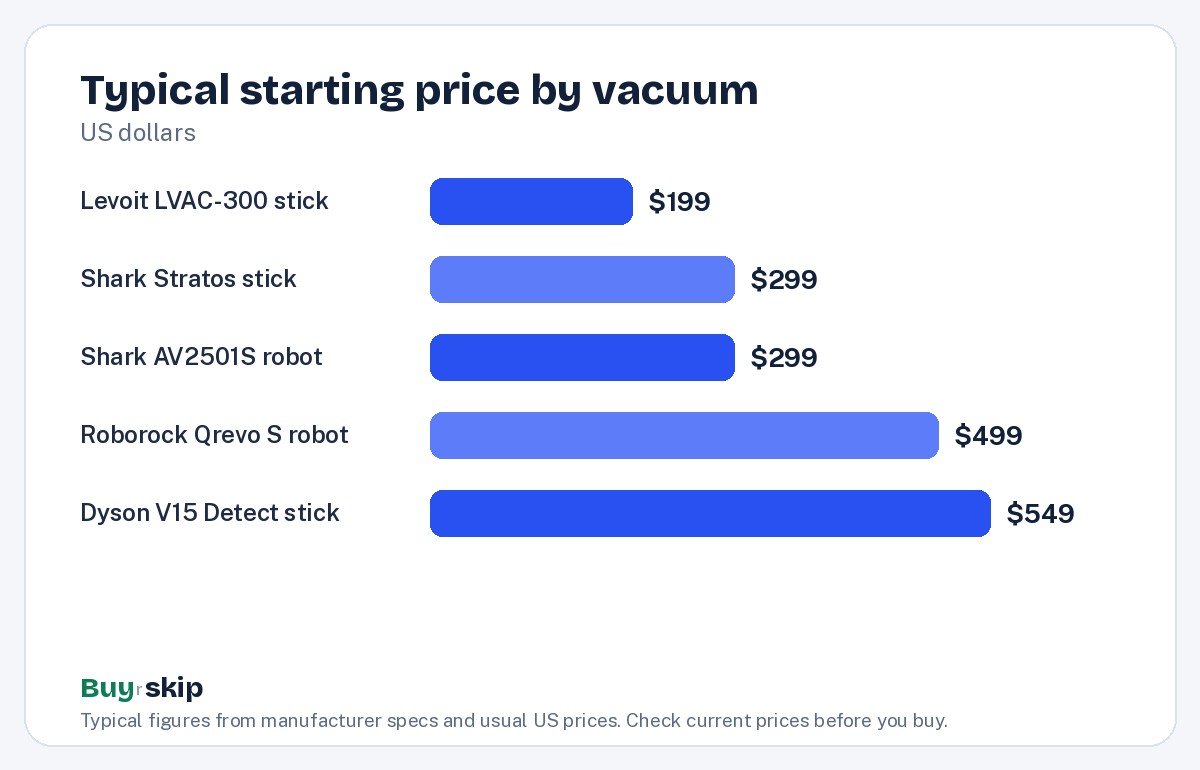
A practical reading of that chart:
- Tight budget: a budget stick alone, or a budget stick plus the eufy RoboVac 11S.
- Mid budget, pet home: the Shark AV2501S plus the Shark Stratos covers daily hair and furniture.
- Mid budget, hard floors: the Roborock Qrevo S plus the Levoit LVAC-300 replaces vacuuming and mopping.
- Higher budget, large carpeted home: the Dyson V15 Detect for deep cleans plus a mapped robot for daily upkeep.
Remember to budget for consumables. Robots go through side brushes and filters every few months, plus dust bags and mop pads depending on the dock. Sticks need occasional filters and, eventually, a battery. Our guide to the most durable robot vacuums explains which parts wear out and how to choose models with good parts support.
The combo approach: why many homes end up with two
Owner-feedback patterns point the same way again and again: people who buy only a robot still reach for a stick for spills and stairs, and people who buy only a stick often wish the floors stayed clean between sessions. The robot plus stick combination works because the two machines do not overlap much.
- The robot handles the boring, repetitive daily passes and, on many models, mopping.
- The stick handles anything urgent, elevated or awkward: stairs, cars, couches, entry mats and the corner the robot missed.
This also lets you spend less on each machine. A mid-range robot plus a mid-range stick usually serves a home better than a flagship of either type alone. If you want to browse both categories side by side, compare mapped robot vacuums with a self-empty base and cordless stick vacuums for pet hair.
When to skip a robot entirely
A robot is not for everyone. Skip it if:
- Your floors are routinely covered in toys, laundry or cables and that will not change.
- Most of your home is deep shag carpet or has many high thresholds a robot cannot cross.
- You live in a very small studio where a stick takes a few minutes and a dock would eat valuable floor space.
- You are uncomfortable with an app-connected device, especially camera-based models. Some robots keep images on the device, but you should check before buying.
In those cases, a good cordless stick is the better buy. If you do go with a robot, our robot vacuum setup tips will help you avoid the first-week frustrations that make people give up on them.
Frequently asked questions
Can a robot vacuum replace a stick vacuum?
For daily floor cleaning on one level, often yes. For everything else, no. A robot cannot do stairs, cars, upholstery or a sudden spill, and it struggles in cluttered rooms. Most households find a robot reduces how often they use a stick rather than eliminating it. If you can buy only one and you have stairs, buy the stick first.
Is a stick vacuum as powerful as an upright?
Premium cordless sticks clean well enough to be the main vacuum in most homes, including on carpet. Corded uprights still tend to have the edge for deep cleaning large areas of thick carpet, and they never run out of battery. For apartments and homes with mostly hard floors, a good stick is usually plenty, and much easier to store and carry.
Which is better for pet hair, a robot or a stick?
They work best together. A robot running daily keeps shed hair from building up on floors, which is the biggest pet-hair problem. A stick with a tangle-resistant brushroll, like the Shark Stratos, handles hair on furniture, stairs and pet beds. If you can afford only one, choose a robot for single-level homes and a stick for multi-level homes.
Do robot vacuums clean as well as a regular vacuum?
On a single pass, a strong stick or upright usually pulls more deep dirt from carpet. A robot makes up for that with frequency: cleaning daily keeps floors consistently cleaner than one big weekly session. Suction figures in Pa are not comparable across brands, so judge cleaning on review consensus and brush design rather than the number on the box.
Is it worth buying a robot vacuum if I already have a cordless stick?
Yes, if you find yourself vacuuming more than twice a week or have shedding pets. The robot takes over the routine passes and your stick becomes a tool for quick jobs, which also helps its battery last longer. If you vacuum once a week and are happy with that, the extra cost is harder to justify.
Are upright vacuums still worth buying in 2026?
For large homes with lots of wall-to-wall carpet, yes. Uprights offer strong deep cleaning, big capacity and no battery limits. For most other homes, a cordless stick is more convenient and easier to store, and a robot handles daily upkeep. Uprights make the most sense as a deep-cleaning tool paired with a robot.
The bottom line
In the robot vacuum vs stick vacuum question, the robot wins for effortless daily upkeep on a single level, and the stick wins for flexibility: stairs, cars, spills and small homes. Uprights are now a specialist tool for big carpeted houses.
If you can buy only one, match it to your home with the rules above. If you can buy two, a mapped robot plus a mid-range stick is the setup most homes are happiest with. Check current prices before you buy.
Check price on Amazon: Roborock Qrevo S Robot Vacuum and Mop
Paid link. Typical price $499–$799; check the current price on Amazon.