We research products independently from specs, manufacturer documentation, warranty terms and owner feedback. When you buy through links on this page, we may earn a commission at no extra cost to you. As an Amazon Associate we earn from qualifying purchases.
Quick answer
The Infant Optics DXR-8 PRO Video Baby Monitor is the best baby monitor for most families: a private, non-Wi-Fi link, a 5-inch parent screen, swappable lenses and no monthly fee. If you want to check on your baby from anywhere and like sleep data, choose the Nanit Pro Smart Baby Monitor & Floor Stand. For tight budgets, grandparents’ houses and travel, the VTech VM819 Video Baby Monitor covers the basics for about $50–$70.
The best baby monitors fall into two camps, and choosing the right camp matters more than any single feature. Non-Wi-Fi monitors pair a camera with a dedicated parent screen over a private radio link, so nothing streams to the internet and there’s no app or account to manage. Wi-Fi monitors stream to your phone so you can watch from work or the backyard, often with sleep tracking, but they depend on your home network and usually push a subscription for their best features. A third category, wearable sensors, reports readings like pulse rate and oxygen. Our picks are based on specs, manufacturer documentation, warranty terms, independent review consensus and owner-feedback patterns.
One note before you shop: no consumer monitor prevents SIDS. Safe-sleep basics, like placing babies on their backs on a firm, flat sleep surface with nothing else in the crib, matter far more than any gadget.
Quick picks
| Product | Best for | Our verdict | Typical price |
|---|---|---|---|
| Infant Optics DXR-8 PRO Video Baby Monitor | Most families | Buy | about $180–$230 |
| Nanit Pro Smart Baby Monitor & Floor Stand | Sleep tracking from your phone | Buy | about $250–$380 |
| Nanit Pro Camera | Sleep insights with a wall mount | Buy | about $250–$300 |
| Infant Optics DXR-8 Pro | Privacy-first parents | Buy | about $160–$200 |
| VTech VM819 Video Baby Monitor | Tight budgets and travel | Buy | about $50–$70 |
| Owlet Dream Sock | Pulse and oxygen readings | Consider | about $250–$300 |
Baby gear prices move around a lot, so check the current price before you buy.
The best baby monitors in 2026
Best overall Our verdict: Buy
Infant Optics DXR-8 PRO Video Baby Monitor
Typical price: about $180–$230
Most families. Buy it if you want a dependable video monitor that works without Wi-Fi, apps or a monthly fee.
- Pros
- ✓ No Wi-Fi, so nothing streams to the cloud
- ✓ Large 5-inch parent screen
- ✓ Swappable lenses for wide or zoomed views
- ✓ Active Noise Reduction cuts background hiss
- Cons
- ✕ No phone viewing away from home
- ✕ Parent unit battery needs a nightly charge
Check price on Amazon Paid link
The Infant Optics DXR-8 PRO Video Baby Monitor is the monitor we’d recommend to most families. It connects the nursery camera to the parent unit over an encrypted, non-Wi-Fi radio link, so there’s no app, no account, no cloud and no subscription. Nothing you see on the screen travels over the internet, which is the simplest answer to worries about hacked cameras.
The 5-inch, 720p parent screen is large enough to see movement and expressions at a glance in the middle of the night. Swappable lenses let you choose a wide view of the whole room or a tighter view of the crib, which is handy as your baby grows and starts moving around. Active Noise Reduction cuts the constant background hiss that makes some audio monitors hard to sleep beside, so you hear your baby rather than static.
The trade-offs come with the private design. You can’t watch from work or while traveling, because it only works in and around the house. The parent unit’s battery also needs a nightly charge, so plan to keep it on a charger by the bed. Skip it if remote phone viewing matters; the Nanit Pro Smart Baby Monitor & Floor Stand is built for that.
Best smart monitor Our verdict: Buy
Nanit Pro Smart Baby Monitor & Floor Stand
Typical price: about $250–$380
Sleep tracking from your phone. Buy it if you want to see your baby from anywhere on your phone and like detailed sleep data.
- Pros
- ✓ Clear overhead 1080p view
- ✓ Sleep tracking and breathing-motion features with Nanit wear
- ✓ Watch from anywhere on iPhone or Android
- ✓ Floor stand avoids drilling the wall
- Cons
- ✕ Best insights need a paid Nanit Insights plan
- ✕ Relies on home Wi-Fi
Check price on Amazon Paid link
The Nanit Pro Smart Baby Monitor & Floor Stand is for parents who want to see the crib from anywhere on an iPhone or Android phone and enjoy detailed sleep data. Its overhead 1080p view looks straight down into the crib, which gives a clearer picture of how your baby is lying than a side-angle camera. The app turns that view into sleep tracking, and with Nanit’s wearables it adds breathing-motion features.
The floor stand is a practical win for renters and anyone who doesn’t want to drill into the nursery wall. A wall mount is sold separately if you change your mind later. Sharing access with a partner, grandparent or sitter is easy because everyone just uses the app. It also means you can glance at the crib from the office, the car pickup line or a date night without carrying a separate parent unit.
The catches are the subscription and the network. The deepest insights need a paid Nanit Insights plan, and everything depends on your home Wi-Fi, so a weak signal in the nursery can mean a choppy feed. Skip it if you dislike subscriptions or want a monitor that never touches the internet; the Infant Optics is the better fit.
Best for wall mounting Our verdict: Buy
Nanit Pro Camera
Typical price: about $250–$300
Sleep insights. Buy it if you want a clear overhead view and sleep tracking on your phone.
- Pros
- ✓ Sharp overhead video
- ✓ Sleep insights
- ✓ Wall mount
- Cons
- ✕ Subscription for extra features
Check price on Amazon Paid link
The Nanit Pro Camera delivers the same core Nanit experience, a sharp overhead view and sleep insights in the app, in a version set up for wall mounting instead of the floor stand. If you own your home and want a clean install with the camera fixed above the crib, this listing usually costs about $250–$300, which can undercut the floor-stand bundle.
Choose between the two Nanit listings based on how you want to mount the camera, not on picture quality, since the camera at the heart of both is the Nanit Pro. Compare current prices and confirm which mount is in the box before ordering. As with the bundle, extra features sit behind a subscription. Skip it if you want no subscription at all; a non-Wi-Fi monitor like the Infant Optics DXR-8 PRO Video Baby Monitor has no ongoing costs.
Also great Our verdict: Buy
Infant Optics DXR-8 Pro
Typical price: about $160–$200
Privacy-first parents. Buy it if you want a simple, private monitor without Wi-Fi.
- Pros
- ✓ No internet needed
- ✓ Interchangeable lenses
- ✓ Good range
- Cons
- ✕ No phone viewing
Check price on Amazon Paid link
The Infant Optics DXR-8 Pro is a second listing for Infant Optics’ DXR-8 Pro and is often priced a little lower, at about $160–$200. It takes the same privacy-first approach: a dedicated parent screen, no internet connection, interchangeable lenses and good range around a typical home.
Treat it as an alternative route to our top pick and buy whichever listing is cheaper on the day you shop, after checking that the screen size, lens kit and parent unit match what you expect. Like our top pick, it can’t be viewed from your phone, so it isn’t the right choice if you want to check in from work. For parents who simply want a reliable screen on the nightstand and no account to manage, it’s an easy buy. Because the price gap between the two Infant Optics listings is often small, don’t stretch your budget for one over the other. Spend the difference on a spare lens or a second camera if you have more than one child sleeping in separate rooms, and check that any add-on you buy is listed as compatible with your parent unit.
Best budget Our verdict: Buy
VTech VM819 Video Baby Monitor
Typical price: about $50–$70
Tight budgets and travel. Buy it if you want a simple, private video monitor for a small home, a grandparent’s house or travel.
- Pros
- ✓ Inexpensive
- ✓ No Wi-Fi or account needed
- ✓ Two-way talk and lullabies
- ✓ Light enough to pack
- Cons
- ✕ Small 2.8-inch screen
- ✕ Lower-resolution video
Check price on Amazon Paid link
The VTech VM819 Video Baby Monitor proves you don’t need to spend much for a private video monitor. At about $50–$70, it uses a non-Wi-Fi digital link with no account or subscription, plus two-way talk and lullabies. It’s light enough to pack, which makes it a good second monitor for grandparents’ houses, vacations and naps on the go.
The compromises show up in the screen and picture. Its 2.8-inch display is small, and video resolution is lower than the Infant Optics, so night views are less detailed. Range is also better suited to apartments and smaller homes than large houses with thick walls. Still, for a monitor that costs about a third of the Infant Optics, it covers the essentials: you can see and hear your baby, talk back and play a lullaby, all without touching the internet or creating an account.
Buy it if you want a simple, private monitor for a small home, a grandparent’s place or travel. Skip it if you want a big screen, sharp night video or long range; step up to the Infant Optics DXR-8 PRO Video Baby Monitor.
Consider for health readings Our verdict: Consider
Owlet Dream Sock
Typical price: about $250–$300
Parents who want pulse and oxygen readings. Buy it if you want FDA-cleared pulse-rate and oxygen readings for a healthy infant and understand what the alerts mean.
- Pros
- ✓ FDA-cleared readings for healthy infants
- ✓ Notifications through a base station and app
- ✓ Pairs with Owlet cameras
- Cons
- ✕ Expensive for a sock and base
- ✕ Sock fit and false alerts can frustrate some parents
- ✕ Not a replacement for safe-sleep practices
Check price on Amazon Paid link
The Owlet Dream Sock is different from the cameras on this list. It’s a sock worn on your baby’s foot that tracks pulse rate and oxygen level, with FDA-cleared readings for healthy infants from 0 to 18 months (5 to 30 lb). Notifications arrive through a base station and the app, and it pairs with Owlet cameras if you want video as well.
We rate it Consider because it suits a specific kind of parent. Buy it only if you want those readings and understand what the alerts mean. It’s expensive for a sock and base at about $250–$300, and owners report that sock fit and false alerts can be frustrating, which is stressful at 3 a.m.
Most important, it’s not a replacement for safe-sleep practices, and no consumer monitor prevents SIDS. If you mainly want to see and hear your baby, a camera like the Infant Optics DXR-8 PRO Video Baby Monitor or Nanit Pro Camera is the better buy. If your baby has a medical condition, ask your pediatrician about monitoring rather than relying on a consumer device.
How to choose baby monitors
Wi-Fi or non-Wi-Fi
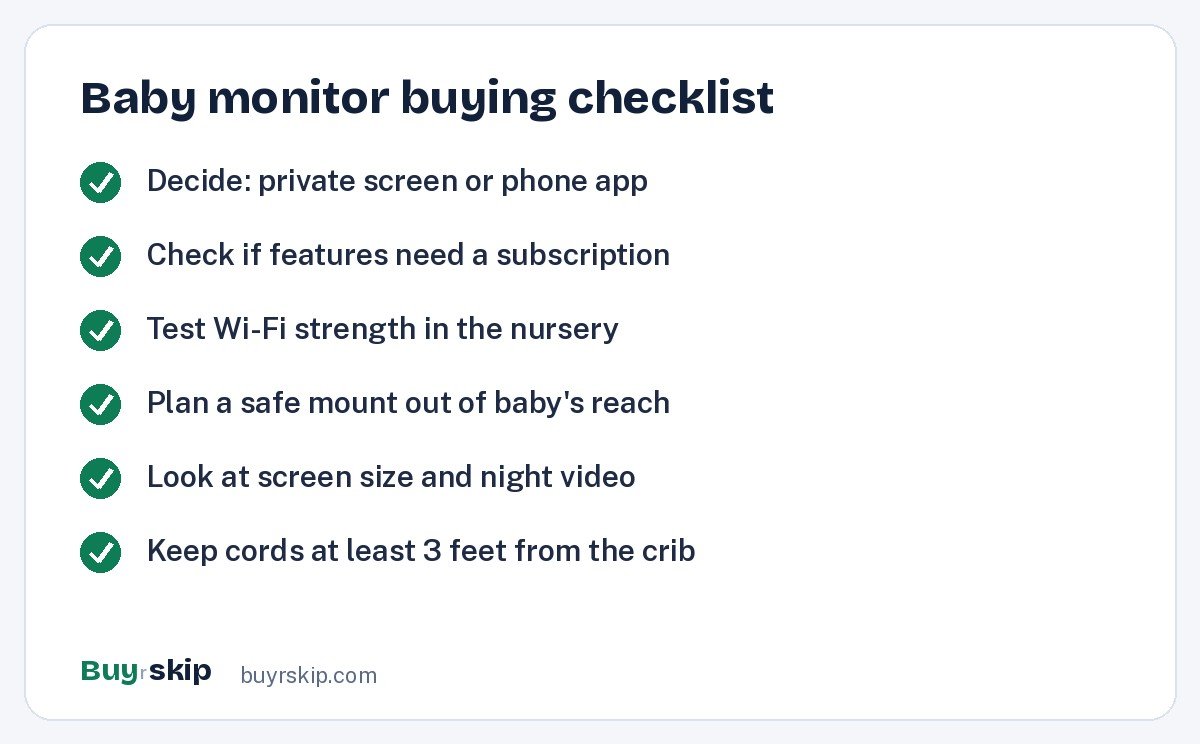
This is the main decision. Non-Wi-Fi monitors like the Infant Optics DXR-8 PRO Video Baby Monitor and VTech VM819 Video Baby Monitor keep video inside your home, need no account and keep working if the internet goes down. Wi-Fi monitors like the Nanit Pro Smart Baby Monitor & Floor Stand let you watch from anywhere and share access easily. Rule of thumb: if privacy and simplicity come first, buy non-Wi-Fi. If you want to check in from work or love data, buy a Nanit.
Subscriptions and ongoing costs
Non-Wi-Fi monitors cost nothing after purchase. Smart monitors often lock their best features behind a plan: Nanit’s deepest sleep insights need Nanit Insights. Before buying, decide whether the free features are enough, and add the plan’s yearly cost to the price when comparing.
Screen size and video quality
On a dedicated parent unit, screen size matters more than resolution. The Infant Optics’ 5-inch screen is much easier to read at a glance than the VTech’s 2.8-inch display. On phone-based monitors, the overhead 1080p Nanit view shows the whole crib clearly. Night vision quality varies, so if you’ll check often overnight, favor the bigger screen or the Nanit.
Range and home layout
Radio-link monitors have a limited range that walls, floors and appliances can shorten. In a large house, or if the nursery sits far from your bedroom, the Infant Optics is the safer bet over the VTech. Wi-Fi monitors depend on your router instead, so check signal strength in the nursery. If it’s weak, see our guide to the best Wi-Fi routers.
Audio, two-way talk and extras
Sound is often what wakes you, so audio quality deserves attention. The Infant Optics’ Active Noise Reduction cuts background hiss, which makes it easier to leave the volume up overnight without listening to static. Two-way talk lets you soothe your baby with your voice without walking in, and the VTech adds built-in lullabies. Temperature readouts, night lights and similar extras are nice to have but rarely decide whether a monitor is good. Focus on a clear picture, clean audio and reliable connection first, then treat extras as tie-breakers.
Mounting and cord safety
Place cameras and cords well out of reach. Keep any cord at least 3 feet from the crib, and never put a camera on the crib rail. The Nanit’s floor stand avoids drilling, while the wall-mount version gives a clean overhead install. For tabletop cameras, a cord cover kit or a universal baby monitor wall mount keeps wires tidy and safe.
Price and value
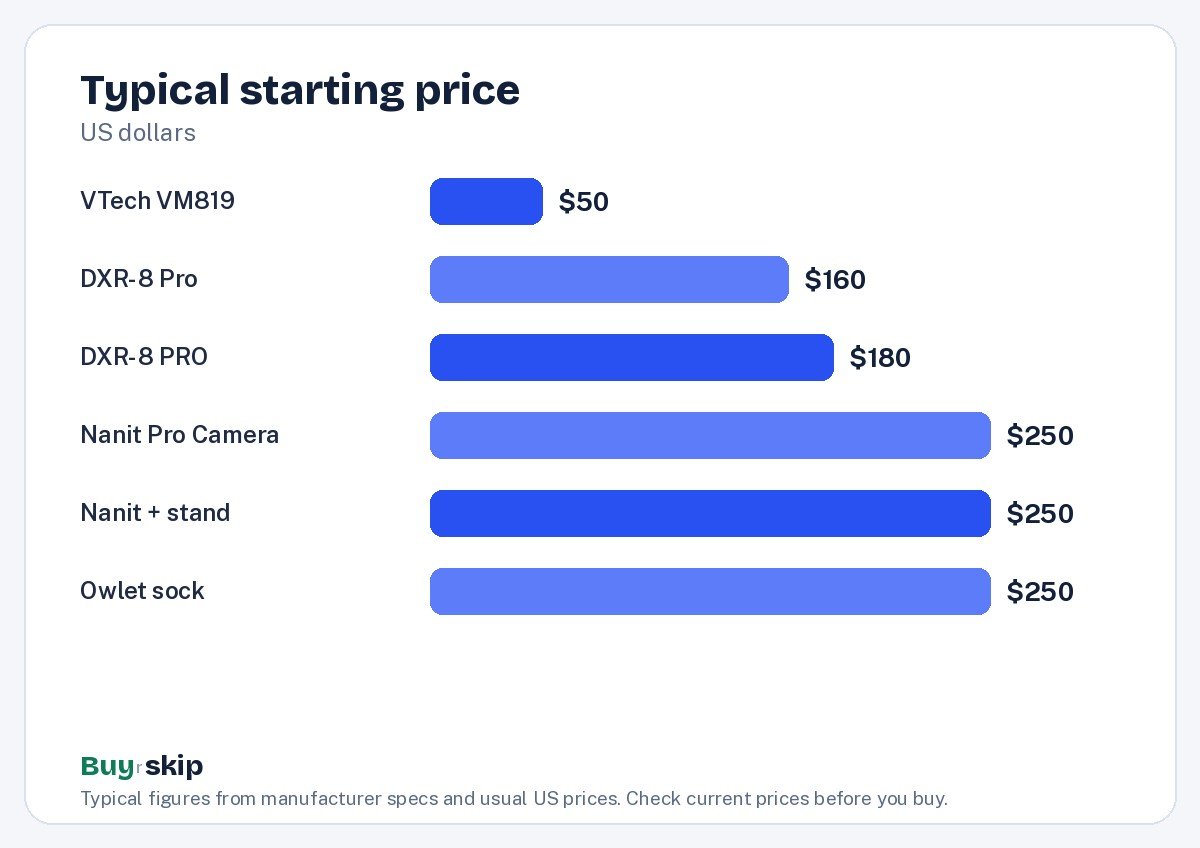
The VTech is the cheapest private option. The two Infant Optics listings sit in the middle and cost nothing more after purchase. Nanit and Owlet start around $250 and may add subscription costs. Spend on the type of monitor that matches how you’ll use it, not on extra features you won’t open after the first month.
Frequently asked questions
Are non-Wi-Fi baby monitors safer from hacking?
They remove the internet from the picture. Monitors like the Infant Optics DXR-8 PRO Video Baby Monitor and VTech VM819 send video over a local radio link rather than through a cloud account, so there’s no online login to compromise. If you choose a Wi-Fi monitor, use a strong, unique password, turn on two-step verification and keep the app and firmware updated.
Do I need a baby monitor with an app?
Only if you want to watch from outside the house or track sleep patterns. Many families are well served by a dedicated parent screen, which is always on, needs no phone and works without internet. If you want to check in from work, share access with a sitter or see sleep trends, an app-based monitor like the Nanit Pro Smart Baby Monitor & Floor Stand makes sense.
Does the Owlet Dream Sock prevent SIDS?
No. No consumer monitor prevents SIDS. The Dream Sock reports FDA-cleared pulse-rate and oxygen readings for healthy infants and sends notifications, which some parents find reassuring. Safe-sleep practices matter far more: back to sleep, a firm, flat surface and an empty crib. Talk to your pediatrician if you have specific health concerns.
What is the difference between the two Nanit listings?
Both are built around the Nanit Pro camera with its overhead 1080p view and app-based sleep insights. The Nanit Pro Smart Baby Monitor & Floor Stand includes a floor stand, which avoids drilling, while the Nanit Pro Camera listing comes set up for wall mounting. Pick the mount that suits your nursery and compare current prices.
How long will we use a baby monitor?
Many families use a video monitor well past the baby stage, into the toddler years, to check on naps and early wake-ups. That’s one reason to buy a monitor with a decent screen or a good app rather than the cheapest option. Wearables like the Owlet Dream Sock have a shorter window, covering 0 to 18 months.
Can I take a baby monitor when we travel?
Yes, and a small non-Wi-Fi monitor is often the easiest option. The VTech VM819 Video Baby Monitor is light enough to pack and doesn’t need hotel Wi-Fi or an account, so setup takes a minute in a new room. Wi-Fi monitors can work on the road but depend on the local network, which can be unreliable in hotels and rentals. Pack the charger and a short extension cord.
The bottom line
For most families, the Infant Optics DXR-8 PRO Video Baby Monitor is the best baby monitor: private, simple, no fees and a screen big enough to read at a glance. If remote viewing and sleep data matter, choose the Nanit and budget for its subscription if you want the full insights. The VTech is the budget and travel pick. Building out the nursery? See our best sound machines for better naps.
Check price on Amazon: Infant Optics DXR-8 PRO Video Baby Monitor
Paid link. Typical price about $180–$230; check the current price on Amazon.