We research products independently from specs, manufacturer documentation, warranty terms and owner feedback. When you buy through links on this page, we may earn a commission at no extra cost to you. As an Amazon Associate we earn from qualifying purchases.
Quick answer
Quick answer: the Breville Barista Express BES870XL is the best espresso machine for most people. It puts a conical burr grinder, a 15-bar pump, a pressure gauge and a real steam wand in one box for about $549–$749, so you can learn proper espresso without buying extras. For the best value in push-button drinks, the Philips 3200 Series with LatteGo makes lattes from whole beans for about $599–$799. On a tight budget, the De’Longhi Stilosa gets you started for around $100.
Choosing among the best espresso machines comes down to one question: how much of the work do you want to do? Manual and semi-automatic machines reward practice with better shots and latte art. Super-automatics grind, brew and froth at the press of a button. Somewhere in between sit machines like the Breville Oracle line, which automate the fiddly parts but still use a traditional portafilter. Our picks are based on manufacturer specs and documentation, warranty terms, independent review consensus and owner-feedback patterns, not on in-house trials.
Quick picks
| Product | Best for | Our verdict | Typical price |
|---|---|---|---|
| Breville Barista Express BES870XL | Beginners who want it all | Buy | about $549–$749 |
| Breville Barista Express | First espresso machine | Buy | about $600–$750 |
| Breville Oracle Jet | Café quality with automation | Buy | about $2,000–$2,500 |
| Breville Barista Pro | Faster workflow | Buy | about $750–$850 |
| Breville Oracle Touch | Touchscreen convenience | Buy | about $2,500–$3,000 |
| Jura E8 Super-Automatic Espresso Machine | One-touch drinks | Buy | about $1,300–$1,700 |
| Breville Bambino Plus BES500 | Compact and fast | Buy | about $399–$499 |
| Rancilio Silvia Pro X | Manual espresso enthusiasts | Buy | about $2,000–$2,400 |
| Philips 3200 Series Fully Automatic Espresso Machine with LatteGo | Push-button lattes | Buy | about $599–$799 |
| De'Longhi Eletta Explore | Hot and iced drinks | Buy | about $1,100–$1,400 |
| Jura Z10 Super-Automatic Espresso Machine | Hot and cold brew drinks | Consider | about $3,500–$4,200 |
| De'Longhi Dinamica Plus | Busy households | Consider | about $1,100–$1,500 |
| De'Longhi Stilosa EC260BK Manual Espresso Machine | Budget espresso | Consider | about $99–$129 |
Prices move often, so check the current price before you buy.
The best espresso machines in 2026
Best overall Our verdict: Buy
Breville Barista Express BES870XL
Typical price: about $549–$749
Beginners who want it all. Buy it if you want to learn real espresso at home with a built-in grinder and a proper steam wand.
- Pros
- ✓ Built-in conical burr grinder
- ✓ Manual steam wand for latte art
- ✓ Pressure gauge helps you dial in
- ✓ Everything you need in the box
- Cons
- ✕ Learning curve
- ✕ Grinder range limits light roasts
Check price on Amazon Paid link
The Breville Barista Express BES870XL is the machine we point most first-time buyers toward, because it removes the biggest hidden cost of home espresso: a separate grinder. It has an integrated conical burr grinder, a 15-bar pump, a 67-oz water tank and a manual steam wand that can texture milk well enough for latte art. The pressure gauge on the front is a quiet advantage. It shows you whether a shot is running too fast or too slow, which makes dialing in a new bag of beans much less of a guessing game.
The trade-offs are real. There is a learning curve, and you will waste some coffee while you find the right grind size and dose. The built-in grinder also has a limited range, so very light roasts can be hard to dial in. If you want push-button lattes with no learning curve, skip it and look at the Philips 3200 with LatteGo instead.
Also great Our verdict: Buy
Breville Barista Express
Typical price: about $600–$750
First espresso machine. Buy it if you want café-style espresso and milk drinks with an all-in-one machine.
- Pros
- ✓ Built-in grinder
- ✓ Good steam wand
- ✓ Great value for an all-in-one
- Cons
- ✕ Learning curve
- ✕ Grinder is basic for light roasts
Check price on Amazon Paid link
The Breville Barista Express is the same all-in-one Barista Express design; BES870XL is the model number you will often see on the listing. Some retailers sell it under the plain name, sometimes in different colors or bundles, at about $600–$750. Everything above applies: built-in conical burr grinder, roughly 2 L water tank, a good steam wand and strong value for an all-in-one machine.
Our advice is simple. Compare the two listings on the day you shop and buy whichever is cheaper from a reputable seller with a full Breville warranty. Do not pay extra for this listing unless it includes a color or accessory you actually want. As with the BES870XL, the grinder is basic for light roasts, and anyone who wants one-touch drinks should go super-automatic.
Best premium Our verdict: Buy
Breville Oracle Jet
Typical price: about $2,000–$2,500
Café quality with automation. Buy it if you want café-quality espresso with automatic grinding, tamping and milk.
- Pros
- ✓ Automates the hard parts
- ✓ Excellent milk texturing
- ✓ Fast heat-up
- Cons
- ✕ Expensive
- ✕ Large footprint
Check price on Amazon Paid link
The Breville Oracle Jet is for people who want café-quality espresso without learning barista skills. It grinds, doses and tamps for you, then textures milk automatically, while still brewing through a traditional portafilter. That combination is the appeal: you get shots closer to what a manual machine produces, with much of the consistency of a super-automatic. Heat-up is fast, and milk texturing is a standout.
It costs about $2,000–$2,500 and takes up a lot of counter space, so measure under your cabinets first. The Oracle Jet is the newer of the two Oracle models here, and it is the faster one. If you want full manual control over every variable, this is the wrong machine; the Rancilio Silvia Pro X suits that buyer better.
Best for faster workflow Our verdict: Buy
Breville Barista Pro
Typical price: about $750–$850
Faster workflow. Buy it if you want the Barista Express experience with faster heat-up and a better display.
- Pros
- ✓ Very fast heat-up
- ✓ Clear display
- ✓ More grind settings
- Cons
- ✕ Pricier
- ✕ Still a learning curve
Check price on Amazon Paid link
The Breville Barista Pro keeps the Barista Express formula, a built-in grinder plus a manual steam wand, and improves the parts that slow you down. It heats up very fast, its clear display makes settings easier to read, and the grinder has more settings for finer adjustment. If you make two or three drinks back to back each morning, that quicker heat-up adds up.
The price is about $750–$850, and it still has a learning curve like any semi-automatic. On a tighter budget, the Barista Express makes similar coffee for less money, so only step up if speed and the display matter to you.
Also great Our verdict: Buy
Breville Oracle Touch
Typical price: about $2,500–$3,000
Touchscreen convenience. Buy it if you want dual-boiler quality with simple touchscreen drinks.
- Pros
- ✓ Dual boiler
- ✓ Easy touchscreen
- ✓ Consistent results
- Cons
- ✕ Very large
- ✕ Expensive
Check price on Amazon Paid link
The Breville Oracle Touch pairs a dual boiler with a touchscreen menu, so you can brew espresso and steam milk at the same time and pick drinks by tapping an icon. Results are consistent, and it automates grinding, tamping and milk much like the Oracle Jet. It is very large and expensive at about $2,500–$3,000.
The Oracle Touch is the older Oracle model in this list, and the Oracle Jet is newer and faster to heat up. The Touch is worth it only at a clear discount below the Jet. If you find it priced well under the Jet and like the touchscreen and dual-boiler setup, it remains a strong machine.
Best for one-touch drinks Our verdict: Buy
Jura E8 Super-Automatic Espresso Machine
Typical price: about $1,300–$1,700
One-touch drinks. Buy it if you want great one-touch espresso drinks with almost no effort.
- Pros
- ✓ One-touch lattes and cappuccinos
- ✓ Very easy cleaning
- ✓ Reliable
- Cons
- ✕ Milk foam less silky than a steam wand
- ✕ Pricey
Check price on Amazon Paid link
The Jura E8 Super-Automatic Espresso Machine is for households that want great espresso drinks with almost no effort. You press a button and it grinds whole beans, brews and adds milk for lattes and cappuccinos. Owners consistently point to two strengths: very easy cleaning, with automated rinse programs, and long-term reliability. That makes it a good fit for families where several people make coffee at different times.
The trade-off with any super-automatic is milk texture. The E8’s foam is less silky than what a skilled user gets from a steam wand, so latte art is off the table. It also costs about $1,300–$1,700. If you want manual control, choose a Breville semi-automatic. If you want one-touch convenience for less, the Philips 3200 costs roughly half as much.
Best for small kitchens Our verdict: Buy
Breville Bambino Plus BES500
Typical price: about $399–$499
Compact and fast. Buy it if you want café-style lattes from a compact machine that heats up in seconds and froths milk automatically.
- Pros
- ✓ 3-second heat-up
- ✓ Automatic milk frothing
- ✓ Compact footprint
- Cons
- ✕ No built-in grinder
- ✕ Small water tank
Check price on Amazon Paid link
The Breville Bambino Plus BES500 packs real espresso into a compact footprint. Its standout feature is a heat-up time of about 3 seconds, so you can go from cold machine to shot almost instantly. The automatic steam wand textures milk for you to a set temperature and foam level, which is unusual at this price and a big help for beginners who want lattes.
The catch is that there is no built-in grinder, and the water tank is small. Espresso quality depends heavily on a good burr grinder, so budget for one; pre-ground coffee goes stale fast and limits what any machine can do. If you would rather buy one box and be done, the Breville Barista Express BES870XL includes a grinder. If space is tight and you already own a decent grinder, the Bambino Plus at about $399–$499 is hard to beat.
Best for manual enthusiasts Our verdict: Buy
Rancilio Silvia Pro X
Typical price: about $2,000–$2,400
Manual espresso enthusiasts. Buy it if you want precise manual control and a machine built to last decades.
- Pros
- ✓ Dual boiler with PID
- ✓ Commercial-grade parts
- ✓ Excellent temperature stability
- Cons
- ✕ Needs a separate grinder
- ✕ Learning curve
Check price on Amazon Paid link
The Rancilio Silvia Pro X is built for people who enjoy the craft of espresso and want a machine that lasts decades. It has a dual boiler with PID temperature control, which keeps brew temperature stable and lets you brew and steam at the same time. Commercial-grade parts are a big part of Rancilio’s reputation, and this machine is designed to be serviced rather than replaced.
It needs a separate quality grinder, which can add a meaningful amount to the total cost on top of about $2,000–$2,400 for the machine. There is also a learning curve, and nothing is automated. If you do not want to buy a grinder or learn technique, look at the Breville Oracle Jet, which gets you excellent shots with far less effort.
Best value Our verdict: Buy
Philips 3200 Series Fully Automatic Espresso Machine with LatteGo
Typical price: about $599–$799
Push-button lattes. Buy it if you want one-touch espresso, cappuccino and latte macchiato with almost no effort.
- Pros
- ✓ One-touch drinks from whole beans
- ✓ LatteGo milk system cleans in seconds
- ✓ Ceramic grinder
- Cons
- ✕ Espresso is less rich than manual machines
- ✕ Plastic build
Check price on Amazon Paid link
The Philips 3200 Series Fully Automatic Espresso Machine with LatteGo is the best value if what you really want is a latte at the press of a button. It grinds whole beans with a ceramic grinder that has 12 settings and offers 5 one-touch drinks, including espresso, cappuccino and latte macchiato. The LatteGo milk system is the reason to pick it: it has no tubes, comes apart in a couple of pieces and rinses clean in seconds, which removes the chore that puts many people off milk drinks.
Expect espresso that is less rich than what a manual machine produces, and a mostly plastic build. At about $599–$799, though, it costs far less than other super-automatics here. If you want to control every variable, skip it for the Barista Express.
Best for iced drinks Our verdict: Buy
De'Longhi Eletta Explore
Typical price: about $1,100–$1,400
Hot and iced drinks. Buy it if you like iced lattes and cold brew as much as hot coffee.
- Pros
- ✓ Cold brew and cold foam
- ✓ Many drink options
- ✓ Easy to use
- Cons
- ✕ Large
- ✕ Shots behind manual machines
Check price on Amazon Paid link
The De'Longhi Eletta Explore is the pick if iced lattes and cold brew matter as much as hot coffee. It offers cold brew and cold foam alongside a long menu of hot drinks, and it is easy to use, so everyone in the house can make what they like. For households split between hot and cold drinkers, that flexibility is the main selling point.
It is large, and its straight espresso shots fall behind what manual machines can produce. At about $1,100–$1,400, buy it for drink variety, not for the best possible espresso. If straight espresso is your priority, a semi-automatic like the Breville Barista Pro is the better spend.
Also great Our verdict: Consider
Jura Z10 Super-Automatic Espresso Machine
Typical price: about $3,500–$4,200
Hot and cold brew drinks. Buy it if you want the most capable one-touch machine, including cold brew.
- Pros
- ✓ Hot and cold extraction
- ✓ Automatic grind adjustment
- ✓ Premium build
- Cons
- ✕ Very expensive
Check price on Amazon Paid link
The Jura Z10 Super-Automatic Espresso Machine is the most capable one-touch machine in this list. It offers both hot and cold extraction, so it can make cold brew style drinks, and its smart grinder adjusts automatically for different drinks. The build is premium throughout.
The problem is value. At about $3,500–$4,200, it costs more than double the Jura E8 and well above the De'Longhi Eletta Explore, which also handles cold drinks. Consider the Z10 only if you want the most capable super-automatic and price is not a concern.
Also great Our verdict: Consider
De'Longhi Dinamica Plus
Typical price: about $1,100–$1,500
Busy households. Buy it if you want lattes at the touch of a button with no barista skills.
- Pros
- ✓ One-touch milk drinks
- ✓ Easy to clean milk system
- ✓ Consistent
- Cons
- ✕ Expensive
- ✕ Less control over flavor
Check price on Amazon Paid link
The De'Longhi Dinamica Plus serves busy households that want lattes at the touch of a button with no barista skills. It makes one-touch milk drinks, its milk system is easy to clean, and results are consistent from cup to cup.
It lands in our consider tier because of the competition. At about $1,100–$1,500, it costs more than the Philips 3200, which covers the basics for much less, and it sits close to the Jura E8 and Eletta Explore. You also give up control over flavor. Buy it if you find it at a good price and like De’Longhi’s menu; otherwise the Philips is the smarter value.
Best budget Our verdict: Consider
De'Longhi Stilosa EC260BK Manual Espresso Machine
Typical price: about $99–$129
Budget espresso. Buy it if you want to try espresso at home for around $100.
- Pros
- ✓ Very affordable
- ✓ Steam wand for milk
- ✓ Compact
- Cons
- ✕ Pressurized baskets limit flavor
- ✕ Inconsistent shots
Check price on Amazon Paid link
The De'Longhi Stilosa EC260BK Manual Espresso Machine is the cheapest real espresso machine here, at about $99–$129. It has a 15-bar pump, a 34-oz water tank, a compact body and a steam wand for milk, which makes it a reasonable way to find out whether you enjoy espresso before spending more.
Keep expectations modest. It uses pressurized baskets, which forgive inconsistent grinds but limit flavor, and shots can be inconsistent. It also has no grinder. If you want consistent café-quality shots, save up for the Breville Bambino Plus BES500 plus a grinder, or the Barista Express.
How to choose espresso machines
The right machine depends less on brand and more on how much of the work you want to do each morning. These are the decisions that matter.
Manual, semi-automatic or super-automatic
Semi-automatic machines like the Barista Express and Silvia Pro X make you grind, dose, tamp and steam. They reward practice and give the best shots for the money. Super-automatics like the Jura E8 do everything with a button press. Automated portafilter machines like the Oracle Jet sit in the middle.
- If you want to learn and enjoy the process, buy a semi-automatic.
- If you want lattes with zero skill, buy a super-automatic.
- If you want great shots without the learning curve and have the budget, buy the Oracle Jet.
Grinder: built in or separate
Grind quality affects espresso more than almost anything else. A built-in grinder saves money and counter space, which is why the Barista Express and Barista Pro are such good starting points. A separate grinder gives you more range, especially for light roasts. If you buy the Bambino Plus or Silvia Pro X, include a burr grinder in your budget. You can browse burr grinders made for espresso to get a sense of the extra cost.
Milk drinks and steam wands
If you mostly drink lattes and cappuccinos, milk handling matters as much as the shot. Manual steam wands give the silkiest texture and allow latte art but take practice. Automatic wands, like the one on the Bambino Plus, do the work for you. Super-automatic milk systems are the easiest, and the Philips LatteGo is the simplest to clean, but foam is less silky.
Boilers and heat-up time
Single-boiler machines have to switch between brewing and steaming temperatures, which slows milk drinks. Dual boilers, found on the Oracle Touch and Silvia Pro X, brew and steam at the same time. Fast heat-up systems, like the roughly 3-second heat-up on the Bambino Plus, are great for one or two drinks a morning.
Water, cleaning and upkeep
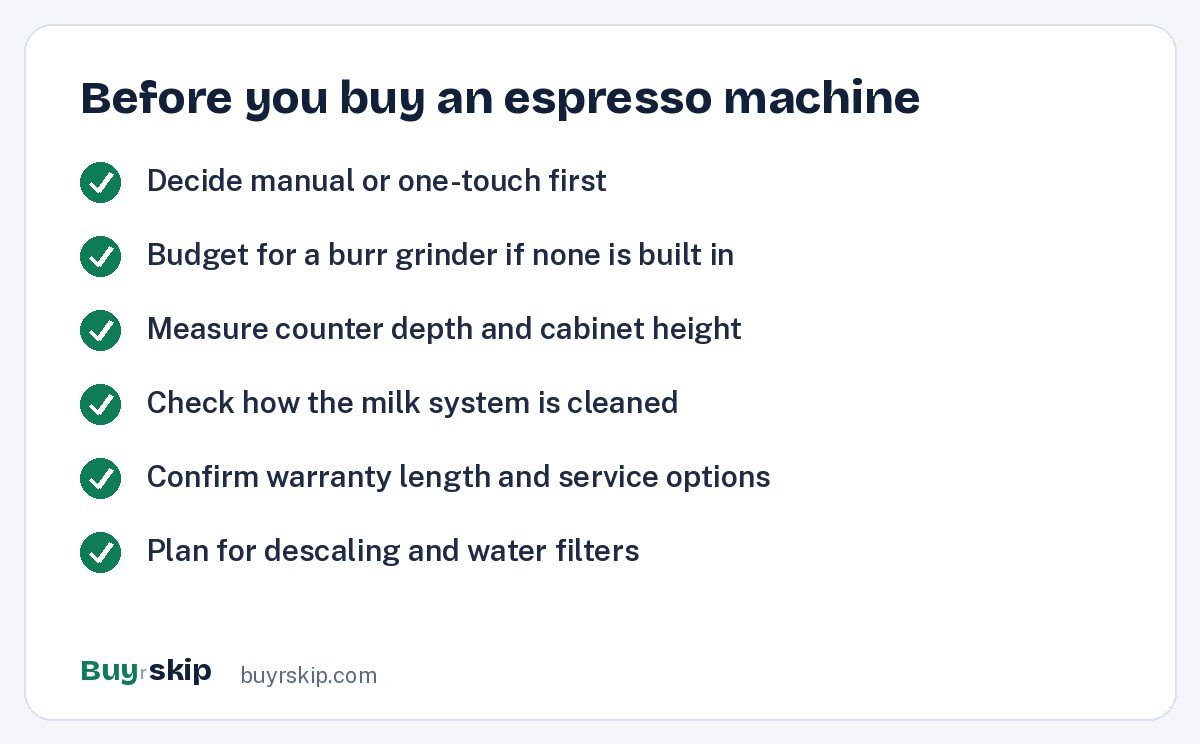
Every espresso machine needs regular care, but the type of care differs. Semi-automatics need you to purge the steam wand, knock out pucks and backflush on a schedule. Super-automatics handle more of this with rinse cycles, yet they still need descaling, brew unit cleaning and milk system cleaning. If you know you will skip chores, pick a machine with an easy milk system, like the Philips LatteGo, or one known for easy cleaning, like the Jura E8. Filtered water reduces scale, and some machines accept water filter cartridges that cut down on descaling.
Size and counter space
The Oracle machines, Eletta Explore and Jura models are large. Measure the depth of your counter and the height under your cabinets, leaving room to fill the tank and add beans. In small kitchens, the Bambino Plus and Stilosa are the easiest fits.
Total cost
Look past the sticker price. Semi-automatics without grinders need one. All machines need descaling supplies, and many benefit from filtered water. Our chart shows typical starting prices for a sample of the machines here.
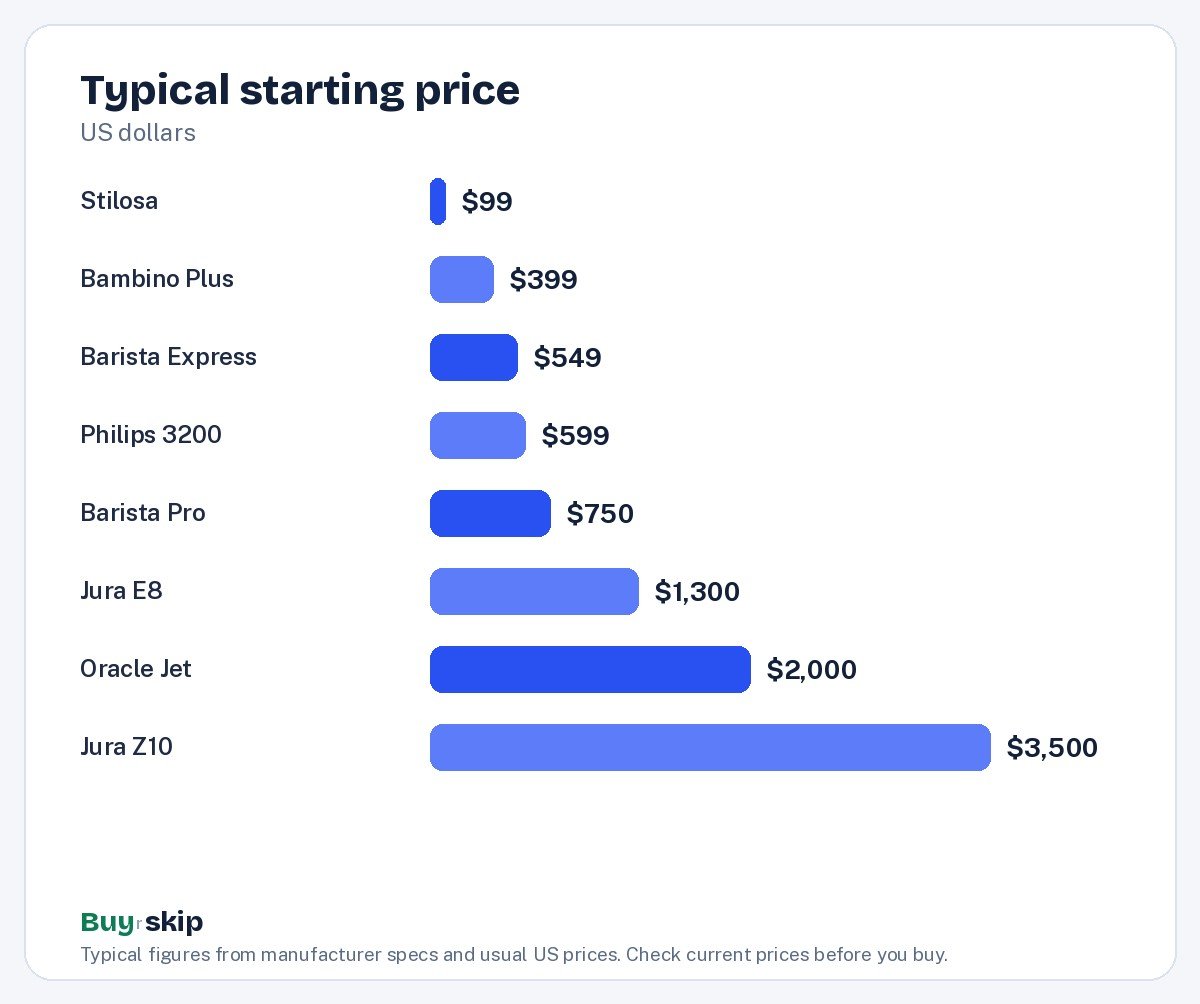
Simple rules: if you are spending under $150, buy the Stilosa to learn. Under $800, buy the Barista Express for manual drinks or the Philips 3200 for one-touch. Above $1,500, choose between the Oracle Jet for café shots and the Jura E8 for pure convenience.
Frequently asked questions
Do I need a separate grinder for an espresso machine?
Only if the machine lacks one. The Breville Barista Express, Barista Pro, Oracle models and all the super-automatics here grind whole beans for you. The Bambino Plus, Rancilio Silvia Pro X and De’Longhi Stilosa do not, so you will need a burr grinder that can grind fine enough for espresso. Pre-ground coffee works in a pinch but loses flavor quickly, and it limits how well you can adjust your shots.
Is a super-automatic worth the money?
It is worth it if convenience is your top priority and several people in your home make coffee. Machines like the Jura E8 and Philips 3200 grind, brew and add milk with one button, and cleanup is simple. The trade-off is that shots and milk texture rarely match a well-run semi-automatic. If you enjoy the ritual of making coffee, a semi-automatic gives you better results for less money.
What is the difference between the Breville Barista Express and the BES870XL?
They are the same Barista Express design. BES870XL is the model number, and retailers sometimes list the machine with or without it, occasionally in different finishes or bundles. That is why prices vary between listings. Compare the current price, confirm the seller offers the full Breville warranty, and buy the cheaper one rather than paying more for the name on the listing.
How much should I spend on my first espresso machine?
Most beginners get the best results in the $400 to $800 range. The Barista Express includes everything you need, while the Bambino Plus is excellent if you add a grinder. Spending around $100 on the Stilosa is fine for trying espresso, but expect inconsistent shots. Spending over $2,000 makes sense only if you already know you love espresso.
How do I keep an espresso machine running well?
Follow the maker’s descaling schedule, since mineral buildup is a common cause of problems. Purge and wipe the steam wand after every use, backflush or run cleaning cycles as the manual directs, and empty the drip tray often. Filtered or softened water can reduce scale, and some machines take water filters. You can find espresso machine descaling solution for most brands.
The bottom line
For most people, the Breville Barista Express BES870XL is the best espresso machine to buy. It includes a grinder and a proper steam wand, it teaches you real espresso skills, and it costs far less than buying a machine and grinder separately. If you want lattes without learning anything, the Philips 3200 with LatteGo is the value choice, and the Jura E8 is the premium one-touch option.
If you also brew drip coffee or tea, see our guides to the best coffee makers and best electric kettles. Check the current price before you order.
Check price on Amazon: Breville Barista Express BES870XL
Paid link. Typical price about $549–$749; check the current price on Amazon.