We research products independently from specs, manufacturer documentation, warranty terms and owner feedback. When you buy through links on this page, we may earn a commission at no extra cost to you. As an Amazon Associate we earn from qualifying purchases.
Quick answer
The Honda EU7000iS Inverter Generator is the best generator if you want quiet, clean power that is safe for electronics and a reputation for reliability that few brands can match. It is very expensive, though. For most households on a budget, the Westinghouse WGen9500DF Dual Fuel Generator delivers high output on gasoline or propane with electric start for roughly a quarter of the price.
A generator is the kind of purchase you make once and hope to use rarely, which makes it easy to overspend or, worse, buy something that cannot run what you need when the lights go out. The best generators for home backup balance three things: enough output for your essentials, a fuel plan you can actually keep stocked, and noise and power quality you can live with for days. Our picks are based on specs, manufacturer documentation, warranty terms, independent review consensus and owner-feedback patterns, not on in-house trials.
Quick picks
| Product | Best for | Our verdict | Typical price |
|---|---|---|---|
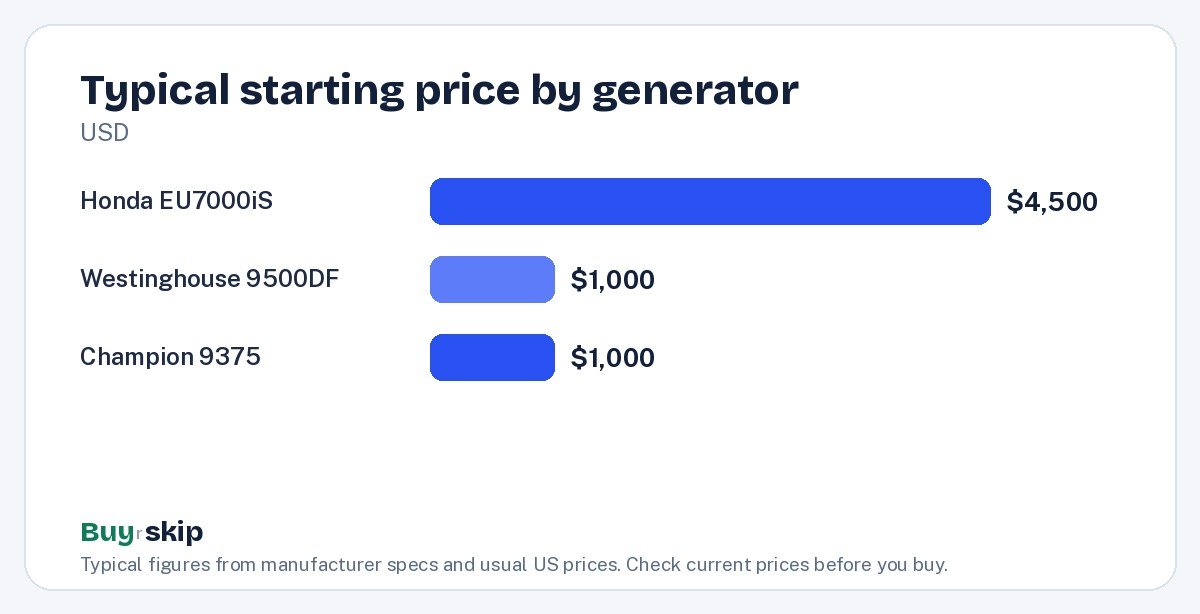
| Honda EU7000iS Inverter Generator | Quiet whole-home backup | Buy | about $4,500–$5,500 |
| Westinghouse WGen9500DF Dual Fuel Generator | Value home backup | Buy | about $1,000–$1,400 |
| Champion Power Equipment 9375-Watt Dual Fuel Generator | Budget dual fuel | Consider | about $1,000–$1,300 |
Prices shift with the season and storm forecasts, so check the current price before you buy.
The best generators in 2026
Best overall Our verdict: Buy
Honda EU7000iS Inverter Generator
Typical price: about $4,500–$5,500
Quiet whole-home backup. Buy it if you want quiet, reliable backup power that is safe for electronics.
- Pros
- ✓ Very quiet for its power
- ✓ Clean inverter power
- ✓ Legendary reliability
- Cons
- ✕ Very expensive
- ✕ Gas only
Check price on Amazon Paid link
The Honda EU7000iS is the generator for people who want backup power they never have to second-guess. As an inverter generator, it produces clean, stable power that is safe for computers, TVs, modern furnaces and other sensitive electronics. It is also very quiet for its power class, which matters when an outage lasts for days and you, your family and your neighbors have to listen to it around the clock.
Honda’s reputation for reliability is the other big reason to buy it. Owners tend to keep Honda generators for many years, and the brand has a wide dealer and service network across the US. For a machine that may sit unused for months and then has to start in a storm, that dependability has real value.
The downsides are price and fuel. At about $4,500–$5,500, it costs several times more than the dual fuel picks here, and it runs on gasoline only, so you cannot switch to propane if gas stations close or lines get long. Skip it if you want the lowest price per watt; the Westinghouse WGen9500DF Dual Fuel Generator delivers more raw output for far less. Buy the Honda if you live close to neighbors, need clean power for electronics or simply want the most trustworthy machine available.
Best value Our verdict: Buy
Westinghouse WGen9500DF Dual Fuel Generator
Typical price: about $1,000–$1,400
Value home backup. Buy it if you want strong backup power that runs on gasoline or propane at a fair price.
- Pros
- ✓ Dual fuel flexibility
- ✓ High output
- ✓ Electric start
- Cons
- ✕ Loud
- ✕ Not an inverter
Check price on Amazon Paid link
The Westinghouse WGen9500DF is the value pick for home backup. It runs on gasoline or propane, which is a real advantage during long outages: propane stores for a long time without going stale, and having two fuel options gives you a backup if one runs short. It offers high output for running essentials like a refrigerator, sump pump, well pump, lights and some heating or cooling, and electric start means you do not have to wrestle with a pull cord on a cold morning.
The trade-offs are noise and power type. It is loud, so it is not ideal if neighbors are close or local rules limit generator noise. It is also not an inverter, so its power is less refined than the Honda’s. Many modern appliances handle conventional generator power fine, but if you plan to run sensitive electronics directly, use a quality surge protector or a small battery backup in between.
Skip it if you need quiet operation near neighbors. Buy it at about $1,000–$1,400 if you want strong backup power and fuel flexibility for a fair price.
Best budget Our verdict: Consider
Champion Power Equipment 9375-Watt Dual Fuel Generator
Typical price: about $1,000–$1,300
Budget dual fuel. Buy it if you want an affordable dual-fuel generator for occasional outages.
- Pros
- ✓ Good value
- ✓ Dual fuel
- ✓ Easy start
- Cons
- ✕ Loud
- ✕ Heavy
Check price on Amazon Paid link
The Champion 9375-Watt Dual Fuel Generator is an affordable way to get dual fuel backup with electric start. It is good value, runs on gasoline or propane and starts easily, which makes it a sensible choice for homes that see a handful of outages a year and want a dependable plan without spending a lot.
Like the Westinghouse, it is loud, and it is also heavy, so plan where it will live and how you will move it into position. It is not an inverter, so it is not the right choice if you need clean power for sensitive electronics. Skip it if that is your priority; the Honda EU7000iS Inverter Generator is built for it.
Typical prices, about $1,000–$1,300, often overlap with the Westinghouse WGen9500DF Dual Fuel Generator, which we rate a little higher overall. Compare current prices and buy the Champion if it is the cheaper of the two when you shop. Champion is a common brand at home improvement stores and online, so replacement parts, covers and wheel kits are generally easy to find. For an occasional-use machine that mostly waits in the garage for the next storm, that availability and a lower price can matter more than small differences in features.
How to choose generators
Add up the watts you actually need
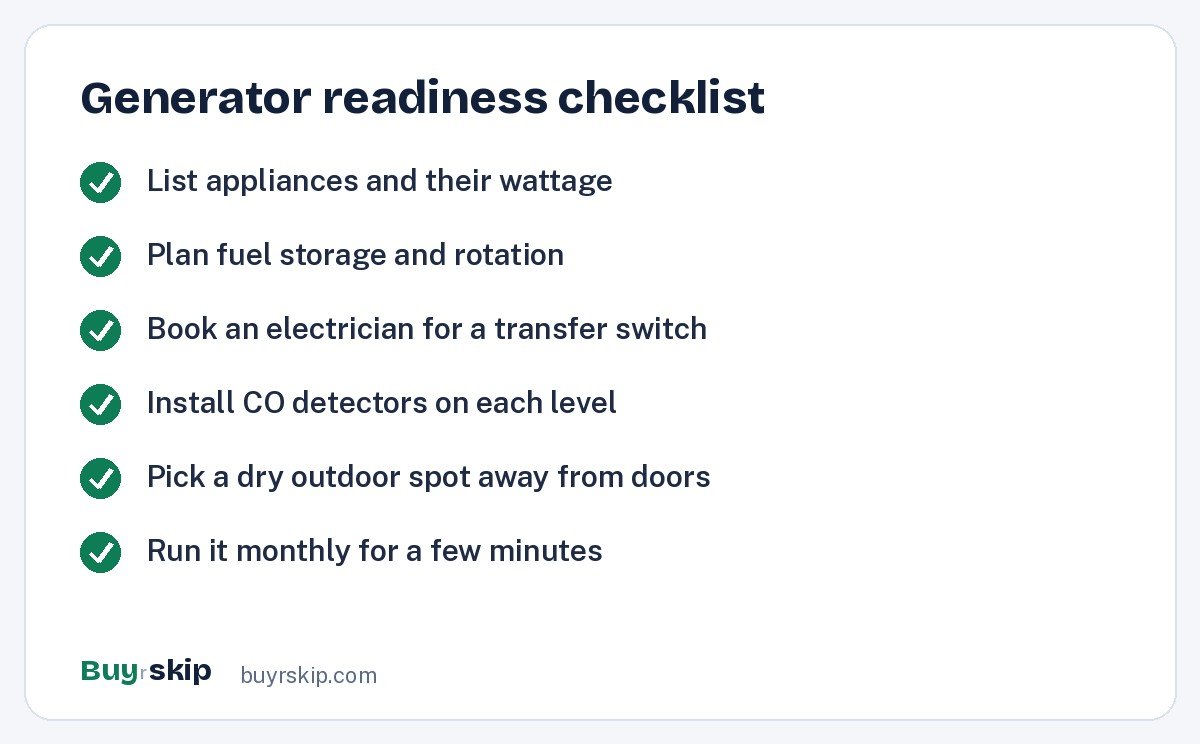
Start by listing what you want to run during an outage: refrigerator, freezer, sump pump, well pump, furnace blower, lights, phone chargers, maybe a window air conditioner. Check each appliance’s label or manual for running watts and starting watts. Motors, such as those in pumps and refrigerators, need a brief surge of extra power to start. Add up the running watts of everything that will run at once, then add the largest single starting surge. Leave some headroom, since running a generator flat out all day is hard on it. Be realistic about what can wait. You may not need the dryer, the oven and the central air during an outage, and trimming the list can save you thousands on the generator itself.
Inverter or conventional?
Inverter generators like the Honda EU7000iS Inverter Generator produce cleaner, more stable power and are usually much quieter, but they cost more per watt. Conventional generators like the Westinghouse WGen9500DF Dual Fuel Generator and Champion Power Equipment 9375-Watt Dual Fuel Generator deliver more power for the money but are louder.
- If you have close neighbors or sensitive electronics, buy the Honda.
- If you want the most output per dollar, buy the Westinghouse.
- If the Champion is cheaper the day you shop, it is a solid alternative.
Pick a fuel plan
Gasoline is easy to find but goes stale in storage and can be hard to buy during a widespread outage. Propane stores for a long time and is easy to keep in tanks, but generators usually produce somewhat less power on propane than on gasoline. Dual fuel models give you both options. If you store gasoline, add a fuel stabilizer and rotate it.
Plan the connection
Running extension cords from a generator works for a few appliances, but it gets messy fast. A transfer switch or an approved interlock kit, installed by a licensed electrician, lets you power selected household circuits safely. Never plug a generator into a wall outlet, a practice called backfeeding; it can energize utility lines and endanger line workers and your home. A transfer switch also makes outages easier: instead of running cords through a cracked window, you flip a few switches and selected circuits come back on. Ask the electrician about a power inlet box on the outside wall and a heavy-duty generator power cord matched to your generator’s outlet.
Put safety first
Generators produce carbon monoxide, an odorless gas that can kill. Never run one inside a home, garage, basement or shed, even with doors open. Place it outdoors, well away from windows, doors and vents, with the exhaust pointed away from the house. Install battery-powered carbon monoxide detectors on every level of your home.
Think about noise, weight and storage
Conventional open-frame generators are loud enough that you will raise your voice nearby, while inverters like the Honda are far quieter for their size. If you live in a dense neighborhood, noise may decide the purchase for you. Weight matters too. Home backup generators are heavy, and even with wheels you will want a clear, level path from storage to the spot where it runs. Store it somewhere dry and secure, with fuel kept separately in approved containers, and cover it between uses.
Maintain it before you need it
A generator that sits for a year often will not start when you need it. Run it every month or so for a short session, change the oil on schedule, and either drain the fuel or use stabilizer. Keep spare oil, a spark plug and an air filter on hand. Electric start models also need their battery kept charged. Before storm season, check the oil level, test the electric start, confirm your propane tanks are full and make sure the cords and transfer switch are where you expect them. A short dry run on a calm day is far better than learning the process in the dark.
Frequently asked questions
What size generator do I need to run a house?
It depends on what you want to power. Essentials like a refrigerator, sump pump, lights and chargers can run on a midsize generator, while central air conditioning or an electric water heater need far more. Add up the running watts of everything you want on at once, plus the biggest starting surge, and leave headroom. An electrician can help you choose which circuits to back up.
Is a portable power station better than a generator?
They suit different needs. A portable power station is silent, safe to use indoors and needs no fuel, but its battery capacity limits how long it can run large appliances. A generator can run for days as long as you have fuel. Many households use both. See our best portable power stations and best battery backup for a home power outage guides.
How long can a generator run continuously?
That depends on fuel tank size, load and fuel type. Running at a lighter load stretches fuel further, and propane tanks can be swapped without shutting down your plan for long. Most manufacturers also advise shutting down periodically to check oil, especially during multi-day outages. Check your model’s manual for refueling and maintenance intervals, and never refuel while the engine is hot.
Do I need a dual fuel generator?
Not strictly, but it is a smart hedge for home backup. Gasoline can be hard to buy during a big storm, while propane tanks can sit in storage for long periods and be ready when needed. That flexibility is why both the Westinghouse WGen9500DF Dual Fuel Generator and Champion Power Equipment 9375-Watt Dual Fuel Generator appeal to budget buyers. If quiet, clean power matters more than fuel choice, the Honda is still worth it.
How far from the house should a generator be?
Keep it well away from the house, with the exhaust pointed away from windows, doors and vents. US safety guidance from the CDC recommends at least 20 feet. Never run it in a garage or under a closed porch, and always use carbon monoxide detectors inside. Also check local rules and any homeowners association guidelines on generator placement and noise, and keep it far enough from neighboring homes that your exhaust does not drift into their windows either.
Can I run a generator in the rain?
Generators are not designed to get wet, and water near electrical outlets is dangerous. Use a purpose-made generator tent or cover that keeps rain off while allowing plenty of airflow, and never run a generator in an enclosed space to keep it dry. Check the manufacturer’s guidance for your model. Snow is a similar problem: keep the area around the generator clear so air can flow and the exhaust is never blocked. Our best snow blower for heavy snow guide can help with winter storms.
The bottom line
The Honda EU7000iS Inverter Generator is the best generator for quiet, clean, reliable home backup if your budget allows. The Westinghouse WGen9500DF Dual Fuel Generator is the smart value pick for strong output on gas or propane, and the Champion Power Equipment 9375-Watt Dual Fuel Generator is a fine budget alternative when it is cheaper.
Check price on Amazon: Honda EU7000iS Inverter Generator
Paid link. Typical price about $4,500–$5,500; check the current price on Amazon.