We research products independently from specs, manufacturer documentation, warranty terms and owner feedback. When you buy through links on this page, we may earn a commission at no extra cost to you. As an Amazon Associate we earn from qualifying purchases.
Quick answer
The best jump starter for most drivers is the NOCO Boost Plus GB40: it is small enough for a glove box, has spark-proof clamps with reverse-polarity protection, and is rated for gas engines up to 6.0L. Truck and big SUV owners should step up to the NOCO Boost X GBX45. For the most rated power per dollar, the GOOLOO GP4000 is the value pick, and the Clore Jump-N-Carry JNC660 suits garages.
A dead battery always seems to happen at the worst time, and waiting for another car with cables is no fun. The best jump starters let you restart your own car in a few minutes with no second vehicle. They differ in size, battery type, safety features and how big an engine they can handle. This guide ranks four proven options and explains which fits your vehicle. Picks are based on specs, manufacturer documentation, warranty terms, independent review consensus and owner-feedback patterns.
Quick picks
| Product | Best for | Our verdict | Typical price |
|---|---|---|---|
| NOCO Boost Plus GB40 | Most cars | Buy | about $90–$110 |
| NOCO Boost X GBX45 | Trucks and bigger SUVs | Buy | about $130–$160 |
| GOOLOO GP4000 Jump Starter | Value for big engines | Buy | about $90–$130 |
| Clore Automotive Jump-N-Carry JNC660 | Garages and shops | Consider | about $140–$190 |
The best jump starters in 2026
Best overall Our verdict: Buy
NOCO Boost Plus GB40
Typical price: about $90–$110
Most cars. Buy it if you drive a typical gas car or small SUV and want a compact, safe jump starter in the glove box.
- Pros
- ✓ Spark-proof, reverse-polarity protection
- ✓ Small enough for a glove box
- ✓ Charges phones and has an LED light
- Cons
- ✕ Not for large diesels
- ✕ Recharge it every few months
Check price on Amazon Paid link
The NOCO Boost Plus GB40 is the jump starter most drivers should keep in the car. It is a compact lithium-ion unit rated at 1,000 peak amps and listed for gas engines up to 6.0L and diesels up to 3.0L, which covers the vast majority of sedans, hatchbacks, crossovers and small SUVs. It is small enough to live in a glove box or seat-back pocket, so it is there when you need it.
Safety is its strongest point. The clamps are spark-proof and the unit has reverse-polarity protection, so connecting the clamps the wrong way will not cause sparks or damage. That makes it friendly for people who have never jumped a car. It also charges a phone over USB and has an LED light for roadside use at night.
The trade-offs: it is not meant for large diesels, and like any lithium jump starter, it should be topped up every few months so it is ready. Expect about $90–$110, and check the current price. If you drive a V8 truck, look at the GBX45 instead.
Best for trucks Our verdict: Buy
NOCO Boost X GBX45
Typical price: about $130–$160
Trucks and bigger SUVs. Buy it if you drive a V8 truck or larger SUV and want more cranking power than the GB40.
- Pros
- ✓ More power than the GB40
- ✓ USB-C charging in and out
- ✓ Same spark-proof safety
- Cons
- ✕ Costs more
- ✕ Still not for very large diesels
Check price on Amazon Paid link
The NOCO Boost X GBX45 gives you more cranking power without losing much portability. It is rated at 1,250 peak amps for gas engines up to 6.5L and diesels up to 4.0L, so it handles V8 pickups, full-size SUVs and many vans. It keeps the same spark-proof clamps and protection as the GB40, so safety is not a trade-off for power.
It also adds USB-C charging in and out, which means you can recharge it from the same cable as your phone or laptop and use it as a small power bank on trips. The extra headroom is helpful on cold mornings, when engines are harder to turn over and batteries deliver less.
It costs more, about $130–$160, and it is still not built for very large diesels. Skip it if you drive a small car; the GB40 does the job for less. Buy it if your vehicle has a bigger engine or you want one jump starter that can also help the family truck.
Best value Our verdict: Buy
GOOLOO GP4000 Jump Starter
Typical price: about $90–$130
Value for big engines. Buy it if you want a lot of rated power for big engines without paying NOCO prices.
- Pros
- ✓ Strong value
- ✓ Large built-in power bank
- ✓ Safety clamps
- Cons
- ✕ Peak-amp claims are marketing numbers
- ✕ Bulkier than NOCO
Check price on Amazon Paid link
The GOOLOO GP4000 Jump Starter is the pick if you want a lot of rated power for big engines without paying NOCO prices. GOOLOO rates it at 4,000 peak amps, and it includes safety clamps, a large built-in USB power bank and a light. For about $90–$130, that is a lot of hardware.
Read that rating carefully, though. Peak-amp numbers are set by each maker, and there is no single standard behind them, so a 4,000 A figure from one brand is not directly comparable to 1,250 A from another. Think of it as a marketing number, not a promise of four times the starting power. The GP4000 is also bulkier than the NOCO units, so it may not fit in a glove box.
Buy it if value matters most and you want a big power bank in the same box. Skip it if you want the most trusted brand and conservative ratings; the NOCO GBX45 is the safer bet for trucks.
Best for garages Our verdict: Consider
Clore Automotive Jump-N-Carry JNC660
Typical price: about $140–$190
Garages and shops. Buy it if you want a durable shop-style booster that stays on a charger in the garage.
- Pros
- ✓ Strong, proven cranking
- ✓ Heavy-duty cables
- ✓ Simple and durable
- Cons
- ✕ Heavy, about 18 lb
- ✕ Lead-acid battery needs regular charging
Check price on Amazon Paid link
The Clore Automotive Jump-N-Carry JNC660 is a different kind of tool. It is a lead-acid booster of the type many repair shops and fleet garages rely on, rated at 1,700 peak amps with heavy-duty cables and a simple, durable design. It is built to be used over and over, which is why it suits shops, farms, and households with several vehicles.
The downside is weight and upkeep. At about 18 lb, it is not something you toss in the trunk for every trip, and its sealed lead-acid battery needs regular charging to stay healthy. Most owners keep it plugged in on a charger in the garage. Expect about $140–$190.
That is why it is a consider rather than a buy. If you want something to carry in the car, buy the GB40 or GBX45. If you want a proven booster that sits in the garage and handles cold mornings for every vehicle you own, the JNC660 is a strong choice.
How to choose jump starters
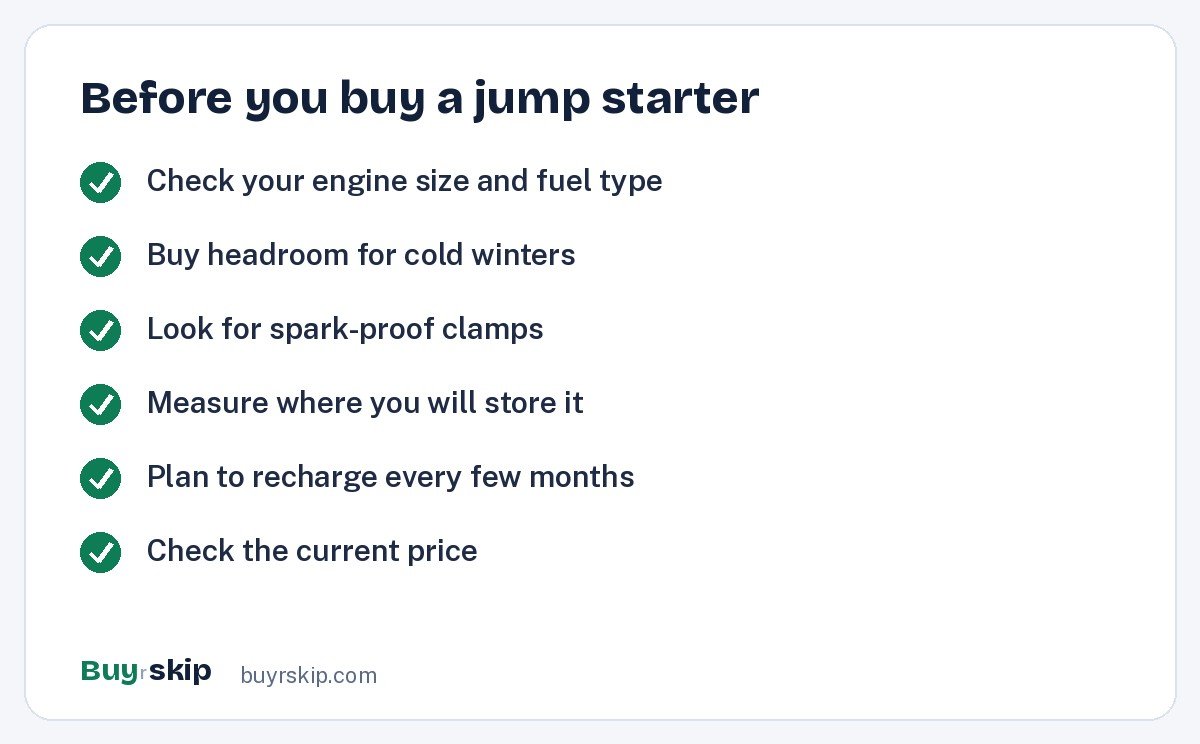
Jump starters look similar, but the details decide whether one will actually start your car on a cold morning. Here is what matters.
Match the engine size, not the peak amps
The most useful number on the box is the engine rating: the largest gas and diesel engine the maker says the unit can start. Diesel engines need much more power than gas engines of the same size. Peak amps are less useful because brands measure them differently.
Decision rule: if your car has a gas engine up to 6.0L, the GB40 is enough. If you drive a V8 truck or large SUV, buy the GBX45. If you have a large diesel, check the maker’s diesel rating carefully before buying any model.
Lithium or lead-acid
Lithium jump starters like the NOCO and GOOLOO units are small and light and hold a charge for months. Lead-acid boosters like the Jump-N-Carry JNC660 are heavy but simple and rugged, and they are meant to stay on a charger. Choose lithium for the car and lead-acid for the garage.
Safety features
Look for spark-proof clamps and reverse-polarity protection. These stop sparks and damage if the clamps touch or go on the wrong terminals. All the NOCO units here have both, and the GOOLOO includes safety clamps. If you are new to jumping cars, these features are worth paying for.
Size and where you will keep it
A jump starter only helps if it is with you. Measure your glove box or storage spot. The GB40 fits in most glove boxes, the GBX45 is slightly larger, and the GP4000 is bulkier. The JNC660 belongs on a garage shelf. A padded jump starter storage case keeps clamps and cables tidy in the trunk.
Cold weather and maintenance
Batteries lose power in the cold, and engines are harder to crank. If you live somewhere with harsh winters, buy more headroom than your engine strictly needs. Recharge lithium units every few months and after each use, and keep lead-acid boosters on their charger. A unit left flat for a year may not help when you need it.
Extras
USB ports, power banks and lights are handy on the roadside. The GBX45 adds USB-C in and out, and the GP4000 has a large power bank. These are nice bonuses, but engine rating and safety should come first. If you also want to fix low tires on the road, see our best tire inflators guide.
Using a jump starter safely
Every model comes with its own instructions, and they are worth reading before the day you need them. The general pattern is the same for most units: turn off the ignition and accessories, connect the red clamp to the positive terminal, connect the black clamp to a bare metal ground point or the negative terminal as the manual directs, switch on the jump starter, then try to start the car. Once the engine runs, switch off the unit and remove the clamps in reverse order.
If the car does not start after a short crank, wait before trying again, as the manual recommends. Repeated long cranking can overheat the starter and drain the pack. If a battery will not hold a charge even after a successful jump, the battery itself may be failing, and a jump starter will only get you to a shop. Keeping a car battery tester in the garage helps you spot a weak battery before it strands you.
Decision rule: if you have never jumped a car before, choose a unit with spark-proof clamps and reverse-polarity protection, such as the GB40 or GBX45.
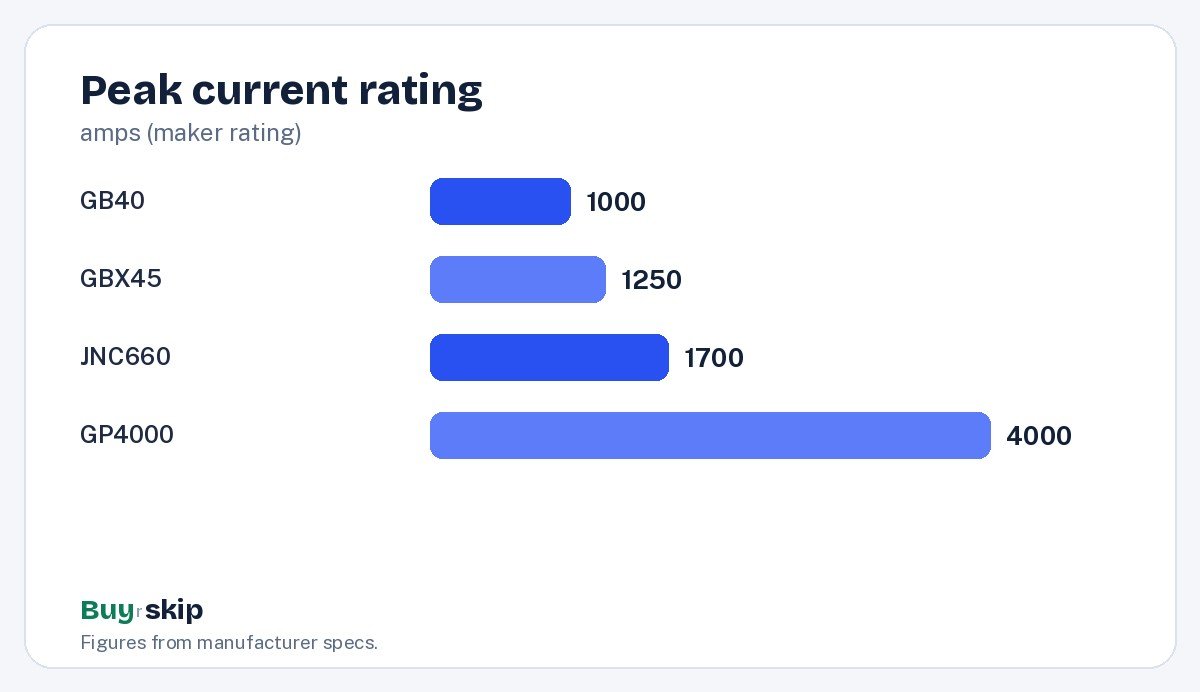
Remember that these peak ratings come from each maker and are not measured the same way, so use them as a rough guide only. The engine rating matters more.
Frequently asked questions
How big a jump starter do I need?
Match the maker’s engine rating to your vehicle. Most cars and small SUVs with gas engines up to 6.0L are covered by the NOCO GB40. V8 trucks and larger SUVs are better served by the GBX45, which is rated for gas engines up to 6.5L and diesels up to 4.0L. Diesels need more power, so check the diesel rating specifically.
Are peak amp ratings accurate?
Peak amps are set by each manufacturer, and there is no single standard behind them, so they are not directly comparable between brands. A higher number does not guarantee a better start. The engine size rating and independent review consensus are more reliable guides. Treat very large peak numbers, like the GOOLOO’s 4,000 A rating, as marketing figures.
How often should I charge a jump starter?
Recharge lithium jump starters every few months and after every use, since they slowly lose charge while stored. Lead-acid boosters like the Jump-N-Carry JNC660 need more regular charging and are usually kept plugged into a charger in the garage. Check the manual for your model, and top it up before long trips or winter.
Can a jump starter damage my car?
Used correctly, a quality jump starter is safe for your car. Spark-proof clamps and reverse-polarity protection, found on the NOCO units, reduce the risk of sparks or damage from connecting clamps wrong. Always follow the manual, connect to the correct terminals, and avoid cranking for long stretches without a rest between attempts.
Should I keep a jump starter in a hot car?
Extreme heat and cold are hard on batteries. Many owners keep lithium jump starters in the car anyway, since that is where they are needed. Check the maker’s storage temperature range in the manual, avoid leaving the unit in direct sun on a dashboard, and recharge it more often in very hot or cold seasons.
The bottom line
The NOCO Boost Plus GB40 is the best jump starter for most drivers: compact, safe and rated for most gas engines. Truck owners should buy the GBX45, value seekers should look at the GOOLOO GP4000, and anyone with a garage full of vehicles should consider the Clore Jump-N-Carry JNC660.
For broader backup power at home, see our best portable power stations. Check the current price before you buy.
Check price on Amazon: NOCO Boost Plus GB40
Paid link. Typical price about $90–$110; check the current price on Amazon.