We research products independently from specs, manufacturer documentation, warranty terms and owner feedback. When you buy through links on this page, we may earn a commission at no extra cost to you. As an Amazon Associate we earn from qualifying purchases.
Quick answer
Quick answer: The Anker 737 Power Bank (PowerCore 24K) is the best power bank for most travelers: 24,000 mAh, 140W USB-C output that can charge many laptops, a smart display, and a capacity under the 100 Wh airline limit. For daily carry, the Anker Nano Power Bank (10K, 30W, Built-In USB-C Cable) is compact and always has its cable. On a tight budget, the INIU 10,000 mAh Portable Charger is slim and very affordable.
The best power banks are not all trying to do the same job. A pocket battery for topping up a phone on a commute is a very different product from a brick that can recharge a laptop on a long flight, and a magnetic battery that snaps onto an iPhone is different again. Buying the right one is mostly about matching capacity and wattage to the devices you carry. Our picks are based on published specs, manufacturer documentation, warranty terms, independent review consensus and patterns in owner feedback.
Quick picks
| Product | Best for | Our verdict | Typical price |
|---|---|---|---|
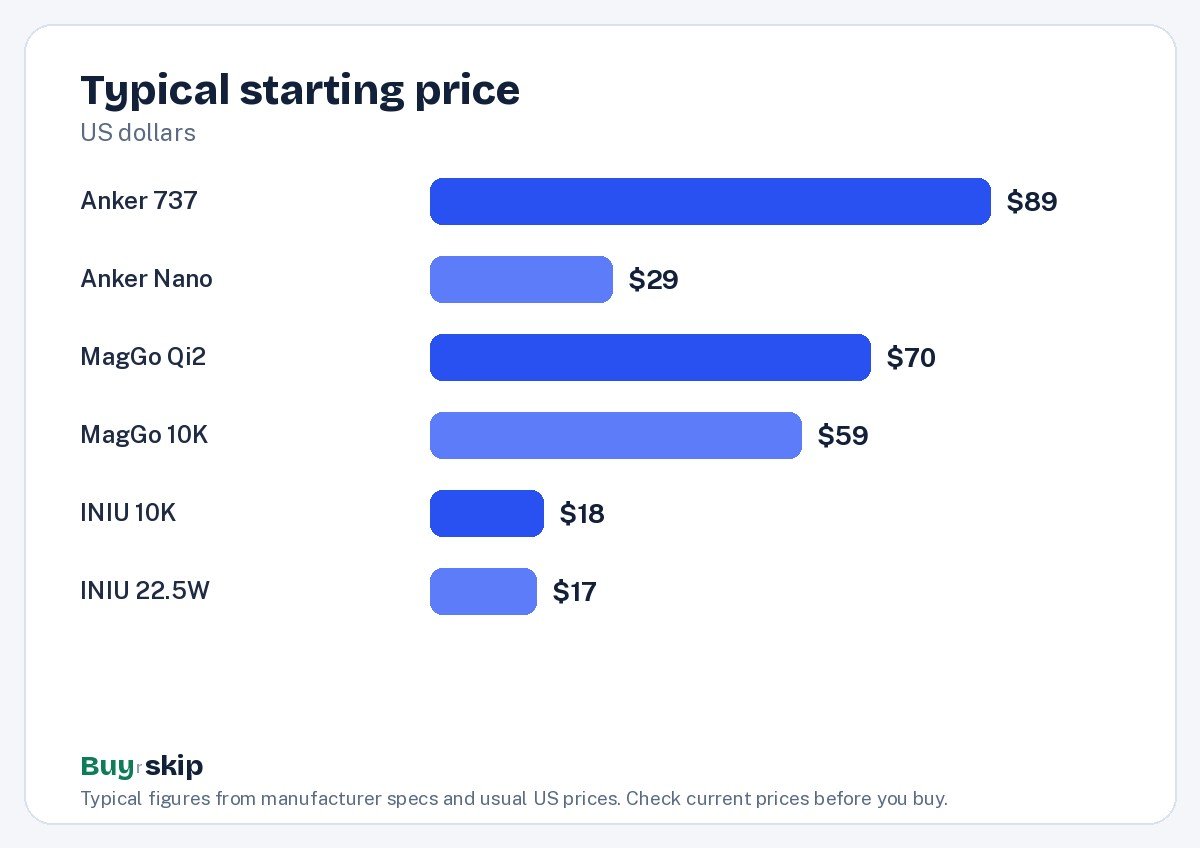
| Anker 737 Power Bank (PowerCore 24K) | Laptops and travel | Buy | about $89–$149 |
| Anker Nano Power Bank (10K, 30W, Built-In USB-C Cable) | Everyday carry | Buy | about $29–$45 |
| Anker MagGo Power Bank 10K (Qi2) | iPhone users | Buy | about $70–$90 |
| Anker 737 Power Bank (24,000 mAh) | Laptops and travel | Buy | about $90–$150 |
| Anker MagGo Power Bank (10K) | iPhone MagSafe users | Buy | about $59–$89 |
| INIU 10,000 mAh Portable Charger | Budget everyday carry | Buy | about $18–$25 |
| INIU Portable Charger 10000mAh 22.5W | Budget backup | Buy | about $17–$25 |
The best power banks in 2026
Best overall Our verdict: Buy
Anker 737 Power Bank (PowerCore 24K)
Typical price: about $89–$149
Laptops and travel. Buy it if you travel with a laptop, tablet and phone and want one power bank that can charge all of them fast.
- Pros
- ✓ 140W USB-C output charges many laptops
- ✓ 24,000 mAh capacity
- ✓ Smart display shows battery and wattage
- ✓ Under the 100 Wh airline limit
- Cons
- ✕ Heavy at about 1.4 lb
- ✕ Pricier than phone-only banks
Check price on Amazon Paid link
The Anker 737 Power Bank (PowerCore 24K) is the one battery that can handle a laptop, a tablet and a phone on the same trip. Its headline feature is 140W USB-C output, enough to charge many laptops at or near full speed, plus a 24,000 mAh (86.4 Wh) capacity. It has two USB-C ports and one USB-A port, so you can charge several devices at once, and a smart display that shows remaining battery and live wattage. That display is more useful than it sounds: you can see whether your laptop is actually drawing fast power or trickling.
Its 86.4 Wh rating keeps it under the 100 Wh limit that US airlines generally allow in carry-on bags without special approval. The trade-off is weight. At about 1.4 lb it is a real brick, and it costs more than phone-only batteries. If you only charge a phone, skip it and get the Anker Nano Power Bank (10K, 30W, Built-In USB-C Cable) or an INIU pack instead. Check the current price, since this model often sells anywhere in its typical range.
Best for everyday carry Our verdict: Buy
Anker Nano Power Bank (10K, 30W, Built-In USB-C Cable)
Typical price: about $29–$45
Everyday carry. Buy it if you want a compact power bank for daily use that always has a cable attached.
- Pros
- ✓ Built-in USB-C cable
- ✓ Compact for a pocket or small bag
- ✓ 30W fast charging for phones
- Cons
- ✕ Not enough power for most laptops
- ✕ Built-in cable cannot be replaced
Check price on Amazon Paid link
The Anker Nano Power Bank (10K, 30W, Built-In USB-C Cable) solves the most common power bank problem: you have the battery but forgot the cable. Its USB-C cable is built in, so it is always there. With 10,000 mAh of capacity and 30W fast charging, it can top up a phone quickly, and it is compact enough for a pocket or a small bag.
The built-in cable is also its weak point. If it frays or breaks, you cannot swap it out, though the battery still has its port for a separate cable. And 30W is not enough for most laptops, so it is not a travel do-everything battery. If you want something that snaps onto an iPhone without a cable at all, look at the Anker MagGo Power Bank 10K (Qi2). If you want to spend as little as possible, the INIU 10,000 mAh Portable Charger costs less. For most people who just want a reliable daily battery, this is the one to buy. It is also a good gift for anyone whose phone tends to die by late afternoon, since there is nothing to set up and no cable to lose.
Best for iPhone Our verdict: Buy
Anker MagGo Power Bank 10K (Qi2)
Typical price: about $70–$90
iPhone users. Buy it if you want a magnetic battery that snaps to your iPhone and charges fast.
- Pros
- ✓ Snaps on with Qi2 magnets
- ✓ Fast wireless charging
- ✓ Built-in stand and display
- Cons
- ✕ Heavier than slim packs
Check price on Amazon Paid link
The Anker MagGo Power Bank 10K (Qi2) is a magnetic battery that snaps onto the back of an iPhone and charges it wirelessly using the Qi2 standard. You can keep using the phone while it charges, without a cable dangling from your pocket. It holds 10,000 mAh, adds a built-in stand for watching video, and has a display so you know how much charge is left.
It is heavier than slim, cable-only packs, and wireless charging in general is less efficient than plugging in. That means some of the stored energy becomes heat instead of phone battery. If that bothers you, a cable battery like the Anker Nano Power Bank (10K, 30W, Built-In USB-C Cable) gives more charge per dollar. It also cannot charge a laptop. But for iPhone owners who want grab-and-go convenience, the magnetic design is worth the trade. It is especially handy on days spent navigating, taking photos or streaming, when the phone is in your hand and a cable would get in the way. Thick or non-magnetic phone cases can weaken the hold, so use a MagSafe-compatible case if you keep one on.
Also great Our verdict: Buy
Anker 737 Power Bank (24,000 mAh)
Typical price: about $90–$150
Laptops and travel. Buy it if you want one battery that can charge a laptop and phone on long trips.
- Pros
- ✓ Charges laptops
- ✓ Large capacity
- ✓ Smart display
- ✓ Fast recharge
- Cons
- ✕ Heavy
- ✕ Expensive
Check price on Amazon Paid link
The Anker 737 Power Bank (24,000 mAh) is listed separately in our data, but its key specs match our top pick: 24,000 mAh capacity, 140W maximum output, a smart display and fast recharging. Treat it as the same class of laptop-capable battery, and confirm the model details on the listing before you buy.
Its typical price is about $90–$150, nearly identical to the Anker 737 Power Bank (PowerCore 24K). Our advice is simple: compare the two listings on the day you shop and buy whichever is cheaper, since you get the same core benefit either way. The trade-offs are the same too. It is heavy and expensive, so skip it if you want something pocket-sized or only charge a phone.
Also great Our verdict: Buy
Anker MagGo Power Bank (10K)
Typical price: about $59–$89
iPhone MagSafe users. Buy it if you use an iPhone 13 or newer, or a Qi2 phone, and want a power bank that snaps on magnetically.
- Pros
- ✓ Strong magnetic hold
- ✓ Qi2 15W wireless charging
- ✓ Built-in kickstand
- Cons
- ✕ Wireless charging wastes some energy as heat
- ✕ Thicker than a slim battery case
Check price on Amazon Paid link
The Anker MagGo Power Bank (10K) is another Anker magnetic battery for iPhone 13 or newer and Qi2 phones. It offers a strong magnetic hold, Qi2 wireless charging at up to 15W, a built-in kickstand, and a USB-C port for wired charging when you want speed. Its 10,000 mAh capacity matches the other MagGo pick.
Its typical price runs a little lower, about $59–$89, which makes it worth a look if you want the magnetic convenience for less. The cons are what you would expect: wireless charging wastes some energy as heat, and it is thicker than a slim battery case. If fastest charging matters most, use a cable. Compare it side by side with the Anker MagGo Power Bank 10K (Qi2); if you want the built-in display, choose that one, and if price matters more, choose this one.
Best budget Our verdict: Buy
INIU 10,000 mAh Portable Charger
Typical price: about $18–$25
Budget everyday carry. Buy it if you want a cheap, slim battery to top up your phone.
- Pros
- ✓ Very affordable
- ✓ Slim
- ✓ USB-C fast charging
- Cons
- ✕ No wireless charging
- ✕ Basic design
Check price on Amazon Paid link
The INIU 10,000 mAh Portable Charger is a cheap, slim battery for topping up a phone. It supports USB-C fast charging, slips easily into a bag or jacket pocket, and costs about $18–$25. For a first power bank, a spare for a kid’s backpack, or a backup for days you know you will be away from an outlet, it does the job without fuss.
It is a basic product. There is no wireless charging, the design is plain, and it is not meant for laptops. If you want a cable that is always attached, spend a bit more on the Anker Nano Power Bank (10K, 30W, Built-In USB-C Cable). If you want magnetic charging, look at the MagGo models. But if price is the priority, this is an easy recommendation.
Best for backup Our verdict: Buy
INIU Portable Charger 10000mAh 22.5W
Typical price: about $17–$25
Budget. Buy it if you want an inexpensive backup battery for a phone in a bag or glovebox.
- Pros
- ✓ Very affordable
- ✓ Slim and light
- ✓ USB-C input and output
- Cons
- ✕ Slower than premium banks
- ✕ Basic LED indicator
Check price on Amazon Paid link
The INIU Portable Charger 10000mAh 22.5W is a similar slim INIU battery with 10,000 mAh and a maximum output of 22.5W. It has USB-C input and output, is slim and light, and typically costs about $17–$25. It is a good battery to leave in a glovebox, a travel bag or an emergency kit so a dead phone never strands you.
It is slower than premium banks and only has a basic LED indicator, so you get a rough idea of charge rather than an exact percentage. It is not for laptops. Between the two INIU picks, the differences are small; buy whichever is cheaper when you shop. If you want faster charging for a newer phone, the 30W Anker Nano Power Bank (10K, 30W, Built-In USB-C Cable) is the step up.
How to choose a power bank
Capacity: how much battery you need
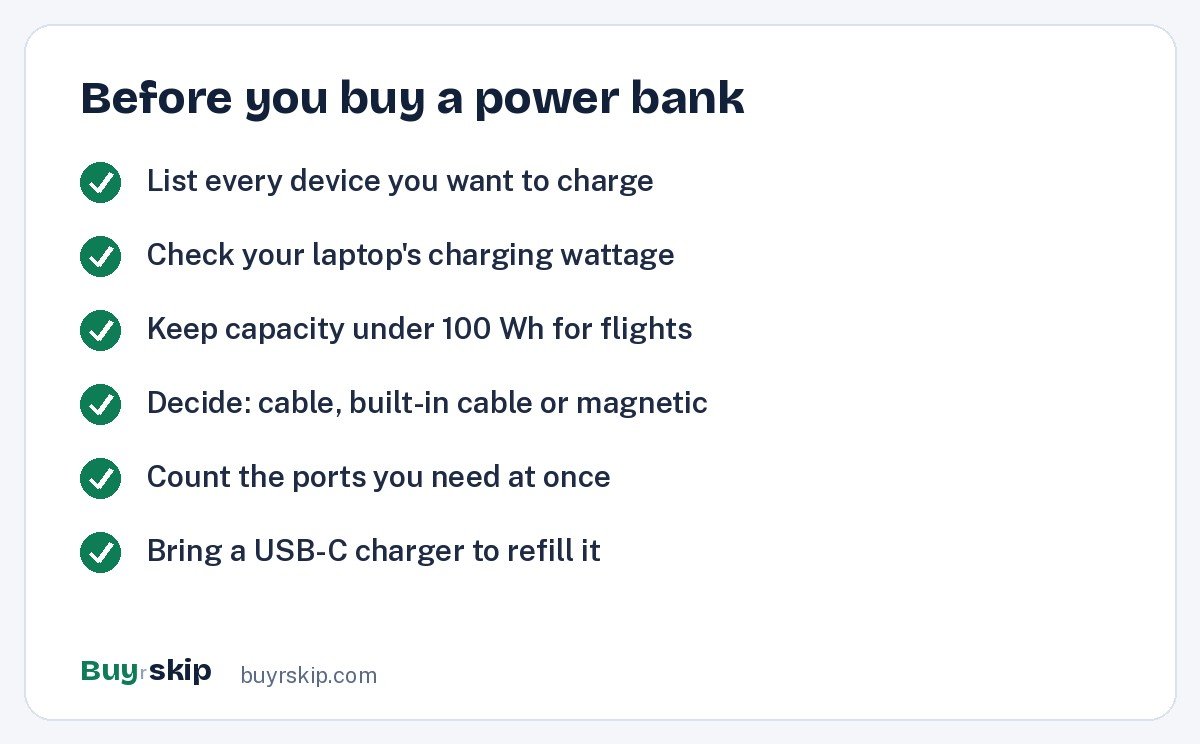
Capacity is listed in milliamp-hours (mAh). A 10,000 mAh battery is the sweet spot for phones: small enough to carry daily, large enough for a meaningful top-up or more. Every phone-focused pick here, from the INIU 10,000 mAh Portable Charger to the Anker MagGo Power Bank 10K (Qi2), uses that size. Some energy is always lost in conversion, so you will not get the full rated capacity into your phone. If you carry a laptop or want several phone charges over a weekend, step up to 24,000 mAh with the Anker 737 Power Bank (PowerCore 24K).
Wattage decides what it can charge
Output wattage determines speed and whether a laptop will charge at all. Phones are happy at 20W to 30W, which is why the 22.5W INIU and 30W Anker Nano work well for them. Many laptops need 45W, 65W or more over USB-C, so a phone-sized battery may charge a laptop very slowly or not at all. If you want to charge a laptop, buy a bank with high USB-C output like the 140W Anker 737, and check your laptop’s charger rating first. You will also need a good cable; browse 100W-rated USB-C cables if yours is a phone cable.
Flying with a power bank
US air travel rules generally allow lithium power banks up to 100 Wh in carry-on bags and do not allow them in checked luggage. Watt-hours are usually printed on the battery. The Anker 737 Power Bank (PowerCore 24K) is rated 86.4 Wh, under that limit, and 10,000 mAh banks are far below it. Rules can vary by airline and country, so check before you fly. For more travel ideas, see our carry-on luggage and travel gear picks.
Cable, built-in cable or magnetic
There are three styles. A standard bank, like the INIU picks, uses whatever cable you bring. A built-in cable, like the Anker Nano, is the most convenient day to day. A magnetic Qi2 bank, like the MagGo models, snaps onto an iPhone 13 or newer, or a Qi2 phone, and charges without a cable. Magnetic is the most convenient but the least efficient. If you value convenience above everything, go magnetic; if you value charge per dollar, go wired.
Ports and charging several devices
Count the devices you might charge at the same time. The Anker 737 has two USB-C ports and one USB-A port, which covers a laptop, phone and earbuds together. Most 10,000 mAh banks are designed to charge one or two devices at a time. Also think about recharging the bank itself: a large battery refills much faster from a strong USB-C wall charger. Our phone charger picks include fast USB-C chargers that pair well with these batteries.
Display, indicators and recharge time
A battery that tells you how much charge it has left is easier to live with. The Anker 737 and the Anker MagGo Power Bank 10K (Qi2) have displays, while the INIU batteries use basic LED indicators that give a rough level. Recharge time matters too, especially for big batteries: a 24,000 mAh bank takes a while to refill from a weak phone charger, so pair it with a strong USB-C wall charger and plan to top it up overnight before a trip. Smaller 10,000 mAh banks refill faster and are less fussy about chargers.
Care and safety
Lithium batteries are safe for daily use when you treat them reasonably. Buy from a known brand, avoid leaving any battery in a hot car on a summer afternoon, and stop using one that swells, smells odd or gets unusually hot. Store a backup battery partly charged rather than empty for long periods, and top it up every few months if it lives in a glovebox or emergency kit. A cheap pack like the INIU Portable Charger 10000mAh 22.5W is a fine emergency spare, as long as you check on it now and then.
When you need something bigger
Power banks are for phones, tablets and laptops. If you want to run a CPAP machine, a mini fridge or lights during an outage, you need a portable power station instead, which has AC outlets and far more capacity. See our portable power station picks for those.
Frequently asked questions
What size power bank do I need for a phone?
For most phones, a 10,000 mAh power bank is the right size. It is small enough to carry daily and holds enough energy for a solid top-up, often more depending on your phone’s battery. The Anker Nano, INIU picks and MagGo models all use this capacity. If you are away from outlets for a long weekend or charge several devices, a 24,000 mAh battery like the Anker 737 makes more sense.
Can a power bank charge a laptop?
Yes, if it has enough USB-C output and your laptop charges over USB-C. Many laptops need 45W to 65W or more, so look for a bank with high output. The Anker 737 Power Bank (PowerCore 24K) delivers up to 140W, enough for many laptops. Phone-sized banks with 20W to 30W output may charge a laptop very slowly or not at all. Check your laptop’s charger wattage before buying.
Can I bring a power bank on a plane?
Generally yes, in your carry-on. US rules allow lithium power banks up to 100 Wh in carry-on bags, and they are not allowed in checked luggage. The Anker 737 is rated 86.4 Wh, and 10,000 mAh banks are well under the limit. Some airlines and countries have extra rules, so it is worth checking your airline’s page before you travel.
Are magnetic power banks worth it?
They are worth it if convenience matters more than efficiency. A Qi2 magnetic bank like the Anker MagGo Power Bank 10K (Qi2) snaps onto an iPhone and charges it while you use the phone, with no cable. The trade-off is that wireless charging wastes some energy as heat, so you get less charge per full battery than with a cable. For pure value, a wired bank is better.
Why are there two Anker 737 and two INIU listings?
Our research data includes separate listings that describe very similar products. The two Anker 737 entries share 24,000 mAh capacity and 140W output, and the two INIU entries are both slim 10,000 mAh batteries. Rather than pick one arbitrarily, we kept both. Compare the listings when you shop, confirm the model details and buy the cheaper option.
The bottom line
If you travel with a laptop, buy the Anker 737 Power Bank (PowerCore 24K). It charges laptops, tablets and phones from one battery and stays under the airline carry-on limit. For daily carry, the Anker Nano with its built-in cable is the most convenient choice, and the INIU batteries are the budget pick.
Check current prices before buying, since these batteries move around in their typical ranges. A small power bank travel case keeps the battery and cables together in a bag.
Check price on Amazon: Anker 737 Power Bank (PowerCore 24K)
Paid link. Typical price about $89–$149; check the current price on Amazon.