We research products independently from specs, manufacturer documentation, warranty terms and owner feedback. When you buy through links on this page, we may earn a commission at no extra cost to you. As an Amazon Associate we earn from qualifying purchases.
Quick answer
Quick answer: The HOKA Speedgoat 6 is the best trail running shoe for most runners: generous cushioning, Vibram grip and a lighter build than the previous version, at about $155–$160. If you run mostly on mud and soft ground, the Salomon Speedcross 6 has the deepest lugs here. For wide feet, the Altra Lone Peak 9 offers a roomy toe box and zero drop for about $140–$150.
Trail shoes are more specialized than road shoes. The best trail running shoes for muddy forest paths are not the best for rocky desert trails, and a shoe that feels great on a smooth fire road can feel firm and awkward on pavement. That is why the right pick depends less on which brand is “best” and more on your terrain, your foot shape and how far you run. Below are four proven models, each with a clear job. Our picks are based on published specs, manufacturer documentation, warranty terms, independent review consensus and patterns in owner feedback.
Quick picks
| Product | Best for | Our verdict | Typical price |
|---|---|---|---|
| HOKA Speedgoat 6 | Most trail runners | Buy | about $155–$160 |
| Salomon Speedcross 6 | Mud and soft ground | Buy | about $140–$150 |
| Altra Lone Peak 9 | Wide feet | Buy | about $140–$150 |
| Brooks Cascadia 18 | Rocky trails | Consider | about $140–$145 |
The best trail running shoes in 2026
Best overall Our verdict: Buy
HOKA Speedgoat 6
Typical price: about $155–$160
Most trail runners. Buy it if you want cushioning and grip for long trail runs.
- Pros
- ✓ Great grip
- ✓ Cushioned
- ✓ Lighter than before
- Cons
- ✕ Narrow for some
Check price on Amazon Paid link
The HOKA Speedgoat 6 is the shoe we would point most trail runners toward first. It combines generous cushioning with a Vibram outsole that grips well across a wide range of surfaces, from packed dirt to wet roots and loose gravel. That mix makes it comfortable on long runs and ultras, when your legs are tired and a softer landing helps, while still giving confident traction on technical sections. It is also lighter than the previous Speedgoat, which makes the cushioning feel less clunky.
The main trade-off is fit. Owners regularly describe it as narrow for some feet, so if you have wide feet or like your toes to spread, try it on before committing, or look at the Altra Lone Peak 9. Its high-cushion design also puts you farther from the ground, so runners who want to feel the trail underfoot may find it less precise. If you mostly run in deep mud, the Salomon Speedcross 6 grips better there. For everyone else, from first trail race to ultra training, it is the most versatile pick.
Best for mud Our verdict: Buy
Salomon Speedcross 6
Typical price: about $140–$150
Mud and soft ground. Buy it if you run on mud and soft trails.
- Pros
- ✓ Huge grip in mud
- ✓ Secure quick laces
- ✓ Protective
- Cons
- ✕ Firm on hard ground
Check price on Amazon Paid link
The Salomon Speedcross 6 is built for mud and soft ground. Its deep, aggressive lugs dig into wet soil, loose dirt and soft forest floors where shallower treads slip. It uses Salomon’s quick-lace system, which tightens with one pull and tucks away, so you get a secure fit without laces coming undone mid-run. The upper is protective too, which helps on overgrown trails.
Those same deep lugs are its weakness on hard ground. On rocks, hardpack and pavement, it feels firm, and the lugs can feel unstable and wear faster. If your local trails are rocky or you run several miles of road to reach the trailhead, skip it and get the HOKA Speedgoat 6 or Brooks Cascadia 18. If you live somewhere wet, run in fall and winter, or race on muddy courses, it is the specialist shoe to own.
Best for wide feet Our verdict: Buy
Altra Lone Peak 9
Typical price: about $140–$150
Wide feet. Buy it if you want a roomy toe box and natural feel.
- Pros
- ✓ Roomy toe box
- ✓ Zero drop
- ✓ Versatile
- Cons
- ✕ Needs transition time
Check price on Amazon Paid link
The Altra Lone Peak 9 is the shoe for runners with wide feet or anyone who wants a more natural feel. Its roomy toe box lets your toes spread as they land, and its zero drop means the heel and forefoot sit at the same height. Many runners like it for long days because there is less pressure on the toes, and it is versatile enough for both trail running and hiking.
The trade-off is that zero drop needs transition time if you are used to traditional running shoes, which usually have a raised heel. Switching abruptly can stress your calves and Achilles tendons. Ease in with shorter runs and build up over several weeks. If you are used to a high heel drop and do not want to change, skip it and choose the HOKA Speedgoat 6 or Brooks Cascadia 18. If your current shoes squeeze your toes, this is the first one to try.
Best for rocky trails Our verdict: Consider
Brooks Cascadia 18
Typical price: about $140–$145
Rocky trails. Buy it if you want a stable, protective shoe for rocky trails.
- Pros
- ✓ Stable
- ✓ Protective
- ✓ Durable
- Cons
- ✕ Firmer ride
Check price on Amazon Paid link
The Brooks Cascadia 18 is a stable, protective shoe for rocky, technical trails. Where softer shoes can feel wobbly on uneven rock, the Cascadia keeps your foot planted, and its protective build helps shield you from sharp stones. It is also durable, which matters if you run rough terrain often, and it doubles well as a light hiking shoe.
It earns a Consider verdict because of its firmer ride. If you want maximum cushioning for long runs, the HOKA Speedgoat 6 feels softer, and if you run in mud, the Salomon Speedcross 6 grips better. The Cascadia makes the most sense for runners who value stability and protection over plushness, especially on rocky mountain trails. It is also a sensible choice for newer trail runners who are still building ankle strength and want a shoe that feels planted rather than bouncy. If you split your time between hiking and running on the same rocky routes, its protective build and durability make it a practical one-shoe solution.
How to choose trail running shoes
Start with your terrain
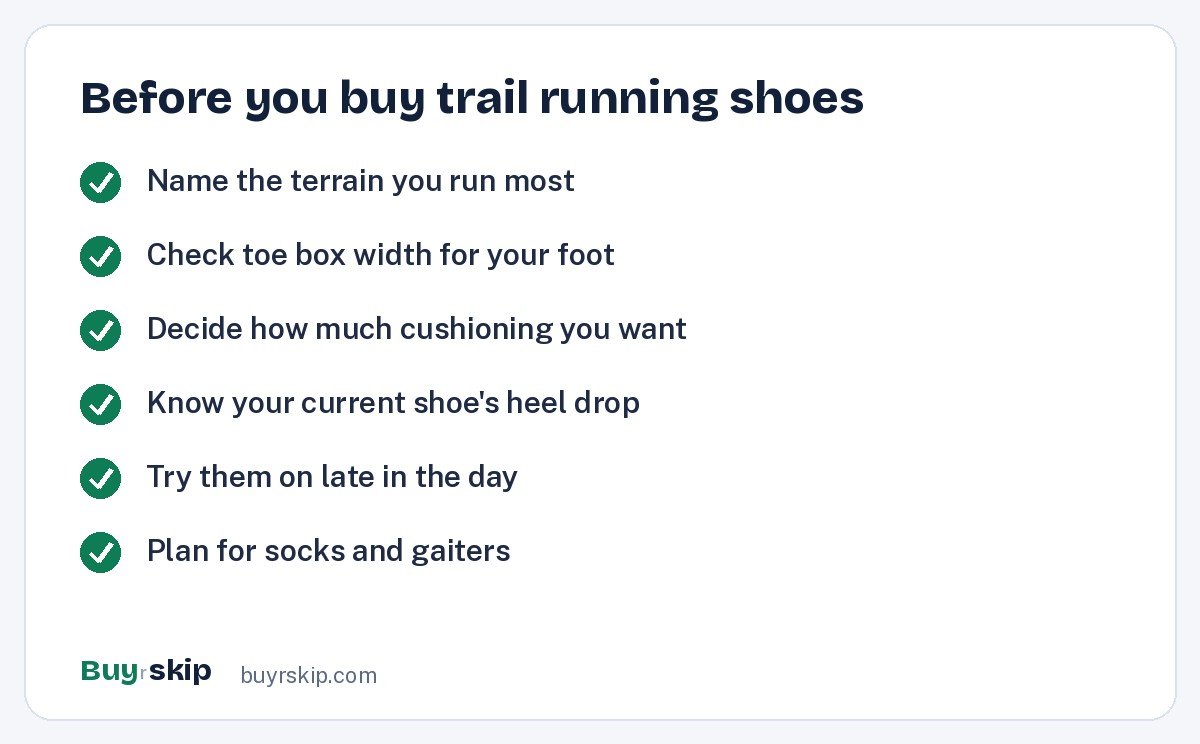
Terrain is the most important decision. For mud and soft ground, choose deep lugs like the Salomon Speedcross 6. For rocky, technical trails, choose a stable, protective shoe like the Brooks Cascadia 18. For mixed trails and long distances, the cushioned HOKA Speedgoat 6 is the best all-rounder. If you run a mix of trail and road, avoid the deepest lugs, which feel awkward on pavement.
Cushioning vs ground feel
More cushioning protects your legs on long runs and descents, which is why the Speedgoat is popular for ultras. Less cushioning gives better ground feel and precision on technical terrain. Neither is better for everyone. If you run long, choose cushioning. If you run short, technical routes and like to feel the ground, choose a firmer, lower shoe.
Fit and toe box
Trail running involves a lot of downhill running, where your foot slides forward. A shoe that is too tight or narrow can cause black toenails and blisters. Leave about a thumb’s width between your longest toe and the end of the shoe. If your feet are wide, start with the Altra Lone Peak 9, which has the roomiest toe box of this group. If you have narrow feet, the Speedgoat may fit well.
Heel drop
Heel drop is the height difference between the heel and the forefoot. Most running shoes have a raised heel. The Altra Lone Peak is zero drop, which feels more natural to some runners but loads the calves and Achilles more. If you switch to zero drop, transition gradually.
Waterproof or breathable?
Some trail shoes come in waterproof versions with a membrane, and they can help on cold, wet runs through dew or shallow puddles. The downside is that waterproof shoes run warmer and, once water gets in over the top, they dry slowly. Many trail runners prefer breathable mesh shoes that drain and dry quickly, paired with good socks. If you run mostly in cold, wet weather, a waterproof version of the shoe you like may be worth checking; in warm or mixed conditions, breathable usually wins.
How to try them on
Feet swell during runs and over the day, so try shoes on in the afternoon or after a run, wearing the socks you actually run in. Walk down a slope or ramp if you can and check that your toes do not hit the front. Your heel should feel locked in without the laces cranked tight. If you are between sizes, the roomier option is often more comfortable on long downhills. Buying from a store with an easy return policy makes this less risky if you shop online.
Price and value
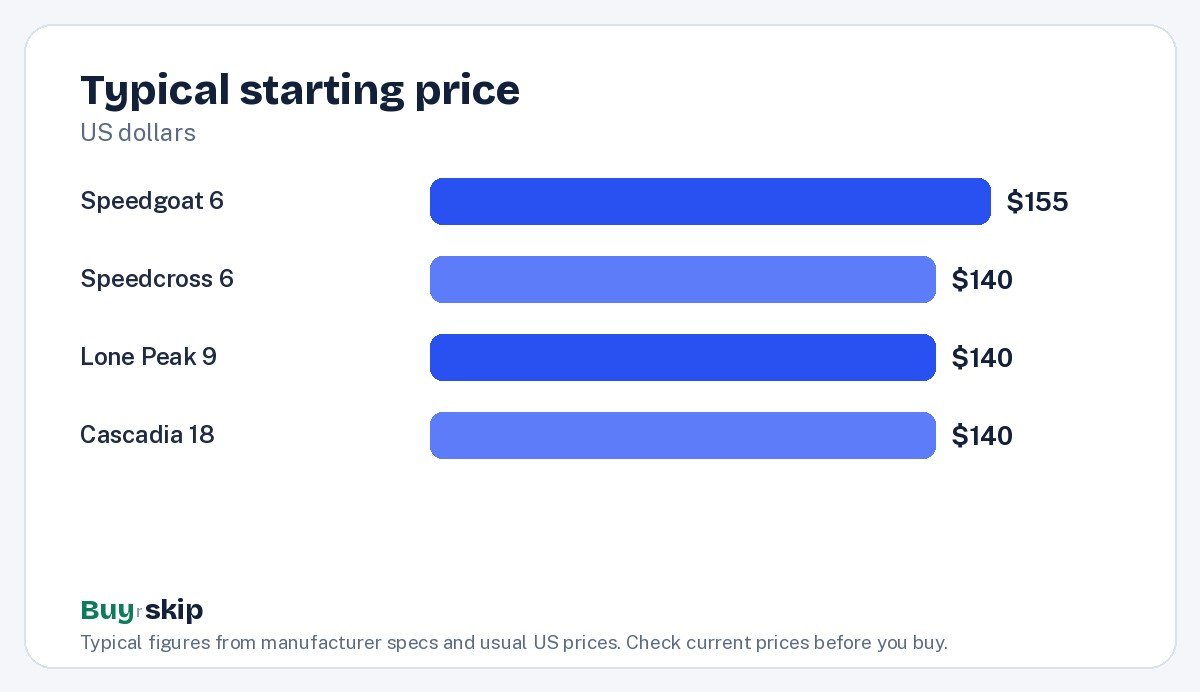
These four shoes sit in a narrow price band, from about $140 to $160 typically, so price should not drive your choice. Pick the shoe that matches your terrain and foot shape, then check the current price. Trail shoes wear out over time, especially on rough terrain, so replace them when the lugs are worn down or the cushioning feels flat.
Accessories that help
Good socks matter as much as the shoe; look for moisture-wicking trail running socks that do not bunch. On dusty or rocky trails, trail running gaiters keep pebbles and grit out of your shoes. For longer runs, carrying water helps. For gear for longer days on foot, see our hiking backpack picks.
Frequently asked questions
Can I use trail running shoes on the road?
You can, but they are not ideal. Trail shoes with deep lugs, like the Salomon Speedcross 6, feel firm and unstable on pavement and wear faster there. If you run a mix of road and trail, choose a shoe with moderate lugs and good cushioning, like the HOKA Speedgoat 6. For mostly road running, a dedicated road shoe is more comfortable; see our running shoe picks.
Are trail running shoes good for hiking?
Yes, many hikers prefer trail running shoes to heavy boots for day hikes and fast, light trips. The Altra Lone Peak 9 and Brooks Cascadia 18 both work well for hiking. They offer less ankle support and protection than boots, so if you carry heavy loads or hike rough terrain in bad weather, our hiking boot picks may suit you better.
What is zero drop, and is it right for me?
Zero drop means the heel and forefoot sit at the same height, as on the Altra Lone Peak 9. Some runners find it feels more natural and pairs well with a roomy toe box. Because it loads the calves and Achilles more, runners used to raised heels should transition gradually with shorter runs. If you do not want to change your stride, choose a traditional shoe like the HOKA Speedgoat 6.
Which trail running shoe is best for mud?
The Salomon Speedcross 6 is the best pick for mud and soft ground, thanks to its deep, aggressive lugs and secure quick-lace system. It grips where shallower treads slip. The trade-off is that it feels firm on rocks and hard ground. If your trails are mostly rocky or hardpacked, choose the HOKA Speedgoat 6 or Brooks Cascadia 18 instead.
How long do trail running shoes last?
It depends on your weight, stride and terrain, so there is no single number. Rough, rocky trails wear outsoles and uppers faster than smooth dirt paths. Replace your shoes when the lugs are visibly worn, the midsole feels flat or you start feeling new aches. The Brooks Cascadia 18 is known for durability if long life is a priority.
The bottom line
The HOKA Speedgoat 6 is the best trail running shoe for most runners, with cushioning for long runs and Vibram grip for varied terrain. Choose the Salomon Speedcross 6 if your trails are muddy, the Altra Lone Peak 9 if you have wide feet or want zero drop, and the Brooks Cascadia 18 for stability on rocks. Try them on with your running socks and check current prices before you buy.
Check price on Amazon: HOKA Speedgoat 6
Paid link. Typical price about $155–$160; check the current price on Amazon.