We research products independently from specs, manufacturer documentation, warranty terms and owner feedback. When you buy through links on this page, we may earn a commission at no extra cost to you. As an Amazon Associate we earn from qualifying purchases.
Quick answer
The best mirrorless camera for most people in 2026 is the Sony Alpha 7 IV, a full-frame hybrid that handles photos and video equally well with a huge lens selection. Beginners should start with the Canon EOS R50, travelers with the Fujifilm X-T5, and anyone wanting a compact all-rounder with the Sony Alpha 6700. For sports and wildlife the Canon EOS R6 Mark II and Nikon Z8 lead, and the Canon EOS R5 Mark II is the pro hybrid pick.
Choosing the best mirrorless camera is less about the single “top” model and more about matching a sensor size, a lens system and a budget to the photos you actually take. This guide gives you clear picks by budget and use, then explains how to choose: sensor size, lenses, autofocus and video. Our picks are based on manufacturer specifications, independent review consensus and owner-feedback patterns rather than our own shooting.
Prices are typical ranges, mostly for the body only, so budget extra for at least one lens. Always check the current price, because camera bodies and kits are discounted regularly.
The best mirrorless camera picks at a glance
| Camera | Typical price | Sensor | Best for | Lens mount |
|---|---|---|---|---|
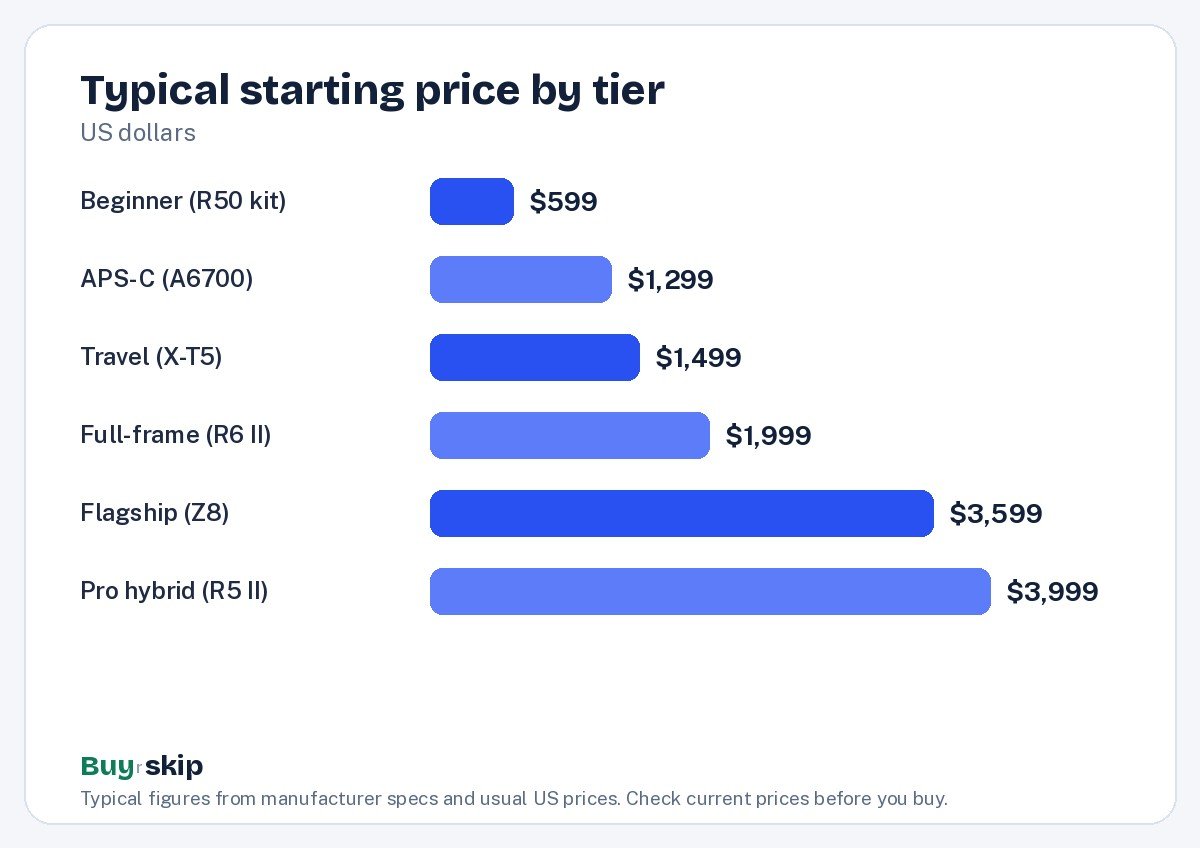
| Sony Alpha 7 IV | about $2,199–$2,499 (body) | Full-frame, 33 MP | Best all-round hybrid | Sony E |
| Canon EOS R50 | about $599–$799 (with kit lens) | APS-C, 24 MP | Beginners | Canon RF |
| Fujifilm X-T5 | about $1,499–$1,699 (body) | APS-C, 40 MP | Travel and street | Fujifilm X |
| Sony Alpha 6700 | about $1,299–$1,499 (body) | APS-C, 26 MP | Compact all-rounder | Sony E |
| Sony ZV-E10 II | about $899–$1,099 | APS-C | Vlogging | Sony E |
| Nikon Z6III | about $2,199–$2,499 (body) | Full-frame, 24 MP | Hybrid video and stills | Nikon Z |
| Panasonic Lumix S5IIX | about $1,999–$2,299 (body) | Full-frame | Video on a budget | L-Mount |
| Canon EOS R6 Mark II | about $1,999–$2,499 (body) | Full-frame, 24 MP | Sports, events, low light | Canon RF |
| Nikon Z8 | about $3,599–$3,999 (body) | Full-frame, 45 MP | Wildlife and sport flagship | Nikon Z |
| Canon EOS R5 Mark II | about $3,999–$4,499 (body) | Full-frame, 45 MP | Hybrid pros | Canon RF |
| Sony Alpha 7R V | about $3,599–$3,999 (body) | Full-frame, 61 MP | Landscape and studio | Sony E |
Best overall: Sony Alpha 7 IV
The Sony Alpha 7 IV remains the safest recommendation for someone who wants one camera to do everything well. The 33 MP full-frame sensor is a sweet spot: more detail than 24 MP cameras for cropping and prints, without the huge files of 45 to 61 MP bodies. It has in-body image stabilization (IBIS), reliable subject-detection autofocus, a fully articulating screen and 10-bit video including 4K 60 (with a crop at that frame rate).
Its biggest strength is the Sony E-mount: the widest choice of lenses from Sony and third parties such as Sigma and Tamron, at every price point. That makes the system cheaper to grow into.
Best overall Our verdict: Buy
Sony Alpha 7 IV
Typical price: $2,199–$2,499 (body)
Enthusiasts who want one full-frame body for photos and video with the widest lens choice
- Pros
- ✓ 33 MP full-frame sensor with IBIS
- ✓ Strong subject-detection autofocus
- ✓ Huge native and third-party lens selection
- Cons
- ✕ 4K 60 uses a crop
- ✕ Newer bodies have faster readout
Check price on Amazon Paid link
Best for beginners: Canon EOS R50
The Canon EOS R50 is the easiest way into mirrorless photography. It is small and light, comes with a kit lens for about $599–$799, and has a guided menu that explains settings as you go. Autofocus with subject detection makes sharp photos of kids and pets far easier than with a phone in tricky light, and it shoots good 4K video.
The trade-offs are what you would expect at this price: no IBIS, a small battery and a modest native RF-S lens range, though it can use Canon’s full-frame RF lenses as you grow.
Best for beginners Our verdict: Buy
Canon EOS R50
Typical price: $599–$799 (with kit lens)
First-time camera buyers who want better photos than a phone in a small, friendly body
- Pros
- ✓ Low price with kit lens
- ✓ Guided interface for learning
- ✓ Subject-detection autofocus
- Cons
- ✕ No in-body stabilization
- ✕ Limited small-sensor lens lineup
Check price on Amazon Paid link
Best for travel: Fujifilm X-T5
Travelers want quality without bulk, and the Fujifilm X-T5 delivers. Its 40 MP APS-C sensor has plenty of detail for cropping and large prints, IBIS steadies slow shutter speeds, and the classic dials for shutter speed, ISO and exposure compensation make it a pleasure to shoot without menu-diving. Fujifilm’s film simulations give attractive JPEGs straight out of the camera, which saves editing time on a trip.
It is a stills-first camera. Video is capable, but the hybrid picks below are stronger for serious filmmaking.
Best for travel Our verdict: Buy
Fujifilm X-T5
Typical price: $1,499–$1,699 (body)
Travel, street and everyday photographers who want high resolution in a compact body with physical dials
- Pros
- ✓ 40 MP APS-C sensor in a small body
- ✓ Tactile dials and film simulations
- ✓ In-body stabilization
- Cons
- ✕ Autofocus trails Sony and Canon for fast action
- ✕ Tilting rather than fully articulating screen
Check price on Amazon Paid link
Best APS-C all-rounder: Sony Alpha 6700
The Sony Alpha 6700 packs much of the full-frame Sony experience into a smaller, cheaper body: 26 MP APS-C, IBIS, AI-based subject detection and strong 4K video. It shares the E-mount with the A7 IV, so lenses carry over if you upgrade later. For many people it is the sweet spot between a beginner camera and a full-frame system.
Best APS-C Our verdict: Buy
Sony Alpha 6700
Typical price: $1,299–$1,499 (body)
Hobbyists who want strong autofocus, IBIS and good video in a compact body at a mid-range price
- Pros
- ✓ AI subject detection
- ✓ IBIS in a small body
- ✓ Shares lenses with Sony full-frame
- Cons
- ✕ Small battery for heavy video use
- ✕ Rangefinder-style viewfinder is small
Check price on Amazon Paid link
For vloggers: Sony ZV-E10 II
If you mostly film yourself, the Sony ZV-E10 II is designed for it: a flip-out screen, good built-in microphone options and vlog-focused features. It skips the viewfinder and IBIS, so it is a worse stills camera than the A6700, but a better fit for talking-head video at its price.
Best for hybrid video: Nikon Z6III
The Nikon Z6III is the hybrid pick for people who care as much about video as stills. Its partially stacked 24 MP full-frame sensor reads out faster than conventional sensors, which reduces rolling-shutter wobble in video and with the electronic shutter. Nikon also gave it a very bright, high-quality electronic viewfinder and advanced video options including internal raw recording.
Best hybrid video Our verdict: Buy
Nikon Z6III
Typical price: $2,199–$2,499 (body)
Shooters who split time between video and stills and want fast readout and a superb viewfinder
- Pros
- ✓ Partially stacked sensor for faster readout
- ✓ Excellent electronic viewfinder
- ✓ Advanced internal video options
- Cons
- ✕ 24 MP is modest for heavy cropping
- ✕ Nikon Z third-party lenses are fewer than Sony E
Check price on Amazon Paid link
Video on a budget: Panasonic Lumix S5IIX
The Panasonic Lumix S5IIX is the value pick for video-first creators. It is full-frame, uses phase-detect autofocus, and adds pro video features such as recording to an external SSD. It uses the L-Mount, shared by Panasonic, Leica and Sigma. Stills autofocus for fast action is not its strength.
Best for sports and wildlife: Canon EOS R6 Mark II and Nikon Z8
Fast action demands quick, sticky autofocus, high burst rates and good high-ISO performance.
The Canon EOS R6 Mark II is the more affordable choice. Its 24 MP full-frame sensor is strong in low light, which helps at indoor sports and evening events, and its subject tracking is a review-consensus favorite. Canon’s RF telephoto lenses cover everything from affordable zooms to professional primes.
Best for sports and events Our verdict: Buy
Canon EOS R6 Mark II
Typical price: $1,999–$2,499 (body)
Sports, events and low-light shooters who want fast autofocus without flagship prices
- Pros
- ✓ Fast, reliable subject tracking
- ✓ Excellent low-light performance
- ✓ Strong RF lens lineup
- Cons
- ✕ 24 MP limits deep crops for wildlife
- ✕ Long telephoto lenses add up quickly
Check price on Amazon Paid link
The Nikon Z8 is the flagship-level option. It has a 45 MP stacked sensor, so it pairs high resolution with very fast readout, and it relies entirely on an electronic shutter. For birds and wildlife, the extra resolution lets you crop distant subjects. It is heavier and pricier, but it is a pro tool in a body smaller than Nikon’s biggest flagship.
Best for wildlife Our verdict: Buy
Nikon Z8
Typical price: $3,599–$3,999 (body)
Serious wildlife and sports photographers who want flagship speed and 45 MP for cropping
- Pros
- ✓ 45 MP stacked sensor
- ✓ Pro-grade autofocus and speed
- ✓ Room to crop distant subjects
- Cons
- ✕ Expensive and fairly heavy
- ✕ Fast cards and long lenses add cost
Check price on Amazon Paid link
Best for professionals: Canon EOS R5 Mark II and Sony Alpha 7R V
The Canon EOS R5 Mark II is the pick for working hybrid professionals. Its 45 MP sensor serves weddings, commercial and editorial work, and it adds 8K video and advanced autofocus control, so one body covers both deliverables.
Best for pros Our verdict: Buy
Canon EOS R5 Mark II
Typical price: $3,999–$4,499 (body)
Professional hybrid shooters who need high-resolution stills and top-tier video in one body
- Pros
- ✓ 45 MP stills with fast performance
- ✓ 8K video and pro video features
- ✓ Advanced autofocus
- Cons
- ✕ Expensive
- ✕ Large files need fast storage and a capable computer
Check price on Amazon Paid link
For landscape, architecture and studio work, the Sony Alpha 7R V has a 61 MP sensor and AI-based subject detection. Its strength is detail, not speed, so choose it for deliberate shooting rather than action.
How to choose a mirrorless camera
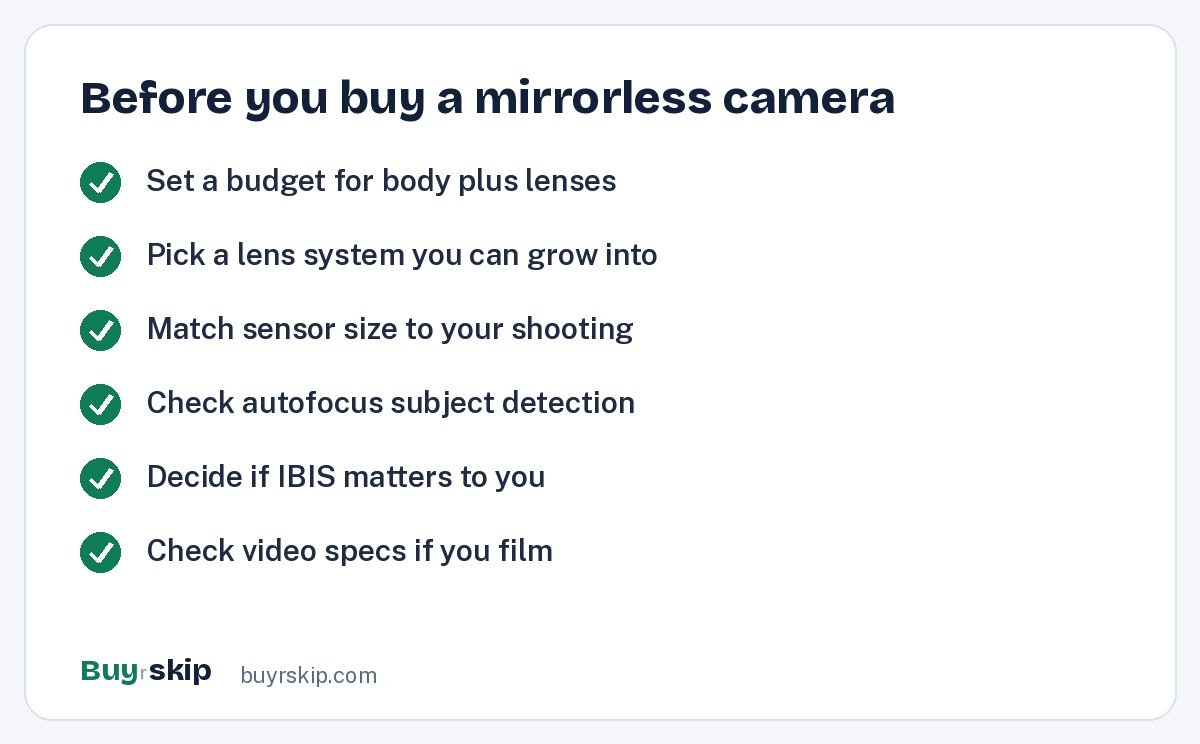
Sensor size: full-frame vs APS-C vs Micro Four Thirds
- Full-frame sensors are the largest common size. They generally give the best low-light performance and the most background blur, but bodies and lenses are bigger and more expensive.
- APS-C sensors are smaller and give a “crop” that makes telephoto lenses act longer, handy for wildlife on a budget. Cameras and lenses are smaller and cheaper. Image quality is excellent for nearly everyone.
- Micro Four Thirds (Panasonic and OM System) is smaller still, with very compact lenses and strong stabilization, at the cost of some low-light performance and background blur.
Rule: if you shoot indoor events, low light or want maximum background blur, go full-frame. For travel, family and learning, APS-C is the smarter spend.
Lenses: you are buying a system
The body is the part you replace every few years; good lenses last much longer. Choose the mount with the lenses you will want:
- Sony E: the widest choice, including many third-party options.
- Canon RF: excellent native lenses; third-party choice has been growing but is more limited, especially for full-frame.
- Nikon Z: strong native optics, growing third-party support.
- Fujifilm X: a deep APS-C lineup designed only for that sensor size.
Plan to spend roughly as much on lenses as on the body over time. A sharp prime lens is often a bigger upgrade than a newer body. To see what is available for your mount, try Sony E-mount prime lenses or Canon RF lenses.
Autofocus
Modern subject detection recognizes eyes, faces, animals, birds and vehicles. Cameras with AI-based systems (Sony’s newer bodies, Canon’s R series, Nikon’s Z line) track moving subjects much better than older models. If you shoot kids, pets or sport, prioritize autofocus over megapixels.
Video
Look for 4K at 60 frames per second, 10-bit recording for more color-grading room, the crop at each frame rate, and whether the camera is known to overheat in long takes. A flip-out screen helps for vlogging, and a headphone jack and mic input matter for serious audio. If you plan to watch your footage on a big screen, our TV buying guide explains what makes 4K HDR look its best, and our best 85-inch TV picks cover screens big enough to show it off.
Stabilization, viewfinder, battery and sealing
- IBIS helps with slow shutter speeds and handheld video. The R50 and ZV-E10 II skip it.
- Electronic viewfinder (EVF): higher resolution and refresh rates make tracking action easier.
- Battery life: mirrorless cameras use power quickly, so budget for a spare battery. On long trips or during outages, a portable power station from our home backup battery guide can recharge batteries and laptops.
- Weather sealing: valuable for outdoor and travel shooters, but no camera is waterproof.
Mistakes to avoid
- Spending everything on the body. A mid-range body with a great lens beats a flagship with a weak kit zoom.
- Choosing a system for one camera. Look at the lenses you will want in two years.
- Buying megapixels you do not need. More resolution means bigger files, more storage and a faster computer.
- Ignoring size and weight. The best camera is the one you take with you.
- Forgetting memory cards and spares. Fast cards and a second battery are essential, not extras. Browse fast V90 SD cards if you shoot high-bitrate video.
Frequently asked questions
Is full-frame worth it for a beginner?
Usually not at first. APS-C cameras like the Canon EOS R50 or Sony Alpha 6700 produce excellent images, cost less, and use smaller, cheaper lenses. Full-frame pays off mainly in low light, for very shallow depth of field and for professional work. Many beginners do better putting the savings into a good lens, and Sony and Canon both let you move up to full-frame later while keeping some lenses.
Should I buy a kit lens?
For a first camera, yes. A kit zoom like the one bundled with the Canon EOS R50 covers wide to short telephoto and lets you learn what focal lengths you use. Once you know, add a fast prime for portraits and low light, or a telephoto zoom for sport and wildlife. Experienced shooters buying bodies like the Sony Alpha 7 IV often skip the kit and choose better lenses directly.
Which camera brand has the best lenses?
Each major system has excellent glass. Sony E-mount has the widest selection, especially from third-party makers, which helps on a budget. Canon RF and Nikon Z have outstanding native lenses, with third-party support still growing. Fujifilm X has a strong lineup made specifically for APS-C. Check the lenses you want and their prices before choosing a body, because the system matters longer than any single camera.
Is a mirrorless camera better than a smartphone?
For many situations, yes: larger sensors handle low light better, interchangeable lenses give real telephoto reach and natural background blur, and dedicated autofocus tracks moving subjects far more reliably. Phones are better at convenience and instant sharing. If you mostly post casual photos online, your phone may be enough. If you want sharper sports shots, better portraits or more creative control, a mirrorless camera is a clear step up.
Do I need in-body image stabilization?
It is very helpful but not essential. IBIS lets you use slower shutter speeds handheld and smooths walking video, and it works with every lens you mount. Without it, many lenses include optical stabilization, and fast shutter speeds or a tripod solve the problem in other ways. If you shoot handheld video or in low light often, prioritize a body with IBIS, such as the Sony Alpha 6700 or Fujifilm X-T5.
How much should I budget for a mirrorless camera?
Plan on about $599–$799 for a beginner kit like the Canon EOS R50, about $1,299–$1,699 for a strong APS-C body, and about $2,000–$2,500 for a full-frame hybrid body. Flagships run about $3,600 and up. Add a lens, a spare battery, memory cards and a bag. Over time, expect lenses to cost about as much as the body, so a smaller body budget often gets you better results.
The bottom line
For most people, the Sony Alpha 7 IV is the camera to buy: full-frame quality, strong video and the deepest lens system. On a smaller budget, the Canon EOS R50 is the friendliest first step, and the Sony Alpha 6700 and Fujifilm X-T5 are the APS-C cameras to grow with.
Specialists should look at the Nikon Z6III for hybrid video, the Canon EOS R6 Mark II or Nikon Z8 for action, and the Canon EOS R5 Mark II for professional hybrid work. Check current prices and remember to budget for lenses before you buy.
Check price on Amazon: Sony Alpha 7 IV
Paid link. Typical price $2,199–$2,499 (body); check the current price on Amazon.