We research products independently from specs, manufacturer documentation, warranty terms and owner feedback. When you buy through links on this page, we may earn a commission at no extra cost to you. As an Amazon Associate we earn from qualifying purchases.
Quick answer
Use this TV buying guide in three steps. First, pick the size from your seating distance (65 inches suits most living rooms). Second, pick the panel from your room: OLED for dim rooms, bright Mini-LED for sunny ones. Third, set a budget and check gaming ports if you play. For most people, a 65-inch Mini-LED like the Hisense U8 is the best value, and a 65-inch LG C5 OLED is the best picture. Take the quiz below for your personal match.
Buying a TV is easier than the spec sheets make it look. Only a handful of choices really change what you see on screen, and most of the rest is marketing. This TV buying guide walks through the decisions in the order that matters, flags the specs you can ignore, and ends with a “What TV should I buy?” quiz you can answer in a minute. Our recommendations are based on manufacturer specs, independent review consensus and owner-feedback patterns, not our own testing.
Step 1: Pick the right size
Size is the decision people most often regret, and almost always in the same direction: they wish they had gone bigger. A simple rule is to measure from your main seat to where the screen will go, then use this table.
| Seating distance | Good size range | Notes |
|---|---|---|
| Under 5 feet | 42 to 50 inches | Bedrooms, small apartments, desks |
| 5 to 7 feet | 50 to 65 inches | Most bedrooms and small living rooms |
| 7 to 9 feet | 65 to 77 inches | Typical living room |
| 9 to 11 feet | 75 to 85 inches | Large living rooms, basements |
| 11 feet and up | 85 to 100 inches | Home theaters, open-plan rooms |
If you are between sizes, go with the larger one. Also check the width of your stand (many TVs have feet near the edges), your wall mount’s weight rating, and whether the box fits through your doors. If you are considering 85 inches or more, our best 85-inch TV guide covers big-screen picks and the 98- to 116-inch options in detail.
Step 2: Pick the panel type for your room
This is the choice that most affects picture quality. There are three main types you will see in 2026.
OLED
Each pixel makes its own light and can switch off completely, so blacks are perfect and there is no glow around bright objects. Viewing angles are wide, which helps when people sit off to the side. OLEDs are at their best in dim or dark rooms. Newer models are brighter than they used to be, but the brightest Mini-LEDs still beat them in direct sun. Common sizes run up to 83 inches, with a 97-inch class at a very high price.
Mini-LED (often sold as QLED, Neo QLED or QD-Mini LED)
These are LCD TVs with thousands of tiny LEDs behind the screen, grouped into dimming zones. They get very bright, which makes HDR pop and keeps the picture vivid in sunny rooms. Contrast is very good but not perfect: you may see slight blooming around bright objects on a black background. Mini-LED dominates sizes of 85 inches and up and offers the most picture for the money.
Basic LED and QLED
Entry-level LCD TVs without Mini-LED dimming. They are fine for casual viewing, kitchens and kids’ rooms, but they have weaker contrast and HDR. If your budget allows, a value Mini-LED is a large step up for not much more.
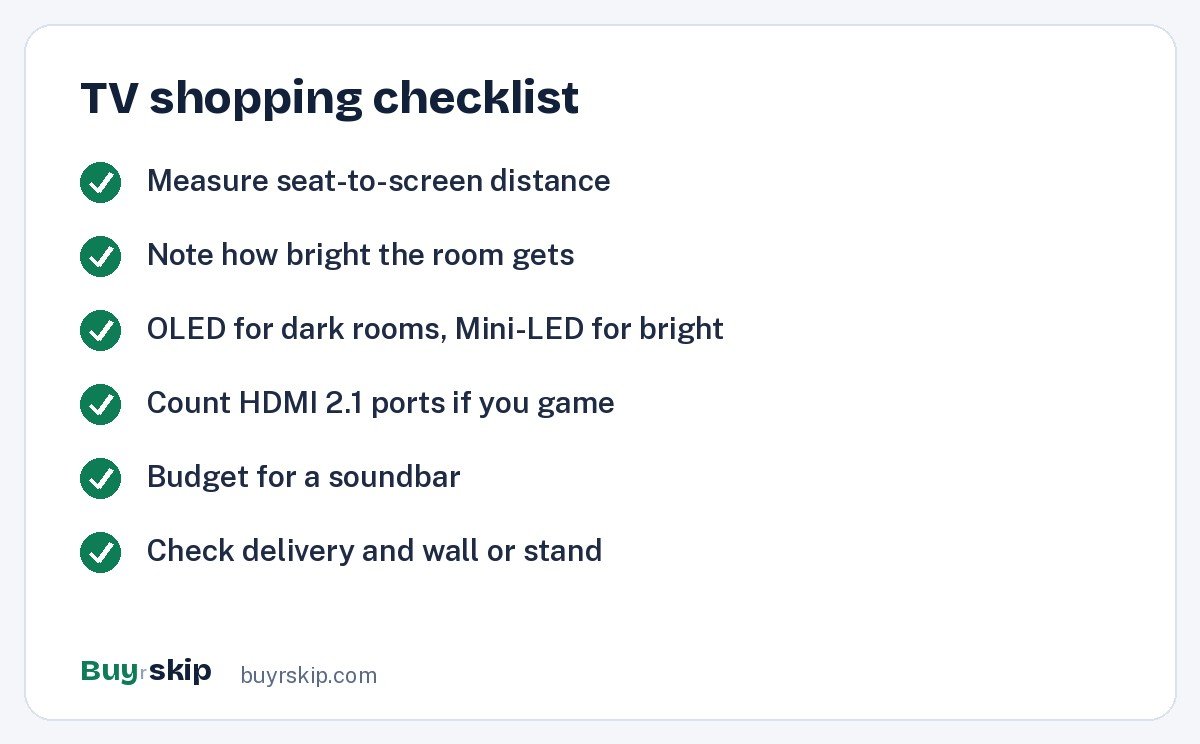
Decision rule: dark room or mostly evening viewing, buy OLED. Bright room, daytime sports or a big screen on a budget, buy Mini-LED. Secondary room or tight budget, a basic model is fine.
Step 3: The specs that actually matter
Brightness and HDR
Brightness, measured in nits, is the spec that best predicts how good a TV looks in a bright room and how much impact HDR content has. Manufacturers do not always publish it, so rely on independent review consensus. HDR formats matter too: Dolby Vision is widely used by streaming services, and HDR10+ is Samsung’s preferred format. Samsung TVs skip Dolby Vision, while most other brands support it.
Local dimming and contrast
For LCD TVs, the number and control of dimming zones decides how deep blacks look. You cannot judge this from zone counts alone, since processing matters as much as hardware. This is where review consensus is more useful than specs.
Refresh rate and gaming
Look for a native 120 Hz panel (some now go to 144 Hz), HDMI 2.1 ports, VRR (variable refresh rate) and ALLM (auto low latency mode). These make PS5, Xbox Series X and PC gaming smoother. Count the HDMI 2.1 ports: some TVs have only two, which matters if you also use a soundbar on eARC.
Processing
Processing handles upscaling of lower-quality sources, motion smoothness and color. It matters more as screens get bigger. Sony, LG and Samsung are known for strong processing, and Hisense and TCL have closed much of the gap in recent years.
Smart platform
Every TV here is a smart TV. The platform (Google TV, webOS, Tizen, Fire TV or Roku) mostly affects menus and app layout, not picture. If you dislike the built-in system, a 4K streaming stick fixes it cheaply.
Sound
Thin TVs have small speakers. If dialogue clarity matters, plan for a soundbar with a dedicated center channel. For quiet late-night viewing, wireless headphones are another option; our noise cancelling headphones buying guide explains what to look for.
Specs you can mostly ignore
- “Motion rate” numbers that are double the native refresh rate.
- Contrast ratios listed as huge or “infinite” by marketing.
- 8K resolution. There is little 8K content, and 4K looks excellent at normal distances.
- AI picture modes. Fine to try, but they will not turn a weak panel into a great one.
Step 4: Set your budget
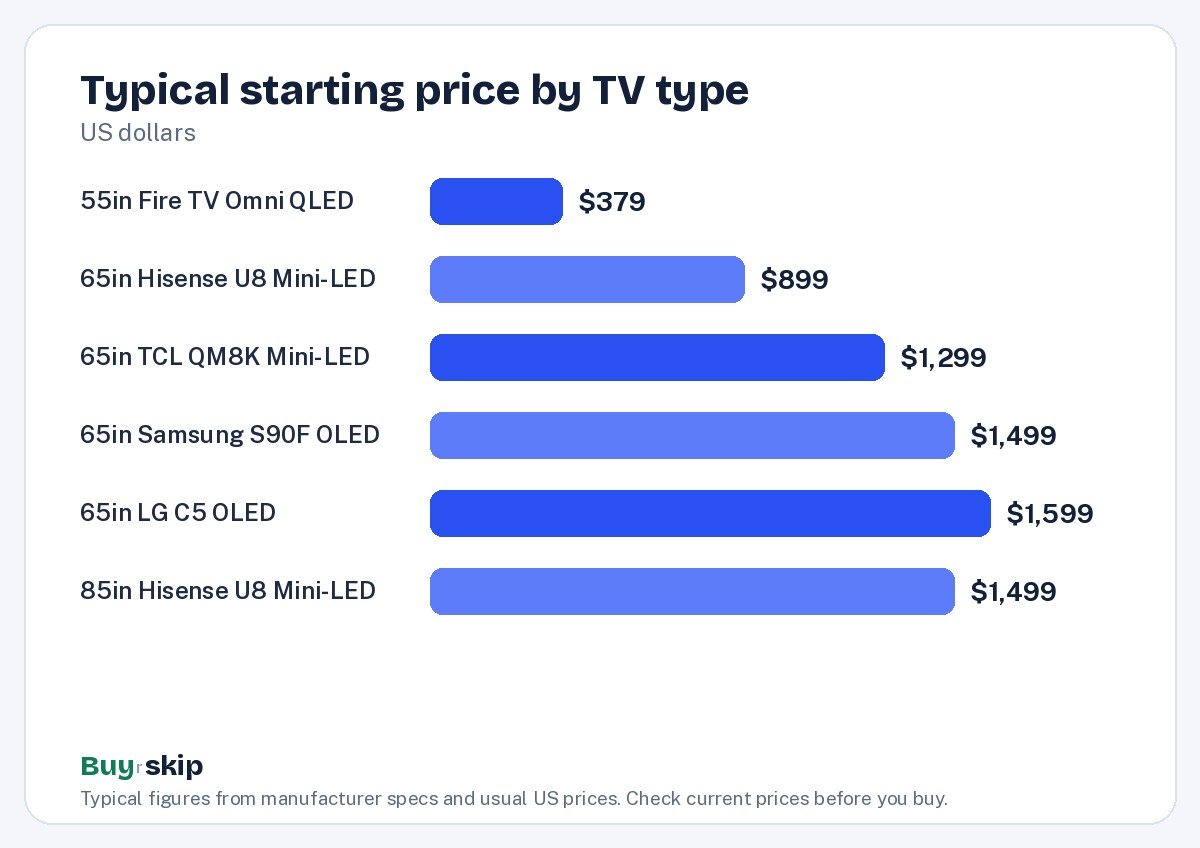
The chart shows the low end of each typical price range. Prices on TVs move often, especially around major shopping events, so always check the current price. A few budget rules:
- Under about $600: a basic QLED at 55 inches or a smaller value model. Fine for secondary rooms.
- About $900 to $1,400: the value sweet spot. A 65-inch Mini-LED like the Hisense U8 delivers most of the picture of far pricier sets.
- About $1,500 to $2,500: 65-inch OLED territory, or a bigger Mini-LED.
- Above that: 77- to 85-inch premium sets and 98- to 100-inch giants.
Leave room for a soundbar, a wall mount if needed, and a surge protector. If your area has frequent outages, our guide to the best battery backup for a home power outage covers keeping electronics running.
TV buying guide picks by situation
Best value Our verdict: Buy
Hisense 65-Inch Class U8 Series Mini-LED (65U8QG)
Typical price: $899–$1,399
Most living rooms where you want bright, punchy HDR and gaming features without paying flagship prices.
- Pros
- ✓ Bright Mini-LED with strong HDR for the money
- ✓ Gaming features including high refresh rate and VRR
- ✓ Works well in mixed lighting
- Cons
- ✕ Viewing angles narrower than OLED
- ✕ Some blooming on dark scenes
Check price on Amazon Paid link
The Hisense 65-inch U8 is the pick for most buyers. It gives you the brightness and contrast that make modern HDR worth watching at a price that leaves room for a soundbar.
Best picture Our verdict: Buy
LG 65-Inch Class OLED evo C5 Series
Typical price: $1,599–$2,499
Movie fans and gamers who watch mostly in dim or dark rooms.
- Pros
- ✓ Perfect blacks and per-pixel contrast
- ✓ Wide viewing angles
- ✓ Excellent gaming support
- Cons
- ✕ Not as bright as top Mini-LEDs in sunny rooms
- ✕ Costs more than value Mini-LED at the same size
Check price on Amazon Paid link
The LG C5 is the best all-round picture for most people with the budget for OLED. It is also a long-standing favorite for console gaming.
Bright OLED Our verdict: Buy
Samsung 65-Inch Class OLED S90F
Typical price: $1,499–$2,299
People who want OLED contrast but watch in a room with some daylight.
- Pros
- ✓ OLED contrast with good brightness
- ✓ Polished smart platform
- ✓ Strong gaming features
- Cons
- ✕ No Dolby Vision
- ✕ Pricing varies a lot by season
Check price on Amazon Paid link
The Samsung S90F is the alternative to the LG if you want a slightly brighter OLED look or prefer Samsung’s ecosystem.
Best for bright rooms Our verdict: Buy
TCL 65-Inch QM8K QD-Mini LED
Typical price: $1,299–$1,999
Sunny living rooms, daytime sports and open-plan spaces.
- Pros
- ✓ Very high brightness
- ✓ Strong HDR highlights
- ✓ Gaming-ready
- Cons
- ✕ Dark-room blacks trail OLED
- ✕ Costs more than the Hisense U8
Check price on Amazon Paid link
The TCL 65-inch QM8K is for rooms where the sun is the enemy. Its brightness keeps the picture vivid when other TVs look washed out.
Budget pick Our verdict: Consider
Amazon Fire TV 55-inch Omni QLED Series
Typical price: $379–$549
Bedrooms, kitchens and Alexa homes on a tight budget.
- Pros
- ✓ Low price
- ✓ Built-in Alexa and Fire TV apps
- ✓ Fine for casual viewing
- Cons
- ✕ Weaker contrast and HDR than Mini-LED
- ✕ Not a gaming TV
Check price on Amazon Paid link
The Fire TV Omni QLED makes sense as a secondary TV, especially if you already use Alexa. For a main living-room set, a value Mini-LED is a better use of money.
Skip it Our verdict: Skip
Samsung 65-Inch Class The Frame
Typical price: $1,299–$1,999
Only for buyers who mainly want the art-display look on the wall.
- Pros
- ✓ Looks like framed art when off
- ✓ Matte screen cuts reflections
- ✓ Slim wall-hugging design
- Cons
- ✕ Picture quality weaker for the money
- ✕ Pay a premium for design over performance
Check price on Amazon Paid link
Skip The Frame unless the art-display look is the main reason you are buying. For the same money, the Hisense U8 or TCL QM8K gives a noticeably better picture.
Common TV buying mistakes
- Going too small. Use the size table above, then lean bigger.
- Buying OLED for a very bright room or a basic LED for a dark home theater.
- Ignoring HDMI 2.1 ports when you own a current console.
- Relying on built-in speakers for a big screen.
- Paying extra for 8K or for “motion rate” numbers.
- Forgetting delivery and mounting, especially at 75 inches and up.
What TV should I buy? Take the quiz
This what TV should I buy quiz takes about a minute. Write down your letter for each question, then read the results below.
1. How far from the screen do you usually sit?
- A. Under 6 feet
- B. 6 to 9 feet
- C. More than 9 feet
2. How bright is the room in the daytime?
- A. Bright: big windows or lots of sun
- B. Mixed: some daylight, lamps at night
- C. Dim or dark most of the time
3. What do you watch most?
- A. Sports and daytime TV
- B. Movies and prestige series
- C. A bit of everything, casually
4. Do you play on a console or PC?
- A. Yes, a lot
- B. Sometimes
- C. Rarely or never
5. What is your budget?
- A. Under about $600
- B. About $900 to $1,500
- C. About $1,500 to $2,500
- D. More than that
6. Which matters more to you?
- A. Best possible picture
- B. Best value for the money
- C. Looks on the wall or simple smart features
Your result
Find the pattern that best matches your answers. If you fit two, read both.
Mostly A on question 2 (bright room) with A on question 3 (sports): your match is a bright Mini-LED. Buy the TCL 65-Inch QM8K QD-Mini LED. If you answered C on question 1, go up to the TCL 85-Inch QM8K for the same brightness on a bigger screen.
C on question 2 (dim room) with B on question 3 (movies) or A on question 6 (best picture): your match is OLED. Buy the LG 65-Inch Class OLED evo C5 Series. If your budget is D and you sit more than 9 feet away, look at the 83-inch C5 in our big-screen guide.
B on question 2 (mixed light) with C or D on question 5 and A on question 6: your match is a bright OLED. Buy the Samsung 65-Inch Class OLED S90F.
B on question 5 (mid budget) with B on question 6 (value): your match is the best-value Mini-LED. Buy the Hisense 65-Inch Class U8 Series (65U8QG). It suits nearly any room and handles casual gaming well.
A on question 4 (lots of gaming): prioritize HDMI 2.1, 120 Hz or higher and VRR. In a dim room, choose the LG C5 OLED. In a bright room, choose the TCL QM8K. On a mid budget, choose the Hisense U8.
C on question 1 (sitting far) with B or C on question 5: size beats everything else. Look at the Hisense 85-inch U8 or, to save more, the TCL 85-Inch QM7K.
A on question 5 (under about $600) with C on question 3 (casual): your match is the Amazon Fire TV 55-inch Omni QLED, especially in an Alexa home or secondary room.
C on question 6 (looks on the wall): The Frame will look the part, but we recommend the Hisense U8 on a slim wall mount instead, unless the art display is truly the priority.
Still unsure? The Hisense U8 is the safest all-round choice for most homes, and the LG C5 is the best picture if your room is dim.
Frequently asked questions
What size TV should I buy for my living room?
Measure from your main seat to the screen. At 7 to 9 feet, a 65- to 77-inch TV fits well; at 9 to 11 feet, 75 to 85 inches. Most people who regret a TV purchase wish they had gone bigger, so if you are between sizes, choose the larger one as long as it fits your wall or stand.
Is OLED worth it over Mini-LED?
OLED is worth it if you watch mostly in a dim or dark room and care about movies, since perfect blacks and wide viewing angles are its strengths. In bright rooms, a good Mini-LED like the TCL QM8K or Hisense U8 often looks better and costs less. Match the panel to your room first, then your budget.
Do I need a TV with HDMI 2.1?
Only if you game on a PS5, Xbox Series X or a gaming PC. HDMI 2.1 enables 4K at 120 Hz and VRR, which make games smoother. For streaming and cable, it makes no difference. If you game and use a soundbar, check how many HDMI 2.1 ports the TV has.
Is an 8K TV worth buying in 2026?
For most people, no. There is very little native 8K content, and at normal seating distances 4K already looks very sharp. Money spent on 8K is better spent on a brighter panel, an OLED, a larger 4K screen or a soundbar.
When is the best time to buy a TV?
Prices tend to drop around major shopping events and as new models arrive and older stock is cleared. That said, prices change often and vary by retailer. Pick the model that fits your room and budget, then watch its current price rather than waiting for a specific day.
Do I need a soundbar?
Not strictly, but most thin TVs have small speakers with limited bass and sometimes muddy dialogue. A soundbar, even an entry-level model, makes a clear difference, especially on large screens. Budget for one when you set your TV budget, and look for HDMI eARC so the TV remote controls its volume.
The bottom line
Start with size from your seating distance, choose OLED for dim rooms and bright Mini-LED for sunny ones, and only pay for gaming features if you game. For most homes, the Hisense 65-inch U8 is the best value and the LG 65-inch C5 is the best picture.
Skip The Frame unless the art look is the point, and skip 8K entirely. Whatever you pick, check the current price, measure your space and leave room in the budget for sound.
Check price on Amazon: Hisense 65-Inch Class U8 Series Mini-LED (65U8QG)
Paid link. Typical price $899–$1,399; check the current price on Amazon.