We research products independently from specs, manufacturer documentation, warranty terms and owner feedback. When you buy through links on this page, we may earn a commission at no extra cost to you. As an Amazon Associate we earn from qualifying purchases.
Quick answer
The VIOFO A229 Pro 2CH is the best dash cam for most drivers. It records 4K up front and 2K out the back with Sony STARVIS 2 sensors, has strong night video and uses a heat-tolerant supercapacitor. If you drive for Uber or Lyft, get the 3-channel Vantrue N4 Pro. If you want something small and simple for about $110–$130, the Garmin Dash Cam Mini 2 is the best budget pick.
The best dash cams quietly record every drive so you have clear footage if someone hits you, cuts you off or disputes what happened. The differences that matter are video quality at night, whether you get rear or cabin coverage, how the camera handles heat, and whether it has a real parking mode to watch your car while it is parked. This list covers the strongest options from VIOFO, Vantrue, Garmin and Nextbase. Our picks are based on specs, manufacturer documentation, warranty terms, independent review consensus and owner-feedback patterns.
Quick picks
| Product | Best for | Our verdict | Typical price |
|---|---|---|---|
| VIOFO A229 Pro 2CH Dash Cam | Best video front and rear | Buy | about $280–$350 |
| Vantrue N4 Pro 3-Channel Dash Cam | Rideshare and families | Buy | about $260–$330 |
| VIOFO A229 Pro Dash Cam | Full coverage | Buy | about $250–$350 |
| Garmin Dash Cam Mini 2 | Small and simple | Buy | about $110–$130 |
| Nextbase 622GW Dash Cam | Feature lovers | Consider | about $250–$330 |
Dash cam prices shift often and bundles vary, so check the current price and exactly what is included before you buy.
The best dash cams in 2026
Best overall Our verdict: Buy
VIOFO A229 Pro 2CH Dash Cam
Typical price: about $280–$350
Best video front and rear. Buy it if you want sharp front and rear video, strong night footage and proper parking mode.
- Pros
- ✓ 4K front with Sony STARVIS 2 sensor
- ✓ Strong night video owners praise
- ✓ Fast Wi-Fi downloads
- ✓ Supercapacitor handles summer heat
- Cons
- ✕ Parking mode needs a hardwire kit
- ✕ Larger than mini cams
Check price on Amazon Paid link
The VIOFO A229 Pro 2CH is the dash cam to buy if you want the clearest footage from both ends of your car. The front camera records in 4K with a Sony STARVIS 2 sensor, and the rear camera records in 2K. STARVIS 2 is Sony’s newer low-light sensor line, and owner feedback consistently praises this camera’s night video, which is when reading plates and details is hardest.
It also gets the practical details right. Wi-Fi downloads to your phone are fast, so pulling a clip after an incident does not take ages. It uses a supercapacitor instead of a lithium battery, which handles summer heat in a parked car far better and is a real advantage in hot states.
The trade-offs are size and setup. It is larger than mini cams, so it is less discreet. Parking mode needs a hardwire kit, which means tapping into your fuse box or paying an installer. Skip it if you want a tiny, set-and-forget camera; the Garmin Mini 2 is far simpler. For everyone else, it is the strongest all-round pick at about $280–$350.
Best for rideshare Our verdict: Buy
Vantrue N4 Pro 3-Channel Dash Cam
Typical price: about $260–$330
Rideshare and families. Buy it if you drive for Uber or Lyft or want to record the cabin as well as the road.
- Pros
- ✓ Records front, cabin and rear
- ✓ Infrared cabin camera for night
- ✓ Supercapacitor for heat
- Cons
- ✕ Many cables to route
- ✕ App is basic
Check price on Amazon Paid link
The Vantrue N4 Pro records three views at once: the road ahead in 4K, the cabin and the rear. That cabin camera is what sets it apart. If you drive for Uber or Lyft, footage of the interior can protect you in disputes with passengers. Families may also like having a view of the back seats.
The cabin camera uses infrared for night recording, so it can capture the interior clearly even when the car is dark. Like the VIOFO, it uses a supercapacitor for better heat tolerance, and it supports parking mode.
The trade-offs come with the extra coverage. Three cameras means many cables to route around the headliner and trim, which takes time to do neatly. Owners also describe the app as basic. At about $260–$330, it is good value for three channels, but skip it if you only need a front camera; a simpler cam costs less and is easier to install.
Also great Our verdict: Buy
VIOFO A229 Pro Dash Cam
Typical price: about $250–$350
Full coverage. Buy it if you want sharp front and rear recording with parking mode.
- Pros
- ✓ Excellent video
- ✓ Front and rear
- ✓ Parking mode
- Cons
- ✕ Hardwiring recommended
Check price on Amazon Paid link
The VIOFO A229 Pro Dash Cam listing covers the same A229 Pro family as our top pick. It offers excellent video, front and rear recording, and parking mode, at about $250–$350.
The reason it appears separately is that A229 Pro listings vary. Depending on the seller and bundle, you may see different configurations and accessories, which explains the wider price range. Before you buy, check the listing carefully for the number of cameras included, whether a hardwire kit or memory card is in the box, and the exact model name. If the price is lower than the A229 Pro 2CH for the same front and rear setup, it is a good deal.
As with the 2CH, hardwiring is recommended to get the most from parking mode. Skip it if you want simple plug-and-play installation. If you do want the full coverage and do not mind a bit of wiring, it is a great choice. Buy from a seller that clearly lists the contents, and keep the box until you have confirmed both cameras work, so a return is easy if the bundle is not what you expected.
Best budget Our verdict: Buy
Garmin Dash Cam Mini 2
Typical price: about $110–$130
Small and simple. Buy it if you want a tiny, discreet front camera that hides behind the mirror.
- Pros
- ✓ Tiny and discreet
- ✓ Voice control
- ✓ Easy app
- Cons
- ✕ No screen
- ✕ 1080p only
- ✕ Front only
Check price on Amazon Paid link
The Garmin Dash Cam Mini 2 is about the size of a car key, small enough to hide behind your rearview mirror where it is nearly invisible from the driver’s seat. That makes it ideal for people who want a dash cam but not a gadget in their line of sight, and a smart pick for a second car, a teen driver’s car or a lease where you do not want to run wires.
It records 1080p video with a 140-degree field of view. Voice control lets you save a clip by saying a command, without taking your hands off the wheel, and Garmin’s app is easy to use. At about $110–$130, it is also the cheapest pick here.
The trade-offs are the flip side of its size. There is no screen, so you set it up and review footage through the app. Video is 1080p only, which captures less detail than 4K, especially for plates at a distance. And it is front only. Skip it if you want rear coverage or a screen on the camera; the VIOFO A229 Pro 2CH covers both ends.
Best for built-in features Our verdict: Consider
Nextbase 622GW Dash Cam
Typical price: about $250–$330
Feature lovers. Buy it if you want built-in features like Emergency SOS crash alerts and image stabilization.
- Pros
- ✓ Emergency SOS feature
- ✓ Image stabilization
- ✓ Rear camera add-on available
- Cons
- ✕ Expensive for its age
- ✕ Rear camera costs extra
- ✕ Battery instead of supercapacitor
Check price on Amazon Paid link
The Nextbase 622GW is a feature-packed 4K front camera. Its standout is Emergency SOS, a crash-response feature designed to help get assistance to you after a serious collision. It also supports what3words location sharing, Alexa built in, image stabilization and a 3-inch touchscreen. A rear camera add-on is available.
For drivers who value those extras, especially Emergency SOS for solo drives or older family members, it is worth a look. The touchscreen also makes settings easy to change without a phone, which some drivers prefer to digging through an app.
The problem is value. It is expensive for its age, at about $250–$330, and the rear camera costs extra. It uses a battery instead of a supercapacitor, which is less tolerant of high heat in a parked car. Newer VIOFO models give sharper night video for similar money. Consider it only if the built-in features matter to you; otherwise, the A229 Pro 2CH is the better buy.
How to choose dash cams
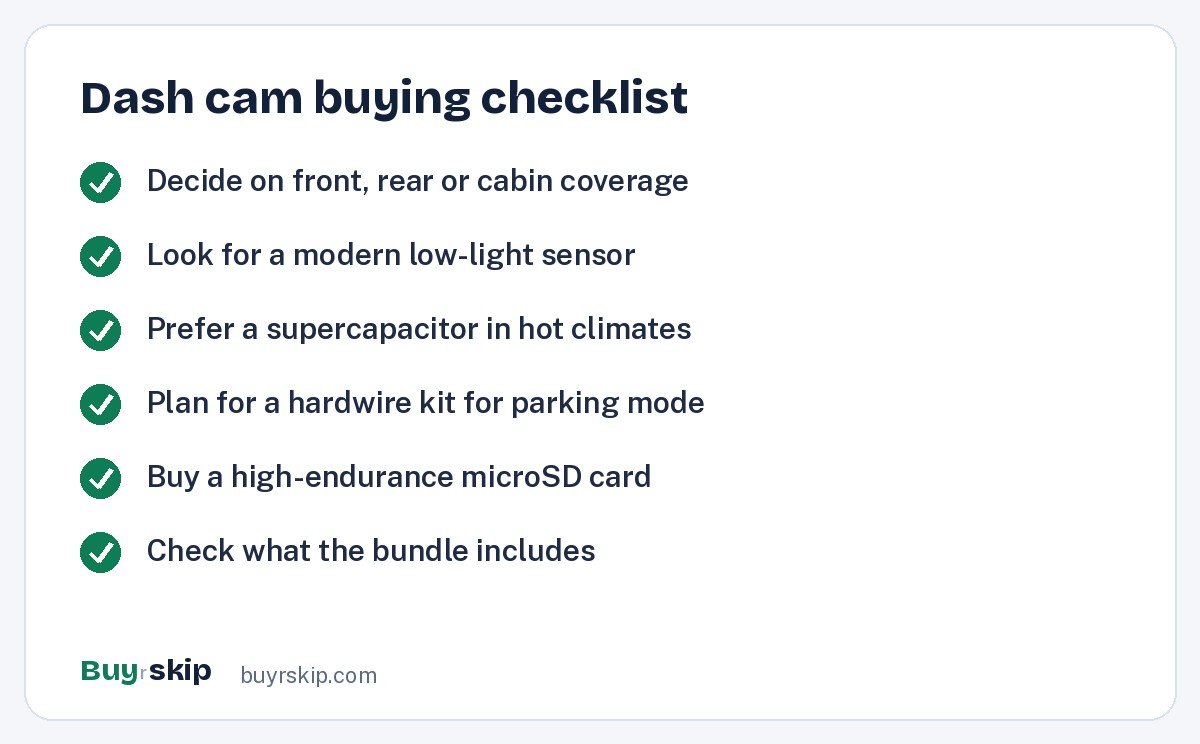
A dash cam is a set-it-and-forget-it purchase, so it pays to get the basics right the first time. These are the decisions that make the biggest difference to the footage you end up with.
Front only, front and rear, or three channels
A front camera covers most incidents, but rear impacts are common in traffic, so front and rear coverage is worth it for most drivers. If you only want the basics, the Garmin Mini 2 is fine. For full coverage, get the VIOFO A229 Pro 2CH. If you carry passengers for work, choose the Vantrue N4 Pro for its cabin camera.
Night video and resolution
Many incidents happen at night, when cheap cameras smear license plates into blur. Resolution matters, but the image sensor matters as much. 4K with a modern low-light sensor, like the STARVIS 2 sensor in the VIOFO A229 Pro, gives the best chance of readable detail. 1080p is fine for recording what happened but captures less detail at a distance. 4K also gives you more room to zoom into a saved clip and still pick out a plate number or street sign, which is exactly what you want from a camera whose whole job is producing clear evidence on the rare day you need it. Keep the windshield clean inside and out, too. Haze and smudges on the glass hurt night footage more than most people expect, especially when headlights from oncoming traffic flare across the frame. A quick wipe of the glass in front of the lens every few weeks is the cheapest image upgrade you can make.
Supercapacitor versus battery
Cars get extremely hot when parked in summer sun. A supercapacitor tolerates heat better than a lithium-ion battery and is generally considered more durable in that environment. The VIOFO and Vantrue use supercapacitors; the Nextbase 622GW uses a battery. If you live somewhere hot, favor a supercapacitor.
Parking mode and hardwiring
Parking mode records bumps and motion while your car is parked, which helps with hit-and-runs in parking lots. Most cameras need a hardwire kit to do this properly, because they need constant power without draining your battery. A dash cam hardwire kit connects to your fuse box and usually includes a low-voltage cutoff. If you are not comfortable wiring, a car audio shop can install it.
Screen, app and controls
Cameras without a screen, like the Garmin Mini 2, rely on a phone app for setup and review. Cameras with a screen, like the Nextbase 622GW, are easier to adjust in the car. Fast Wi-Fi transfer, a strength of the VIOFO, matters most when you need to save and share a clip quickly after an incident. Most dash cams also let you lock a clip with a button press or an impact sensor, so it is not overwritten by loop recording. Learn how your camera does this on day one, before you need it, and check that the time and date are set correctly so your footage is useful if you ever have to share it with an insurer or the police.
Installation effort
Be realistic about setup. A single front camera that plugs into your 12V socket takes minutes. A front and rear setup adds a long cable to run to the back window, which usually takes an hour or so if you tuck it neatly into the trim. A three-channel system like the Vantrue N4 Pro adds another camera and more routing; plan the path first, and keep wires away from passengers’ hands and feet. Many drivers find an afternoon is enough, or a car audio shop can handle it. Hardwiring for parking mode means working at your fuse box with an add-a-fuse adapter. None of it is difficult for a patient DIYer, but if the idea of pulling trim panels puts you off, either budget for professional installation or choose the plug-in Garmin Dash Cam Mini 2.
Memory cards and price
Dash cams write constantly, which wears out ordinary memory cards. A high-endurance microSD card is designed for this kind of continuous recording and is worth the small premium. Format the card occasionally and check that clips are saving correctly.
Here is how the typical starting prices compare:
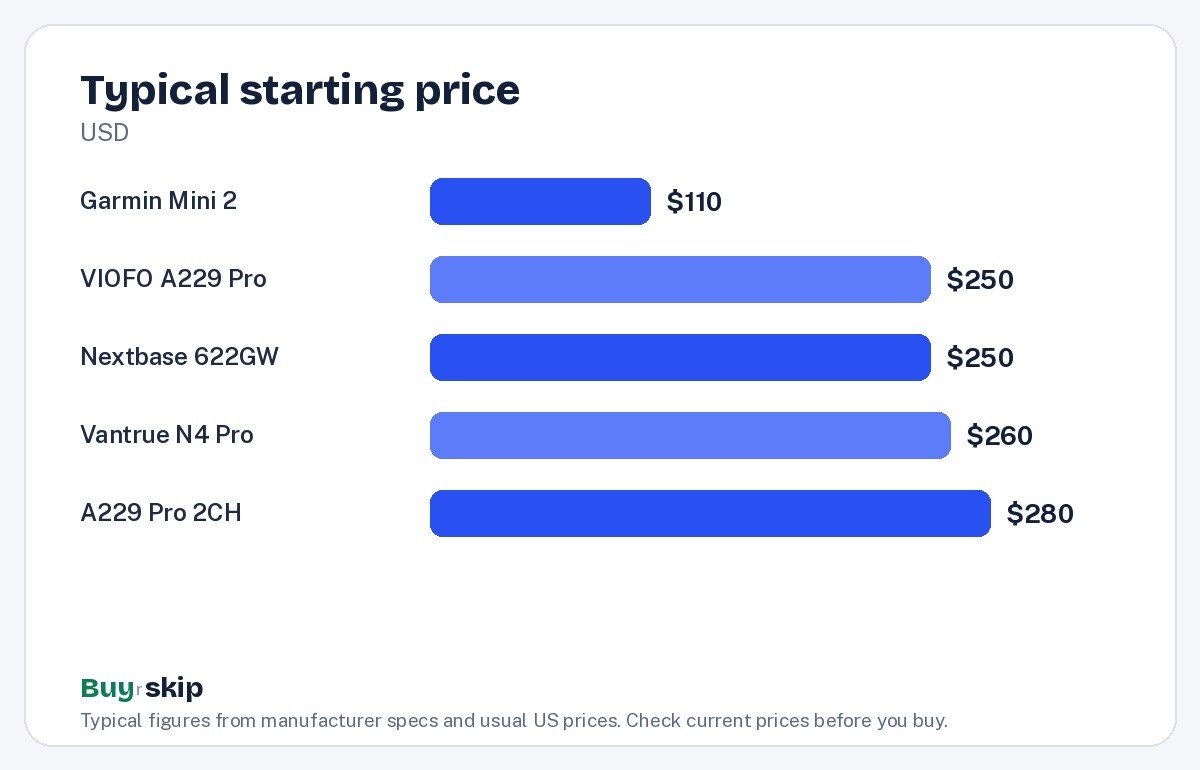
The Garmin is the clear budget choice, while the VIOFO, Vantrue and Nextbase cluster in a similar range. Within that range, the VIOFO offers the best video and the Vantrue the most coverage.
Frequently asked questions
Do I really need a rear dash cam?
For most drivers, yes. Rear-end collisions are a common type of crash, and a front-only camera will not show who hit you or how. A rear camera also captures tailgating and road rage incidents. If budget is tight, a front-only camera like the Garmin Dash Cam Mini 2 is still far better than nothing, but front and rear coverage is the better long-term choice.
Will a dash cam drain my car battery?
A dash cam plugged into a socket that turns off with the ignition will not drain your battery. Parking mode is different, because it needs constant power. Hardwire kits usually include a low-voltage cutoff that shuts the camera off before the battery drops too far. Set that cutoff correctly, and parking mode should not leave you with a dead battery.
Is 4K worth it in a dash cam?
4K helps you capture more detail, especially license plates on nearby cars, but the sensor matters just as much, particularly at night. A 4K camera with a good low-light sensor, like the VIOFO A229 Pro 2CH, is a meaningful step up. A well-made 1080p camera such as the Garmin Mini 2 still clearly records what happened, just with less fine detail.
Is a dash cam good for rideshare drivers?
Yes, and a 3-channel model is the best fit. The Vantrue N4 Pro records the road, the cabin and the rear, and its infrared cabin camera works at night. Interior footage can help if a passenger disputes what happened. Check your local rules about recording passengers, as some areas require you to inform riders that a camera is in use.
Where should I mount a dash cam?
Mount the front camera high on the windshield, usually behind the rearview mirror, so it sees the road clearly without blocking your view. Keep it within the area your wipers clear so rain does not ruin footage. Route the cable along the headliner and down the pillar trim for a tidy install, and avoid placing wires where an airbag deploys.
Can a dash cam lower my insurance?
Some drivers find dash cam footage helpful when an insurer is deciding who was at fault, because it shows exactly what happened instead of relying on two conflicting stories. Whether a dash cam directly lowers your premium depends on your insurer and state, so ask your provider. The bigger, more reliable benefit is having clear evidence ready if you ever need to file a claim.
The bottom line
The VIOFO A229 Pro 2CH is the best dash cam for most drivers, with sharp 4K front and 2K rear video, strong night footage and a heat-tolerant supercapacitor. Rideshare drivers should choose the 3-channel Vantrue N4 Pro, and anyone who wants a tiny, simple front camera should get the Garmin Mini 2. Consider the Nextbase 622GW only if Emergency SOS and its other built-in features matter more than night video.
For more ways to stay prepared on the road, see our best jump starters and best tire inflators guides.
Check price on Amazon: VIOFO A229 Pro 2CH Dash Cam
Paid link. Typical price about $280–$350; check the current price on Amazon.