We research products independently from specs, manufacturer documentation, warranty terms and owner feedback. When you buy through links on this page, we may earn a commission at no extra cost to you. As an Amazon Associate we earn from qualifying purchases.
Quick answer
The Therabody Theragun Prime is the best massage gun for most people. Its 16 mm amplitude reaches deep into sore legs, back and shoulders, the triangle handle makes it easy to reach awkward spots, and the app adds guided routines. If you want something quieter, the Hypervolt 2 is the pick. On a tight budget, the RENPHO Active Massage Gun lets you try percussion massage for well under $100.
Massage guns all look alike in photos, but the differences that matter are easy to miss: how deep the head travels, how loud the motor is, how heavy the gun feels after five minutes, and how well it is built to last. This guide to the best massage guns sorts out who should buy which model and when to save your money. Our picks are based on specs, manufacturer documentation, warranty terms, independent review consensus and owner-feedback patterns, not on in-house trials.
Quick picks
| Product | Best for | Our verdict | Typical price |
|---|---|---|---|
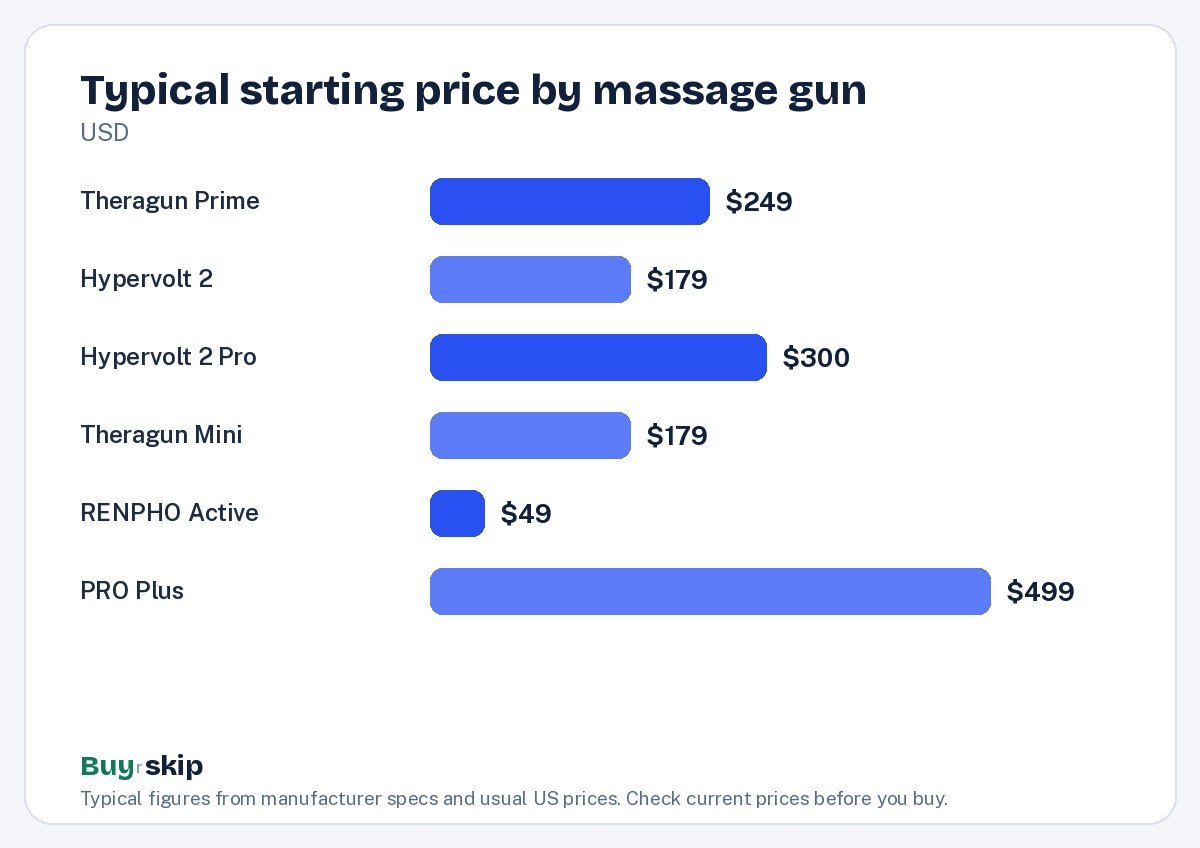
| Therabody Theragun Prime | Most people | Buy | about $249–$299 |
| Hypervolt 2 | Quiet power | Buy | about $179–$229 |
| Hyperice Hypervolt 2 Pro | Quiet, stronger relaxation | Buy | about $300–$350 |
| Theragun Mini (3rd Gen) | Travel | Buy | about $179–$199 |
| RENPHO Active Massage Gun | Budget | Buy | about $49–$79 |
| Therabody Theragun PRO Plus | Recovery enthusiasts | Skip | about $499–$599 |
Prices shift often, so check the current price before you buy.
The best massage guns in 2026
Best overall Our verdict: Buy
Therabody Theragun Prime
Typical price: about $249–$299
Most people. Buy it if you want strong percussion massage for sore legs, back and shoulders with guided app routines.
- Pros
- ✓ Deep, effective percussion
- ✓ Ergonomic triangle handle
- ✓ App-guided routines
- Cons
- ✕ Heavier than mini guns
- ✕ Louder than some rivals
Check price on Amazon Paid link
The Theragun Prime is the massage gun to buy if you want real depth without paying for extras you will not use. Its 16 mm amplitude, the distance the head travels with each stroke, is the same figure Therabody lists for its far more expensive PRO Plus. That depth is what makes percussion feel effective on big muscle groups like quads, hamstrings, glutes and upper back. The triangle-shaped handle lets you grip the gun several ways, which helps when you are working on your own shoulders or lower back.
The app adds guided routines for things like post-run recovery or a stiff neck after a long workday, which is useful if you are new to massage guns and unsure how long to spend on each area. Therabody lists battery life at about 120 minutes, plenty for a week or more of normal sessions.
The trade-offs: it is heavier than mini guns and louder than Hyperice models. Skip it if you want something to fit in a gym bag pocket; the Theragun Mini (3rd Gen) is built for that. At about $249–$299, it is the best balance of depth, build and price here.
Best for quiet power Our verdict: Buy
Hypervolt 2
Typical price: about $179–$229
Quiet power. Buy it if you want a quieter massage gun with solid power.
- Pros
- ✓ Quiet operation
- ✓ Comfortable grip
- ✓ Three speeds
- Cons
- ✕ Shallower than Theragun
- ✕ No travel case
Check price on Amazon Paid link
The Hypervolt 2 is the pick for anyone who finds Theraguns too loud. Hyperice’s guns are known for quieter motors, and owners consistently say you can use this one while watching TV or with someone sleeping nearby without being a nuisance. It has a comfortable grip, three speeds and a battery Hyperice rates at about 3 hours.
The trade-off is depth. Its stroke is shallower than the Theragun Prime’s, so it feels less intense on large, dense muscles. It also does not come with a travel case. Skip it if you want the deepest percussion; the Therabody Theragun Prime goes further. Buy the Hypervolt 2 if you mainly want to loosen up after workouts or at the end of the day and care about noise more than maximum intensity, at about $179–$229.
It is also a sensible choice for people who are a little sensitive to strong percussion. Some first-time users find a deep Theragun too intense on the lower back or calves, and the Hypervolt 2 feels gentler without being weak. Hyperice offers several attachment heads, and the simple three-speed layout is easy to use without an app.
Also great Our verdict: Buy
Hyperice Hypervolt 2 Pro
Typical price: about $300–$350
Quiet relaxation. Buy it if you want strong power with less noise.
- Pros
- ✓ Quiet
- ✓ Five speeds
- ✓ Good battery
- Cons
- ✕ Heavy
Check price on Amazon Paid link
The Hypervolt 2 Pro keeps Hyperice’s quiet motor and adds more power and five speeds, plus a good battery. It suits people who want the quiet character of the Hypervolt 2 but find that model too gentle, or who want finer control over intensity across different muscle groups. It is also a popular gift choice for active friends and family.
The main drawback is weight. It is a heavy gun, which can make longer sessions tiring, especially when you reach behind you. At about $300–$350, it also costs more than the Therabody Theragun Prime, which offers deeper percussion. Skip it if you want the lightest gun. Buy it if quiet operation is your first priority and you still want strong power. Compared with the regular Hypervolt 2, the jump to five speeds gives finer steps between gentle and strong, which helps if several people in the house share one gun and like different intensities. Check the current price gap between the two, though. If the Pro costs close to the Prime, think hard about whether quietness is worth giving up the extra depth.
Best for travel Our verdict: Buy
Theragun Mini (3rd Gen)
Typical price: about $179–$199
Travel. Buy it if you want a small massage gun for travel or the gym bag.
- Pros
- ✓ Very compact
- ✓ Surprisingly strong
- ✓ Quiet
- Cons
- ✕ Less depth
- ✕ Pricey for a mini
Check price on Amazon Paid link
The Theragun Mini (3rd Gen) is a pocket-size Theragun that weighs about 1 pound, according to Therabody. It is small enough for a gym bag, a carry-on or a desk drawer, and it is quiet. Its 12 mm amplitude is shallower than the Prime’s 16 mm, but owners often describe it as surprisingly strong for its size.
It does not replace a full-size gun for deep work on large muscles. It is also pricey for a mini, at about $179–$199, which overlaps with the Hypervolt 2. Skip it if you need deep massage for your quads and back. Buy it if you travel often, want quick relief between meetings or already own a full-size gun and want a second one for the road. It also suits office workers who want to loosen a stiff neck and shoulders at a desk without making a racket. Smaller hands and lighter users often find it easier to control than a full-size gun, which can make it a good fit for someone who finds the Prime unwieldy.
Best budget Our verdict: Buy
RENPHO Active Massage Gun
Typical price: about $49–$79
Budget. Buy it if you want to try a massage gun without spending much.
- Pros
- ✓ Low price
- ✓ Light
- ✓ Several heads
- Cons
- ✕ Shallow stroke
- ✕ Less durable
Check price on Amazon Paid link
The RENPHO Active is the low-risk way to find out whether a massage gun fits your routine. It costs about $49–$79, is light, and comes with five heads and five speeds, so you can experiment with different attachments and intensities. For beginners and casual gym-goers, that is plenty.
You get what you pay for in two places. The stroke is shallow, so it feels more like strong vibration than deep percussion, and owners report it is less durable than Therabody and Hyperice guns. Skip it if you want deep percussion or a premium build; the Therabody Theragun Prime is a different class of tool. Buy the RENPHO if you want to try percussion massage cheaply or need a basic gun for light, occasional use. It is also an easy gift for someone curious about massage guns, since the price does not demand a big commitment. If you end up using it daily and want more depth, you will have a much better idea of what to look for in a premium model, and the RENPHO can live on as a spare in a car or office.
Skip it Our verdict: Skip
Therabody Theragun PRO Plus
Typical price: about $499–$599
Recovery enthusiasts. Buy it if you want heat, cold, vibration and light therapy in one device and money is no object.
- Pros
- ✓ Many therapy modes
- ✓ Rotating arm
- ✓ Strong motor
- Cons
- ✕ Very expensive
- ✕ Heavy
Check price on Amazon Paid link
The Theragun PRO Plus does a lot. Alongside 16 mm percussion, it adds heat, cold, vibration and LED light therapy, a rotating arm for reaching your back, and a strong motor. For a recovery enthusiast with a big budget, that is an impressive list.
The problem is value. Most people buy a massage gun for percussion, and the Therabody Theragun Prime delivers the same 16 mm amplitude for about half the price. The PRO Plus is also heavy and very expensive at about $499–$599. Skip it and buy the Prime, or the Hypervolt 2 if quiet operation matters more to you. If the thermal features genuinely appeal to you, it is worth asking whether you would use them often enough. Many people find that a heating pad, an ice pack and a good percussion gun cover the same ground for far less money, and a lighter gun is simply easier to use every day.
How to choose massage guns
Amplitude decides how deep it feels
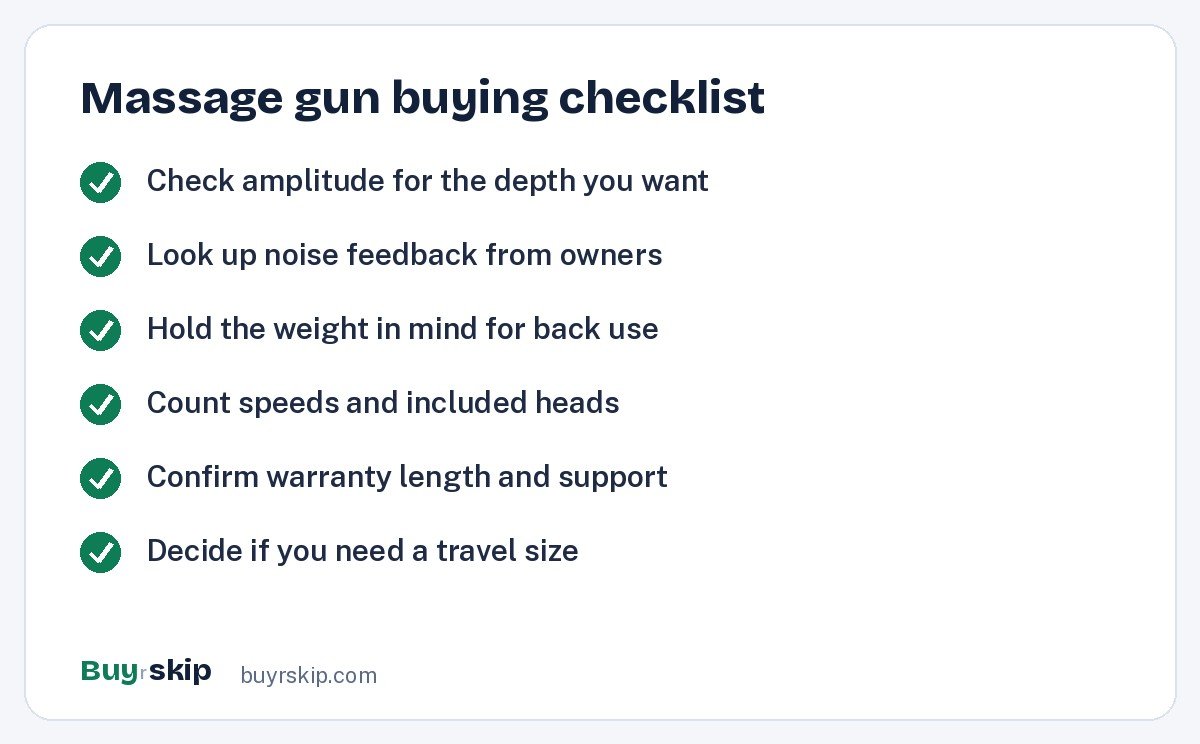
Amplitude, or stroke length, is the single most useful spec. Larger numbers mean the head travels further and pushes deeper into muscle. The Therabody Theragun Prime lists 16 mm, the Theragun Mini (3rd Gen) lists 12 mm, and budget guns like the RENPHO have a shallower stroke. If you lift heavy, run long distances or have dense muscle, go for depth. If you want gentle relief, a shallower stroke is fine and often more comfortable. Amplitude is not the same as speed. A fast gun with a short stroke can feel buzzy without going deep, while a slower gun with a long stroke feels more like a firm, rhythmic press. When comparing models, look at amplitude first and speed range second.
Stall force and speed range
Stall force describes how hard you can press before the motor slows or stops. Brands do not always publish it consistently, so look at owner feedback about whether a gun bogs down under pressure. More speeds help you dial in intensity: the Hypervolt 2 has three, while the Hyperice Hypervolt 2 Pro and RENPHO have five.
Noise matters more than you think
Percussion guns can be loud, and you will often use them in the evening at home. If you share space or use the gun while watching TV, choose a Hyperice model. Theraguns trade some quietness for depth. Very cheap guns can be noisy too, because simpler motors and loose tolerances rattle. If you can, read owner comments about noise rather than relying only on decibel claims, which brands measure in different ways.
Weight and ergonomics
A heavy gun tires your arm quickly, especially when you reach behind your back. The triangle handle on Theraguns helps with grip changes, and the PRO Plus adds a rotating arm. Mini guns weigh much less but cannot work as deep. Think about which areas you most want to reach on your own. If your main target is your upper back, either choose a gun with a handle you can flip around, like a Theragun, or plan on asking someone in your household for help.
Battery life and charging
Most full-size guns run long enough for several sessions between charges. Therabody lists about 120 minutes for the Prime, and Hyperice lists about 3 hours for the Hypervolt 2. Unless you share the gun with a whole household, battery life is rarely the deciding factor. What matters more over time is how the battery ages and how the gun charges. Check whether the battery is replaceable or covered by the warranty, and whether the gun charges by USB-C or a proprietary adapter, which is easy to lose when traveling. Owners of budget guns more often report battery problems after a year or two, which is part of why premium models cost more.
Attachments and extras
Extra heads are useful, but most people end up using two or three. A ball head for general use, a flat head for dense areas and a cone or bullet for small spots cover most needs. If you want more, a set of massage gun attachment heads is inexpensive, though check compatibility first. Third-party heads often use a standard shaft size, but Therabody and Hyperice use their own fittings, so generic heads may not fit. Soft foam heads are kinder on bony areas, while firm plastic heads reach deeper.
Use it safely
Massage guns are for muscles, not bones, joints or the front of the neck. Start on a low speed, keep the gun moving and limit each area to a minute or two. If you have a medical condition, an injury, or take blood thinners, check with your doctor first. Many people pair a gun with a simple foam roller for broader areas.
Frequently asked questions
Do massage guns actually work?
Many people find they help with muscle soreness and tightness after exercise, and percussion massage is widely used by athletes and physical therapists. Results vary by person, though, and a massage gun is a recovery aid, not a treatment for injury. Use it alongside sleep, hydration, stretching and sensible training. If you run, the right shoes matter too; see our best running shoes picks.
How long should I use a massage gun on each muscle?
Most manufacturers suggest about one to two minutes per muscle group, keeping the head moving rather than holding it in one spot. A full session after a workout usually takes five to ten minutes. More is not better; overdoing it can leave muscles tender. App-guided routines like those for the Therabody Theragun Prime take the guesswork out.
Is a mini massage gun strong enough?
For travel, quick relief and smaller muscles, yes. The Theragun Mini (3rd Gen) is surprisingly capable for its size. But a mini gun has a shorter stroke and less mass behind it, so it cannot match a full-size gun on big muscle groups. If you only own one gun and train hard, start with a full-size model.
Why are some massage guns so cheap?
Budget guns like the RENPHO Active Massage Gun save money with shallower strokes, lighter motors and simpler builds. That makes them a fine way to try percussion therapy, but they usually feel less intense and may not last as long. If you plan to use a gun most days, it is worth paying more for a stronger, sturdier model.
Can I use a massage gun every day?
Most people can use one daily at moderate settings, as long as they keep sessions short and avoid tender, bruised or injured areas. Daily use is common among runners and lifters who use a gun as part of a warm-up or cool-down. If an area stays sore or feels worse after use, back off. Pairing recovery with training data from one of the best fitness trackers can help you spot when you need rest.
Theragun or Hypervolt: which should I buy?
Choose Theragun if you want the deepest percussion and an ergonomic handle, and Hypervolt if quiet operation is your priority. The Therabody Theragun Prime is the better pick for depth, while the Hypervolt 2 is the better pick for low noise at a lower price.
The bottom line
The Therabody Theragun Prime is the best massage gun for most people: deep 16 mm percussion, a comfortable handle and useful app routines at a fair price. Choose the Hypervolt 2 for quieter sessions, the Theragun Mini (3rd Gen) for travel and the RENPHO Active Massage Gun if you just want to try one.
Skip the Therabody Theragun PRO Plus unless you truly want heat, cold and light therapy in one device. If you are building a home recovery setup, our best adjustable dumbbells guide pairs well.
Check price on Amazon: Therabody Theragun Prime
Paid link. Typical price about $249–$299; check the current price on Amazon.