We research products independently from specs, manufacturer documentation, warranty terms and owner feedback. When you buy through links on this page, we may earn a commission at no extra cost to you. As an Amazon Associate we earn from qualifying purchases.
Quick answer
The best smart speaker for most music lovers is the Sonos Era 100: it has stereo drivers, rich sound for its size, AirPlay 2, Alexa and room to grow into a multiroom system. If you mainly want timers, weather and smart-light control, the Amazon Echo Dot (5th Gen) is the best value at about $29–$49. Want a screen for recipes and video calls? Get the Echo Show 8 (3rd Gen). iPhone households should look at the Apple HomePod mini.
Picking from the best smart speakers comes down to two questions: how much you care about music, and which voice assistant already runs your home. A $35 speaker and a $450 speaker can both set a timer, but they sound wildly different, and they tie you to different ecosystems. This guide sorts seven current models by what each does best, who should buy it and who should skip it. Picks are based on specs, manufacturer documentation, warranty terms, independent review consensus and owner-feedback patterns.
Quick picks
| Product | Best for | Our verdict | Typical price |
|---|---|---|---|
| Sonos Era 100 | Music lovers | Buy | about $179–$219 |
| Amazon Echo Dot (5th Gen) | Most people | Buy | about $29–$49 |
| Amazon Echo Show 8 (3rd Gen) | Kitchens and bedrooms | Buy | about $130–$150 |
| Amazon Echo Studio | Big sound with Alexa | Buy | about $179–$219 |
| Amazon Echo (4th Gen) | Everyday Alexa | Buy | about $80–$100 |
| Sonos Era 300 | Spatial audio music | Consider | about $450–$480 |
| Apple HomePod mini | iPhone households | Consider | about $89–$99 |
The best smart speakers in 2026
Best overall Our verdict: Buy
Sonos Era 100
Typical price: about $179–$219
Music lovers. Buy it if you care about music quality and want a compact speaker that can grow into a multiroom system.
- Pros
- ✓ Excellent sound for its size
- ✓ Stereo drivers
- ✓ Works with AirPlay 2 and Alexa
- ✓ Bluetooth and USB-C line in
- Cons
- ✕ Sonos app has had reliability issues
- ✕ No Google Assistant
Check price on Amazon Paid link
The Sonos Era 100 is the speaker to buy if music is the main reason you want a smart speaker. It packs stereo drivers into a compact body and delivers excellent sound for its size, so it works as well on a kitchen counter as on a living room shelf. It supports AirPlay 2 for iPhone users, works with Alexa or Sonos Voice Control, and adds Bluetooth plus a USB-C line in, which makes it more flexible than older Sonos speakers that were Wi-Fi only.
Its biggest strength is that it can grow. Add a second Era 100 for a stereo pair, or add other Sonos speakers in other rooms, and the whole system plays together. The trade-offs are real, though. The Sonos app has had well-publicized reliability problems, and there is no Google Assistant support. Expect to pay about $179–$219, and check the current price. Skip it if you mainly want a cheap voice assistant; the Echo Dot does that for a fraction of the cost.
Best value Our verdict: Buy
Amazon Echo Dot (5th Gen)
Typical price: about $29–$49
Most people. Buy it if you want an affordable smart speaker for timers, weather, music and controlling smart lights.
- Pros
- ✓ Low price
- ✓ Clearer sound than older Dots
- ✓ Temperature sensor for routines
- Cons
- ✕ Small sound
- ✕ Alexa prompts can feel pushy
Check price on Amazon Paid link
The Amazon Echo Dot (5th Gen) is the cheapest sensible way to put Alexa in every room. For about $29–$49, it handles timers, weather, reminders, music requests and smart-light control, and it sounds clearer than older Dots. A built-in temperature sensor lets you trigger routines, such as turning on a fan when a room warms up.
This is the right pick for bedrooms, kitchens, kids’ rooms and anywhere a voice assistant matters more than audio quality. The trade-off is obvious: the sound is small. It is fine for podcasts and background music but will not fill a large room. Owners also note that Alexa can feel pushy with suggestions and prompts. If you want room-filling music with Alexa, step up to the Amazon Echo (4th Gen) or the Echo Studio.
Best for kitchens Our verdict: Buy
Amazon Echo Show 8 (3rd Gen)
Typical price: about $130–$150
Kitchens and bedrooms. Buy it if you want Alexa with a screen for calls, recipes and cameras.
- Pros
- ✓ Good sound for its size
- ✓ Smart-home hub built in
- ✓ Camera shutter for privacy
- Cons
- ✕ Shows promotions on screen
Check price on Amazon Paid link
The Amazon Echo Show 8 (3rd Gen) adds an 8-inch screen to Alexa, and that screen changes what a smart speaker can do. You can follow recipes step by step, make video calls, check a video doorbell or camera feed, and see the weather and your calendar at a glance. It also has a smart-home hub built in and a physical camera shutter for privacy.
Sound is good for its size, so it handles kitchen radio and podcasts well. The main complaint is that the screen shows promotions and suggestions, which some owners find distracting. At about $130–$150, it costs a little more than a regular Echo. Skip it if you want the best music sound; the Sonos Era 100 or Echo Studio sounds better. Buy it if your kitchen or nightstand would benefit from a glanceable display.
Best for big sound with Alexa Our verdict: Buy
Amazon Echo Studio
Typical price: about $179–$219
Big sound with Alexa. Buy it if you want a powerful Alexa speaker with spatial audio that can also control Zigbee and Matter devices.
- Pros
- ✓ Big, room-filling sound
- ✓ Spatial audio with Dolby Atmos
- ✓ Built-in smart home hub
- Cons
- ✕ Large
- ✕ Best features tied to Amazon Music
Check price on Amazon Paid link
The Amazon Echo Studio is Amazon’s biggest-sounding speaker. It fills a living room, supports spatial audio with Dolby Atmos, and doubles as a smart-home hub that works with Zigbee, Matter and Thread devices. That hub support means it can control many smart plugs, bulbs and sensors without a separate bridge.
It is the pick for Alexa households that want one powerful speaker for music and home control. The trade-offs: it is large, and its best features lean on Amazon Music, especially for spatial audio. At about $179–$219, it costs the same as the Era 100. Choose the Studio if you want bigger, louder sound and a stronger hub. Choose the Era 100 if you want AirPlay 2, multiroom flexibility beyond Amazon, and a smaller footprint. Skip both if you prefer Google or Apple ecosystems.
Also great Our verdict: Buy
Amazon Echo (4th Gen)
Typical price: about $80–$100
Everyday Alexa. Buy it if you want an affordable Alexa speaker that fills a room.
- Pros
- ✓ Fuller sound than smaller Echos
- ✓ Zigbee hub built in
- ✓ Affordable
- Cons
- ✕ Not hi-fi
Check price on Amazon Paid link
The Amazon Echo (4th Gen) is the middle ground between the tiny Dot and the big Studio. Its spherical design delivers noticeably fuller sound than smaller Echos, and it includes a Zigbee hub, so it can connect compatible smart-home devices directly. At about $80–$100, it is an easy upgrade from a Dot for a main room.
This speaker suits anyone who wants everyday Alexa plus music that fills a room without paying Studio prices. It is not hi-fi, and audiophiles will hear the difference against a Sonos. It also makes a good gift for someone starting a smart home. If you only need voice control in a small room, save money with the Dot. If you want the richest sound, look at the Era 100.
Consider: spatial audio Our verdict: Consider
Sonos Era 300
Typical price: about $450–$480
Spatial audio music. Buy it if music quality matters more than smart features.
- Pros
- ✓ Immersive spatial sound
- ✓ Excellent build
- ✓ Multi-room with Sonos
- Cons
- ✕ Expensive
- ✕ Unusual shape
Check price on Amazon Paid link
The Sonos Era 300 is built for one job: immersive spatial music. Its unusual shape houses drivers that fire in several directions, and with Dolby Atmos tracks it creates a wide, enveloping sound that standard speakers cannot match. Build quality is excellent, and it joins any Sonos multiroom system.
It is a consider rather than a buy because of price and shape. At about $450–$480, it costs more than twice as much as the Era 100, and its odd profile does not fit every shelf. It also carries the same Sonos app concerns. Buy it if music quality matters far more than smart features and you listen to Atmos content. Skip it if you want a screen or a cheap speaker; the Echo Show 8 or Echo Dot fits those needs better.
Best for iPhone households Our verdict: Consider
Apple HomePod mini
Typical price: about $89–$99
iPhone households. Buy it if you use an iPhone and Apple Home and want an easy speaker for AirPlay and Siri.
- Pros
- ✓ Great with iPhone and Apple Music
- ✓ Thread border router for Apple Home
- ✓ Handoff from iPhone
- Cons
- ✕ Needs an Apple device
- ✕ Siri is less capable than Alexa for smart home
Check price on Amazon Paid link
The Apple HomePod mini is the natural smart speaker for people who live in Apple’s world. It works seamlessly with iPhone and Apple Music, supports AirPlay and Handoff from your phone, and acts as a Thread border router for Apple Home, which helps Matter and Thread devices respond reliably.
It earns a consider because it is so tied to Apple. You need an iPhone or iPad to set it up, so Android users should skip it entirely. Siri is also less capable than Alexa for broad smart-home control. Sound is good for a small speaker, though it does not match the Era 100. At about $89–$99, it is a fair price for Apple households. If you are not committed to Apple, the Echo Dot or the Era 100 offers more flexibility.
How to choose smart speakers
The right smart speaker depends less on raw specs and more on your home, your phone and your listening habits. Work through these decisions in order.
Pick your assistant first
Your voice assistant determines which smart-home gear works smoothly and which phone features you get. If your home already runs on Alexa, any Echo fits right in. If you use an iPhone and Apple Home, the HomePod mini is the smoothest choice. Sonos sits in between, with Alexa or Sonos Voice Control and AirPlay 2.
Decision rule: if you own Alexa devices, buy an Echo. If you are all-in on Apple, buy the Apple HomePod mini. If you care about music above all, buy the Sonos Era 100.
Decide how much music quality matters
Small speakers like the Echo Dot and HomePod mini are fine for voice, podcasts and casual music. Mid-size speakers like the Echo (4th Gen) fill a room. For music lovers, stereo speakers like the Era 100 and spatial speakers like the Era 300 and Echo Studio are in a different league.
Decision rule: if music plays most of the day, spend at least on the Era 100 or Echo Studio. If it is mostly timers and news, a Dot is plenty.
Screen or no screen
A screen helps in kitchens and on nightstands, where recipes, calls, camera feeds and clocks are useful. It adds cost and can show promotions. If you want a display, the Echo Show 8 is the only one on this list with one.
Smart-home hub support
Some speakers can talk directly to smart-home devices. The Echo Studio supports Zigbee, Matter and Thread. The Echo (4th Gen) has a Zigbee hub. The HomePod mini is a Thread border router for Apple Home. If you plan to add smart bulbs, plugs or sensors, a built-in hub can save you from buying a separate bridge. Our smart locks and smart lighting guide covers devices that pair well with these speakers.
Multiroom and growth
If you might want speakers in several rooms, plan for it now. Sonos is the strongest multiroom system here, and Echo devices can also group for whole-home audio. Starting with one Era 100 and adding a second later for stereo is a common upgrade path.
Connections and privacy
Bluetooth lets you play from any phone, and the Era 100 adds a USB-C line in for a turntable or other source. For privacy, look for a microphone mute button on any model, and on the Echo Show 8, use the camera shutter. Review voice recording settings in the companion app after setup. Accessories like a smart speaker wall mount can free up counter space.
Placement, room size and common mistakes
Where the speaker lives matters as much as which one you buy. A small speaker in a big open-plan room will sound thin no matter how good it is, while a large speaker on a nightstand is overkill. As a rough guide, put a Dot or HomePod mini in bedrooms, bathrooms and home offices, an Echo (4th Gen), Echo Show 8 or Era 100 in kitchens and medium living spaces, and an Echo Studio or Era 300 in the main room where you actually sit and listen.
Placement also affects voice pickup. Keep the speaker away from range hoods, running water and the TV if you can, since background noise makes any assistant mishear commands. Corners and shelves tend to boost bass, which can help small speakers and muddy big ones. If counter space is tight, a small speaker stand lifts the speaker clear of clutter.
Decision rule: if one speaker has to cover a large living room, buy the Echo Studio or a pair of Era 100s. If it is a small room, the Echo Dot is enough.
The most common mistake is buying on price alone and then being disappointed with music. A Dot is a superb voice assistant but a modest music speaker. The second is mixing ecosystems by accident: a HomePod mini in a home full of Alexa devices will not share routines or groups with them. The third is ignoring the app. Every speaker here depends on its companion app for setup, updates and multiroom grouping, so read recent owner feedback on the app before you commit, especially for Sonos.
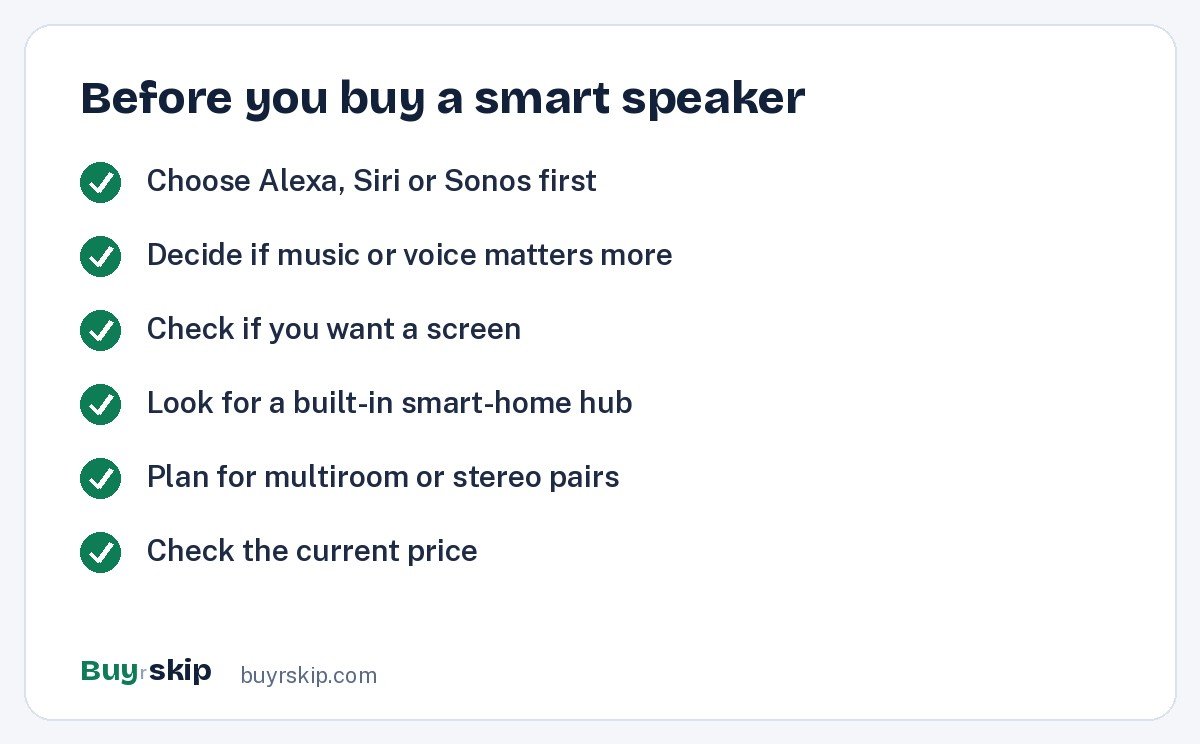
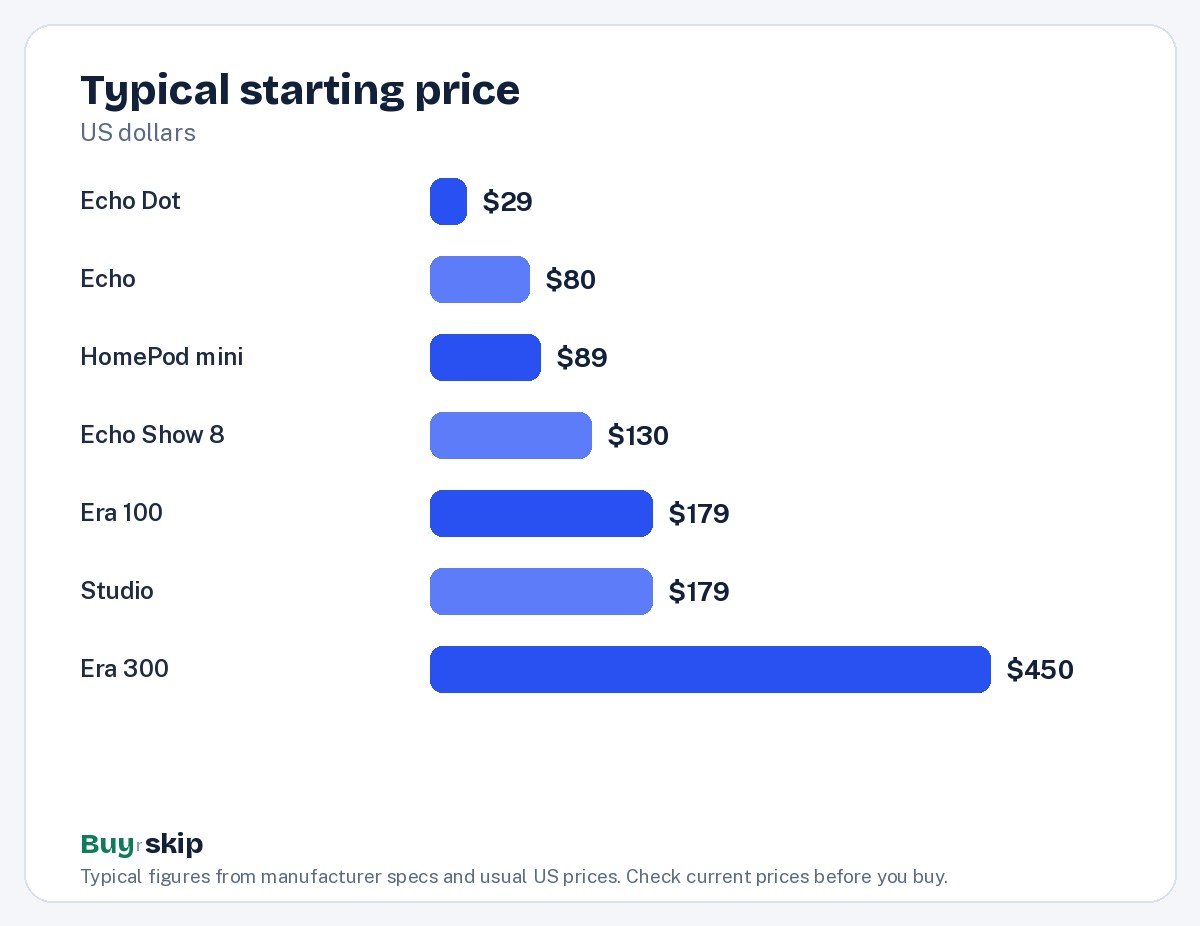
The price spread is wide, but the jump from a Dot to an Echo (4th Gen) is the best-value step up for sound, and the jump to the Era 100 is the biggest step up for music. If you are also shopping for portable sound, see our best Bluetooth speakers roundup, and for TV audio, our best soundbars guide.
Frequently asked questions
What is the best smart speaker for music?
For most people, the Sonos Era 100 offers the best mix of sound quality, size and price, with stereo drivers, AirPlay 2 and Alexa. If you want more immersive spatial audio and can spend more, the Sonos Era 300 is the step up. Alexa fans who want big sound at the Era 100’s price should consider the Echo Studio, which supports Dolby Atmos and doubles as a smart-home hub.
Which smart speaker is best under $100?
The Echo Dot (5th Gen) is the best low-cost pick at about $29–$49 for voice control and casual listening. The Echo (4th Gen) at about $80–$100 sounds fuller and includes a Zigbee hub. iPhone users should look at the HomePod mini at about $89–$99. Prices move often, so check the current price before buying any of them.
Can I use the HomePod mini with an Android phone?
No. The HomePod mini needs an iPhone or iPad to set up, and many of its best features, like Handoff and AirPlay, depend on Apple devices. Android users get a much better experience with an Echo speaker or a Sonos speaker, both of which set up through apps available on Android and work with Bluetooth for direct playback.
Do smart speakers need a hub for smart-home devices?
Not always. Many Wi-Fi bulbs and plugs connect without a hub. But Zigbee and Thread devices need a compatible hub or border router. The Echo Studio supports Zigbee, Matter and Thread, the Echo (4th Gen) has a Zigbee hub, the Echo Show 8 has a smart-home hub, and the HomePod mini works as a Thread border router for Apple Home.
Are Sonos speakers worth it over Echo speakers?
If music quality and multiroom flexibility matter most, yes. Sonos speakers like the Era 100 sound richer and support AirPlay 2 alongside Alexa. The trade-off is the Sonos app, which has had reliability issues, and higher prices. If you mainly want voice control and smart-home features, an Echo gives you more for less money.
The bottom line
The Sonos Era 100 is the best smart speaker for anyone who listens to a lot of music. It sounds excellent for its size, works with Alexa and AirPlay 2, and grows into a multiroom setup. For voice control on a budget, the Echo Dot (5th Gen) is the easy pick, and the Echo Show 8 is worth it if you want a screen. Apple households should get the HomePod mini.
Check the current price before you buy, since smart speakers are discounted often.
Check price on Amazon: Sonos Era 100
Paid link. Typical price about $179–$219; check the current price on Amazon.