We research products independently from specs, manufacturer documentation, warranty terms and owner feedback. When you buy through links on this page, we may earn a commission at no extra cost to you. As an Amazon Associate we earn from qualifying purchases.
Quick answer
The most durable noise cancelling headphones combine a simple, well-supported hinge or no fold at all, ear pads you can replace, a battery big enough that you charge it rarely, and a manufacturer that sells parts and honors warranties. For most people the Sony WH-1000XM6 and Bose QuietComfort Headphones are the safest long-term buys. Batteries, not hinges, are what usually end a pair’s life, so a long battery rating and gentle charging habits matter more than metal.
Finding the most durable noise cancelling headphones is less about rugged looks and more about what fails over three to five years of daily use. This guide covers the weak points, the parts you can replace, how warranties work in practice and which current models are built to last. Our verdicts are based on manufacturer specs and documentation, warranty terms, independent review consensus and long-term owner-feedback patterns.
If you want the full decision framework, including sound and comfort, read our noise cancelling headphones buying guide. This page sticks to one question: will it last?
What actually breaks on noise cancelling headphones
Owners who replace ANC headphones early tend to describe the same handful of failures. Knowing them tells you what to look at before you buy.
- Headband and sliders. The headband flexes every time you put the headphones on. Thin plastic around the slider or the point where the band meets the yoke is the most common place for a crack.
- Folding hinges. A hinge is a moving joint that gets opened and closed hundreds of times a year. Good hinges last; cheap ones loosen or snap.
- Ear pads. Protein leather flakes and foam flattens. Pads are the most predictable wear item, usually lasting one to two years with daily use.
- The battery. Lithium-ion cells lose capacity with every charge cycle and with heat. After a few years, a pair rated for 30 hours may give noticeably less.
- Charging port. A USB-C port that is yanked at angles or packed with pocket lint can stop charging reliably.
- Touch panels and sensors. Sweat, rain and skin oils can make touch controls or wear sensors misbehave.
Notice that only two of these are about raw strength. Most failures are about wear parts and electronics, which is why repairability and warranty matter as much as build.
How to choose the most durable noise cancelling headphones
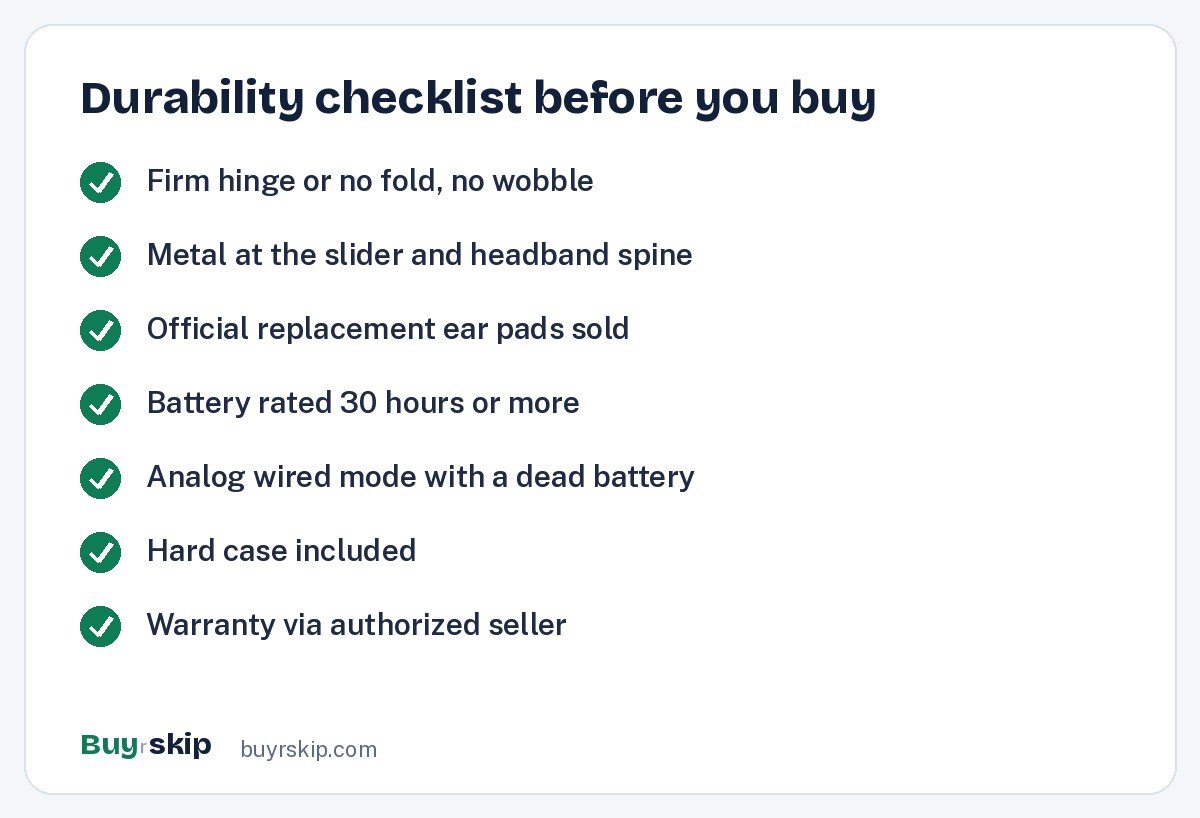
Use the sections below as a checklist when you compare models. Each one is a place where two similar-looking pairs can differ a lot after a couple of years.
Build materials: metal helps, but only in the right places
Metal sliders and a metal headband core resist cracking at stress points. That does not mean all-plastic headphones are fragile. Flexible plastic can survive drops that would dent aluminum, and it keeps weight down, which matters for comfort. Look for metal where the stress is (the slider and the headband spine) and do not pay extra just for metal ear cups.
The Apple AirPods Max (USB-C) show the trade-off. Aluminum cups and a stainless steel headband frame feel tank-like, but the result is a heavy pair that many people find tiring on long sessions, and a pair you do not want to wear is not a pair that lasts in your life.
Hinges and folding: fewer joints, fewer failures
Folding headphones fit a smaller case and are easier to protect in a bag. Non-folding or flat-folding designs have fewer moving parts. Both can last; what you want is a hinge that feels firm, with no wobble or creak in the store or out of the box.
- If you travel a lot, a folding design with a hard case is usually the more durable choice in practice, because the case does the protecting.
- If the headphones mostly live on a desk or a hook at home, a non-folding design removes a failure point.
The Sony WH-1000XM6 brought back an inward-folding design, while the earlier Sony WH-1000XM5 only swivels flat and needs a bigger case. The Sennheiser Momentum 4 Wireless also folds flat rather than inward.
Replaceable ear pads: the easiest win
Ear pads wear out on every pair. The question is whether you can replace them in two minutes or face a fiddly job with adhesive. Check three things:
- Does the manufacturer sell official replacements? Bose sells cushion kits for its QuietComfort line, and Apple and Sonos sell replacement cushions too.
- How do they attach? Magnetic cushions on AirPods Max and the Sonos Ace pull off and click back. Clip-in or twist-lock pads are almost as easy.
- Are third-party pads available? Popular models from Sony, Bose and Sennheiser have plenty of aftermarket replacement ear pads. Fit and seal vary, so official pads are safer for ANC performance.
Fresh pads also restore noise cancelling, because a flattened pad leaks low-frequency sound. If a pair’s ANC “got worse” over time, pads are the first thing to check.
Battery: the real lifespan limit
In almost every wireless ANC headphone, the battery is sealed in and not designed for owner replacement. That makes the battery the most likely reason you retire a pair. Three ways to stretch it:
- Buy more battery than you need. A pair rated around 60 hours, like the Momentum 4, needs fewer charge cycles per year than a 20-hour pair used the same way. Fewer cycles means slower capacity loss.
- Check out-of-warranty service. Some brands offer paid battery service or a flat-rate replacement. Ask before you buy, and check what the service costs relative to a new pair.
- Look for a wired mode that works without power. A 3.5 mm analog connection that works with a dead battery keeps old headphones useful for flights and desk listening long after the battery fades.
Warranty terms and how support works
Most major brands offer about a one-year limited warranty on headphones in the US, and a few offer longer terms. Read three details on the manufacturer’s US warranty page before you buy:
- Length and coverage. Defects are covered; drops, liquid damage and worn pads usually are not.
- Where you bought it. Warranties often require purchase from an authorized seller. Buying through the brand’s official storefront on a large retailer is usually fine, but third-party sellers can be a problem.
- Repair or replace. Many brands swap the whole unit rather than repair it. That is quick, but it means parts and repair options outside warranty may be limited.
Extended protection plans, such as AppleCare+ for AirPods Max or retailer plans, can make sense for expensive pairs if they cover accidental damage and battery service. Read the terms rather than the headline.
Repairability and parts availability
Repairability for headphones is still limited across the industry, but it varies. Signs of a more repairable pair:
- Official replacement pads, headbands or cables listed on the brand’s site.
- Screws rather than glue holding the ear cups together, which independent repair guides and teardowns often comment on.
- A brand that keeps selling parts for older models, not just the current one.
Popular flagship lines from Sony and Bose have the widest parts and accessory ecosystems simply because so many are sold, which makes a long-lived pair easier to keep running.
Water and sweat resistance
Most over-ear ANC headphones carry no official water resistance rating. Light rain is usually fine, but sweat soaking into pads and touch panels is a durability risk. If you want headphones for the gym, consider sweat-resistant noise cancelling earbuds instead and keep the over-ears for travel and work.
Durability features compared
Features vary by model generation, so confirm details on the manufacturer’s site before buying.
| Model | Folding | Ear pad replacement | Case | Wired with dead battery | Typical price |
|---|---|---|---|---|---|
| Sony WH-1000XM6 | Folds inward | Sony parts or aftermarket | Hard case | Yes, 3.5 mm | about $399–$459 |
| Bose QuietComfort Headphones | Folds inward | Official cushion kits | Hard case | Yes, 3.5 mm | about $199–$349 |
| Bose QuietComfort Ultra Headphones (2nd Gen) | Folds inward | Official cushion kits | Hard case | Yes, 3.5 mm | about $379–$449 |
| Sennheiser Momentum 4 Wireless | Folds flat | Official pads sold | Fabric hard case | Yes, 3.5 mm | about $249–$379 |
| Sonos Ace | Folds flat | Magnetic, official | Hard case | No (USB-C audio) | about $299–$449 |
| Apple AirPods Max (USB-C) | No fold | Magnetic, official | Soft Smart Case | No (USB-C audio) | about $449–$549 |
Prices are typical ranges; check the current price before you buy.
The picks most likely to last
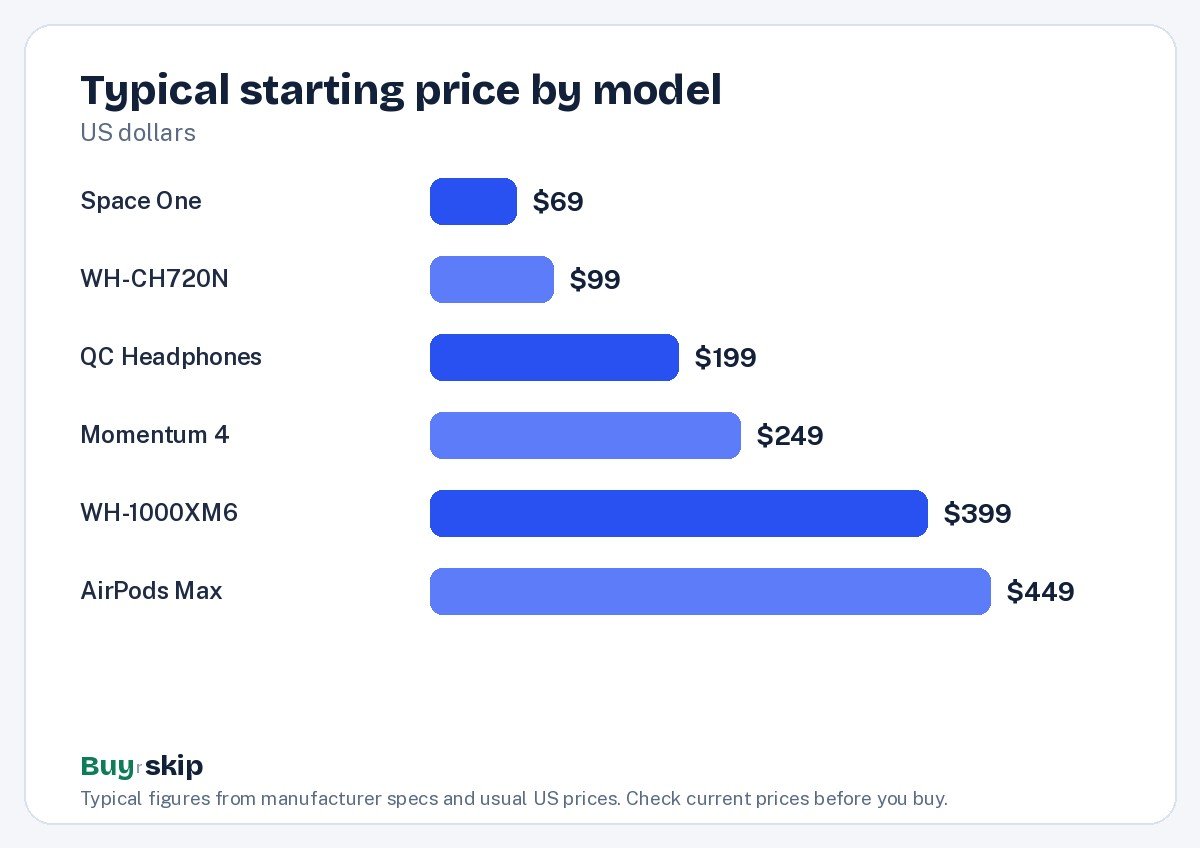
Durability does not scale neatly with price. Mid-priced pairs with official parts can outlast pricier ones that are hard to service. Here is where the picks below and the budget options start:
Best overall Our verdict: Buy
Sony WH-1000XM6
Typical price: $399–$459
Travelers and commuters who want top ANC in a pair built to fold into a protective case every day
- Pros
- ✓ Folding design with hard case
- ✓ Large parts and pad ecosystem
- ✓ Analog cable works as a backup
- Cons
- ✕ Battery is not user-replaceable
- ✕ Premium price
Check price on Amazon Paid link
Best value for longevity Our verdict: Buy
Bose QuietComfort Headphones
Typical price: $199–$349
Buyers who want proven comfort and easy cushion swaps without flagship pricing
- Pros
- ✓ Official replaceable ear cushions
- ✓ Folding design and hard case
- ✓ Simple, mostly physical controls
- Cons
- ✕ Shorter battery than some rivals
- ✕ No high-bitrate Android codec
Check price on Amazon Paid link
Best battery headroom Our verdict: Buy
Sennheiser Momentum 4 Wireless
Typical price: $249–$379
People who keep headphones for years and want the battery to age slowly
- Pros
- ✓ Around 60 hours of battery means fewer charge cycles
- ✓ Replaceable pads
- ✓ Wired analog option
- Cons
- ✕ Does not fold inward
- ✕ Touch controls can be sensitive to sweat
Check price on Amazon Paid link
Best for frequent flyers Our verdict: Buy
Bose QuietComfort Ultra Headphones (2nd Gen)
Typical price: $379–$449
Long-haul travelers who want premium comfort and official spare parts
- Pros
- ✓ Folding design and hard case
- ✓ Official cushion kits
- ✓ Top-tier ANC
- Cons
- ✕ Higher price than the standard QuietComfort
- ✕ More features to manage
Check price on Amazon Paid link
Easiest pad swaps Our verdict: Consider
Sonos Ace
Typical price: $299–$449
Sonos soundbar owners who value magnetic cushions and a solid case
- Pros
- ✓ Magnetic replaceable cushions
- ✓ Sturdy hard case
- ✓ Good build quality
- Cons
- ✕ No analog wired mode
- ✕ Best features need a Sonos soundbar
Check price on Amazon Paid link
Consider Our verdict: Consider
Apple AirPods Max (USB-C)
Typical price: $449–$549
iPhone owners who want a metal build and accept the weight and thin case
- Pros
- ✓ Aluminum and steel construction
- ✓ Magnetic replaceable cushions
- ✓ Strong Apple support network
- Cons
- ✕ Heavy for long sessions
- ✕ Smart Case offers little drop protection
Check price on Amazon Paid link
On a tight budget, the Sony WH-CH720N and Soundcore by Anker Space One are light and inexpensive, and their lower price makes a replacement less painful. Expect plastic construction and fewer official parts, so treat them as good-value pairs rather than five-year investments. If AirPods Max appeal to you, pair them with a hard case for AirPods Max, since the included case leaves much of the headband exposed.
How to choose noise cancelling headphones that last: decision rules
- If you fly or commute daily: buy a folding pair with a hard case, like the Sony WH-1000XM6 or Bose QuietComfort Ultra Headphones (2nd Gen), and always store it in the case.
- If you mostly listen at a desk: a flat-folding pair like the Momentum 4 has fewer joints, and its long battery means fewer cycles.
- If you sweat in them: buy earbuds for workouts instead of wearing premium over-ears to the gym.
- If you keep headphones five years or more: prioritize official replacement pads, an analog wired mode and a brand with a long parts history.
- If you lose or break things often: a budget pair under $150 plus a hard case can be the smarter long-term buy.
Habits that add years to any pair
Even the toughest headphones wear out faster with rough handling. These habits cost nothing:
- Use the case every time. Most broken headbands happen in bags, not on heads.
- Take them off with both hands, holding the ear cups, not by pulling one side over your head.
- Keep them out of heat. A hot car speeds up battery aging.
- Avoid deep discharge. Charge before the battery hits zero, and if you store them for months, leave them around half charged.
- Let sweat dry. Wipe pads and let them air out before closing the case.
- Plug in straight. Avoid bending the USB-C cable at the port.
- Update firmware. Updates can improve battery management and fix bugs that look like hardware faults. Our noise cancelling headphones setup tips walk through the process.
Repair or replace?
When something goes wrong outside warranty, run a quick calculation:
- Worn pads: always replace them. They cost a fraction of a new pair and restore comfort and ANC.
- Cracked headband: check for an official replacement part or a brand repair program. If none exists, a crack in a premium pair is often the end of its travel life, though it may still serve at a desk.
- Weak battery: ask the manufacturer about paid battery service. If the quote is close to half the price of a new pair, replacing usually makes more sense, especially if a newer model improves ANC.
- Charging port fault: first clean it gently with a dry, soft brush. Lint is a common cause.
For a broader look at whether ANC headphones are the right choice at all, see our guide to noise cancelling headphones pros and cons. The same durability thinking applies to other gadgets too; our guide to the most durable robot vacuums covers parts and repairability for home robots.
Frequently asked questions
Which noise cancelling headphones last the longest?
No model is guaranteed to outlast another, but pairs with long battery ratings, official replacement pads, an analog wired mode and a solid case tend to stay useful longest. The Sennheiser Momentum 4 stands out for battery headroom, while Sony and Bose flagships benefit from large parts ecosystems and folding designs that fit hard cases. Your handling and storage habits matter as much as the model.
How long should noise cancelling headphones last?
With daily use, many owners get several years from a quality pair. Ear pads typically need replacing every one to two years, and the battery is usually the part that eventually limits lifespan. Heat, deep discharges and frequent charging speed up battery wear. A pair with replaceable pads and a wired mode can stay useful even after battery capacity drops.
Can I replace the battery in my headphones?
In most wireless ANC headphones the battery is sealed and not meant for owner replacement. Some manufacturers offer paid battery service or a replacement unit at a set price outside warranty. Third-party repair is possible on some models but can be fiddly and may affect water resistance or warranty. Check the brand’s support pages before you buy if battery service matters to you.
Are metal headphones more durable than plastic ones?
Not automatically. Metal at the stress points, like sliders and the headband spine, resists cracking. Flexible plastic can survive drops better than thin metal and keeps weight down, which matters for comfort. Focus on how the hinge and slider are built and whether parts are available, rather than on how much metal is visible.
Does a longer warranty mean better durability?
A longer warranty shows the brand is willing to stand behind its product, but it does not cover the most common wear items, like ear pads, or accidental damage. Read what is covered, whether you must buy from an authorized seller, and whether the brand repairs or replaces. A protection plan that covers accidental damage can matter more than a few extra months of standard warranty.
Are folding headphones less durable?
A hinge is one more moving part, so in theory folding adds a failure point. In practice, folding pairs fit smaller hard cases, and good storage protects headphones from the bag damage that breaks most headbands. If you travel often, a well-built folding pair stored in its case is usually the safer choice. At a desk, non-folding designs have the edge.
The bottom line
The most durable noise cancelling headphones are the ones with replaceable pads, a battery big enough to age slowly, a hinge you trust and a case you actually use. Batteries end more pairs than broken plastic does, so weigh battery life and service options heavily.
For most people, the Sony WH-1000XM6 is the best balance of protection, parts support and performance, and the Bose QuietComfort Headphones are the value pick. Check the current price and the warranty terms before you buy.
Check price on Amazon: Sony WH-1000XM6
Paid link. Typical price $399–$459; check the current price on Amazon.