We research products independently from specs, manufacturer documentation, warranty terms and owner feedback. When you buy through links on this page, we may earn a commission at no extra cost to you. As an Amazon Associate we earn from qualifying purchases.
Quick answer
For most people, the Sony WH-1000XM6 is the safest pick: class-leading noise cancelling, a folding design, strong call quality and about 30 hours of battery. If comfort on long flights matters most, choose the Bose QuietComfort Ultra Headphones (2nd Gen). If you want the longest battery, the Sennheiser Momentum 4 Wireless runs around 60 hours. On a budget, the Soundcore by Anker Space One delivers real noise cancelling for under $100.
This noise cancelling headphones buying guide is the full decision framework: how active noise cancelling (ANC) works, which specs actually change your day, how to match a pair to your phone and your routine, and which 2026 models are worth the money. Our verdicts come from manufacturer specs and documentation, warranty terms, independent review consensus and patterns in owner feedback, not from in-house lab work.
If you are buying your first pair and want a shorter, simpler path, start with our beginner's guide to noise cancelling headphones. If you are still deciding between over-ear headphones, earbuds or plain earplugs, read the pros, cons and alternatives first. Everyone else, read on.
What noise cancelling can and cannot do
Before comparing models, set realistic expectations. ANC uses small microphones on the ear cups to sample outside sound, then plays an inverted signal that cancels it. That trick works best on low, steady sounds: jet engines, train rumble, road noise, air conditioning and the hum of an office HVAC system.
It works less well on sounds that are higher pitched, irregular or sudden: voices, a dog barking, keyboard clatter, a baby crying two rows back. The ear cups themselves block some of those sounds passively, which is why a good seal and well-shaped cushions matter as much as the electronics.
Three things follow from that:
- The best ANC will not make a noisy open office silent. It will make it calmer, and voices will sound farther away.
- Fit is half the performance. Glasses, long hair and a loose clamp all let sound leak in, and no processor can fully fix a poor seal.
- ANC helps you listen at lower volume. Because you are not competing with background rumble, you can turn music down, which is one of the most underrated hearing-safety benefits of these headphones.
The noise cancelling headphones buying guide in 8 decisions
Most shoppers compare a long spec sheet and stall. If you are wondering how to choose the best noise cancelling headphones without that overwhelm, a faster way to choose is to answer eight questions in order. Each one narrows the field, and by the end you will usually be down to one or two models.
1. Set your budget tier first
Price tiers in this category are well defined, and each one buys a clear jump in refinement. Always check the current price, since these models move around often.
| Tier | Typical price | What you get | Example models |
|---|---|---|---|
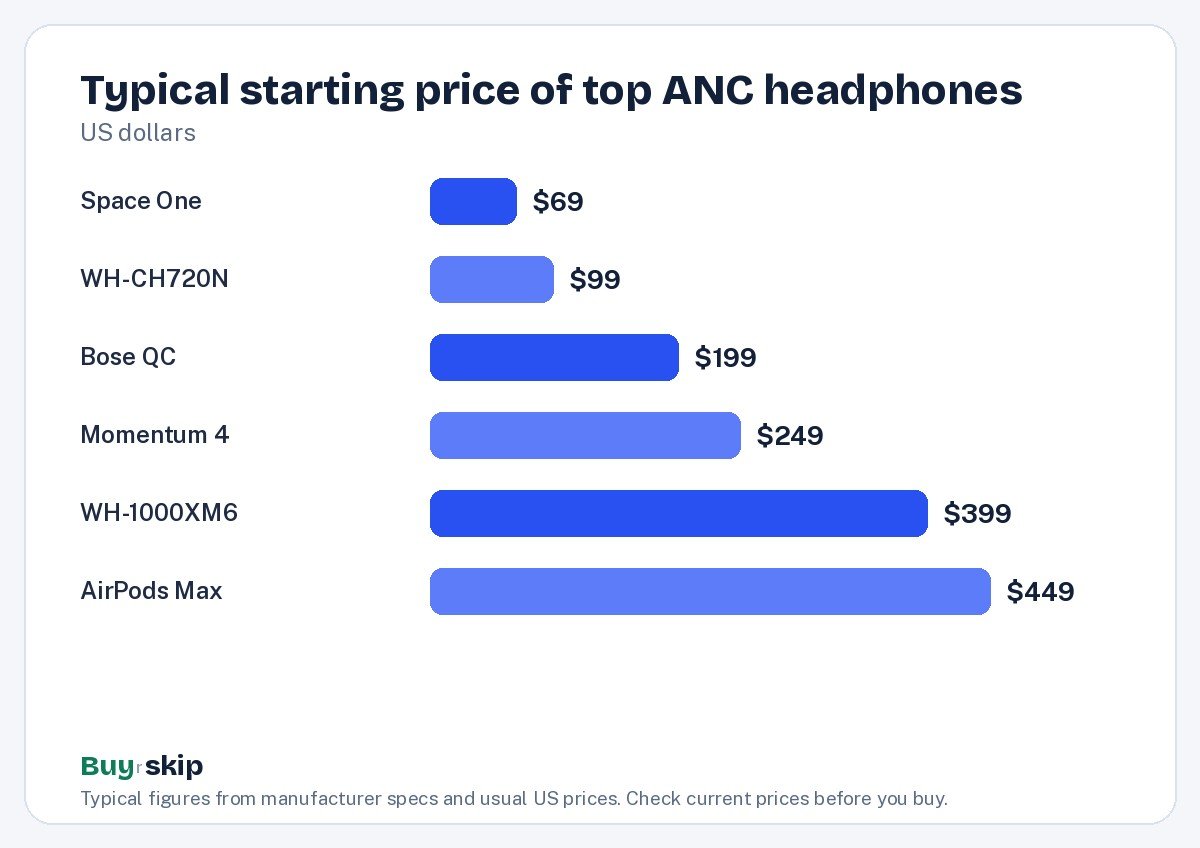
| Budget | about $69–$149 | Real ANC, decent battery, plastic build, simpler apps | Soundcore by Anker Space One, Sony WH-CH720N |
| Midrange | about $199–$379 | Strong ANC, better comfort, multipoint, better calls | Bose QuietComfort Headphones, Sony WH-1000XM5, Sennheiser Momentum 4 Wireless |
| Flagship | about $379–$459 | Top ANC, best mics, adaptive modes, premium materials | Sony WH-1000XM6, Bose QuietComfort Ultra Headphones (2nd Gen) |
| Ecosystem premium | about $299–$549 | Tight integration with one brand’s devices | Sonos Ace, Apple AirPods Max (USB-C) |
A useful rule: if you fly more than a few times a year or commute daily on a train or bus, the flagship tier pays off in comfort and ANC strength. If you mainly want a quieter couch or desk, midrange is the sweet spot.
2. Decide where you will use them most
Your main use case decides which strengths to prioritize.
- Flights and long trips: comfort over many hours, the strongest low-frequency ANC, a folding design and a compact case. Bose and Sony flagships lead here.
- Daily commute: quick transparency mode for announcements, a good mic for calls, light weight and a case that fits your bag.
- Office and calls: microphone quality, multipoint so you can jump between laptop and phone, and comfort with glasses.
- For home use: if you want to choose noise cancelling headphones for home use, weight and clamp matter more than portability, and long battery life means fewer interruptions. Consider TV features too: the Sonos Ace can take over audio from a compatible Sonos soundbar, which is handy for late-night watching.
- Gym and running: over-ear ANC headphones are usually the wrong tool. Sweat damages ear pads and they shift around. Look at sweat-resistant noise cancelling earbuds instead.
3. Prioritize comfort and fit
Comfort is the most common reason owners return headphones, and it is very personal. Things to check on any spec sheet or product page:
- Weight. Lighter pairs feel better after hour three. The Apple AirPods Max (USB-C) are a known heavy option; the Sony WH-CH720N are notably light.
- Clamp force. Strong clamp helps passive isolation but can cause headaches. Owner feedback on Bose models consistently praises a gentle, even clamp.
- Ear cup depth. If your ears touch the inner driver cover, it gets sore quickly. Larger ears do better in deeper cups.
- Glasses. Soft, thick cushions seal around frames better than firm ones.
If you can, buy from a retailer with an easy return window and wear the pair for a full evening at home before you commit.
4. Match the codec to your phone
Bluetooth codecs decide how audio travels from your phone to the headphones. The short version:
- iPhone owners: iPhones use AAC. Every pair in this guide supports it, so do not pay extra for LDAC or aptX you cannot use.
- Android owners: many Android phones support LDAC (used by Sony headphones) and some support aptX Adaptive (used by models like the Sennheiser Momentum 4). These can deliver higher bit rates when the connection is strong.
- Everyone: codec differences are subtle compared with fit, ANC strength and EQ. Treat codecs as a tiebreaker, not a deciding factor.
5. Check battery life and charging
Battery life varies more than most shoppers expect. The Sony WH-1000XM6 is rated for about 30 hours with ANC on, which covers several long-haul flights. The Sennheiser Momentum 4 Wireless is rated around 60 hours, roughly double, which suits people who forget to charge.
Also look for:
- Quick charge. A short top-up giving a few hours of playback is common on midrange and flagship models.
- USB-C charging. Standard across the current lineup, so one cable covers your phone and headphones.
- Wired backup. A 3.5 mm jack or USB-C audio lets you listen when the battery dies, and plug into airline seat-back systems with an adapter. Some premium models only offer USB-C audio, so check before you fly.
6. Think about calls and multipoint
Multipoint lets the headphones stay connected to two devices at once, for example a laptop and a phone, and switch automatically when a call comes in. If you work from home or take calls on the go, treat multipoint as a must-have. Most current Sony, Bose, Sennheiser and Soundcore models support it. Apple’s AirPods Max rely on Apple’s own device switching instead, which works well within Apple gear but not across brands.
For call quality, flagship models generally use more microphones and better voice processing. Review consensus has long favored Sony’s flagship line for calls in noisy places.
7. Look at build, folding and ear pads
Over a few years, ear pads compress, crack and lose their seal, which weakens both comfort and noise cancelling. Replaceable pads are a major long-term advantage. The Bose QuietComfort Headphones have replaceable ear cushions, and replacement pads are widely sold for most major models.
Folding matters if you travel. The Sony WH-1000XM6 brings a folding hinge back to Sony’s flagship, which makes the case smaller. For a deeper look at what makes a pair last, see our guide to the most durable noise cancelling headphones.
8. Weigh ecosystem extras last
Spatial audio, head tracking, wear detection, adaptive ANC that responds to your surroundings and app EQ are nice to have. They rarely decide which pair is best for you. The two exceptions:
- Sonos soundbar owners get a real benefit from the Sonos Ace TV audio swap.
- iPhone, iPad and Mac users who want the most seamless switching may value the AirPods Max integration enough to accept the weight and price.
Comparison: the main models side by side
A side-by-side comparison of noise cancelling headphones is the clearest way to choose once you know your priorities, and it is the part of any noise cancelling headphones buying guide most shoppers skip to. Use this table as a quick filter, then read the picks below.
| Model | Typical price | Standout strength | Main trade-off | Best for |
|---|---|---|---|---|
| Sony WH-1000XM6 | about $399–$459 | Class-leading ANC, about 30 hr battery, folds | Premium price | Most people |
| Bose QuietComfort Ultra Headphones (2nd Gen) | about $379–$449 | Comfort on long flights, top-tier ANC | Premium price | Frequent flyers |
| Bose QuietComfort Headphones | about $199–$349 | Bose comfort, replaceable cushions | Fewer premium extras | Value comfort |
| Sony WH-1000XM5 | about $279–$399 | Previous flagship, often discounted | Does not fold inward | Flagship sound for less |
| Sennheiser Momentum 4 Wireless | about $249–$379 | Around 60 hr battery, rich sound | ANC a step behind leaders | Long battery, music lovers |
| Sonos Ace | about $299–$449 | TV audio swap with Sonos soundbars | Value depends on Sonos gear | Sonos homes |
| Apple AirPods Max (USB-C) | about $449–$549 | Premium build, Apple integration | Heavy, pricey | Committed iPhone users |
| Sony WH-CH720N | about $99–$149 | Light, simple, real ANC | Plain build | Budget comfort |
| Soundcore by Anker Space One | about $69–$99 | Strong ANC under $100 | Plastic feel | Tight budgets |
The picks worth buying in 2026
This is not a ranked list of the best noise cancelling headphones so much as a buying guide shortlist. These are the noise cancelling headphones worth buying based on specs, warranty terms, review consensus and owner feedback. Prices are typical ranges, so check the current price before you buy.
Best overall Our verdict: Buy
Sony WH-1000XM6
Typical price: $399–$459
Anyone who wants the strongest all-round package for travel, commuting and calls
- Pros
- ✓ class-leading noise cancelling
- ✓ about 30 hours of battery
- ✓ folding design with a compact case
- ✓ excellent call quality
- Cons
- ✕ costs near the top of the category
- ✕ LDAC benefit is Android only
Check price on Amazon Paid link
The XM6 is the default recommendation because it has no real weak spot. If you want one pair that handles a red-eye flight, a loud commute and work calls, this is it. [[button: Sony WH-1000XM6]]
Best for long flights Our verdict: Buy
Bose QuietComfort Ultra Headphones (2nd Gen)
Typical price: $379–$449
Frequent flyers and anyone who wears headphones for many hours at a stretch
- Pros
- ✓ comfort widely praised by owners
- ✓ top-tier noise cancelling
- ✓ immersive audio mode
- Cons
- ✕ premium price
- ✕ extras you may never use
Check price on Amazon Paid link
Best value comfort Our verdict: Buy
Bose QuietComfort Headphones
Typical price: $199–$349
Shoppers who want Bose comfort and strong ANC without paying flagship prices
- Pros
- ✓ replaceable ear cushions
- ✓ gentle clamp
- ✓ strong ANC for the price
- Cons
- ✕ fewer premium features
- ✕ calls a step behind flagships
Check price on Amazon Paid link
Best battery life Our verdict: Buy
Sennheiser Momentum 4 Wireless
Typical price: $249–$379
People who hate charging and care most about rich, detailed sound
- Pros
- ✓ around 60 hours of battery
- ✓ rich sound signature
- ✓ aptX Adaptive support
- Cons
- ✕ ANC a step behind Sony and Bose
- ✕ design not as compact for travel
Check price on Amazon Paid link
Best discounted flagship Our verdict: Buy
Sony WH-1000XM5
Typical price: $279–$399
Buyers who want flagship-level performance and can find it on sale
- Pros
- ✓ still excellent ANC
- ✓ strong call quality
- ✓ frequently discounted
- Cons
- ✕ does not fold inward
- ✕ superseded by the XM6
Check price on Amazon Paid link
Best budget Our verdict: Buy
Soundcore by Anker Space One
Typical price: $69–$99
Students and budget shoppers who want genuine ANC under $100
- Pros
- ✓ strong ANC for the price
- ✓ app with EQ
- ✓ multipoint
- Cons
- ✕ plastic build
- ✕ less refined comfort for very long sessions
Check price on Amazon Paid link
Niche picks: buy only if they fit you
The Sonos Ace makes sense mainly if you already own a compatible Sonos soundbar, because the TV audio swap is its standout feature. The Apple AirPods Max (USB-C) suit iPhone users who prioritize premium materials and Apple integration, but their weight and price make them a “consider”, not a default. If you are on the fence between Sony generations, the previous-generation Sony XM5 at a good price can be the smarter buy.
How to read reviews and what pros look for
Reading noise cancelling headphones reviews gets easier once you know what reviewers and audio professionals focus on. Rather than chasing star ratings, look for agreement on these points:
- ANC on low frequencies. Reviewers usually judge how well a pair handles engine and HVAC rumble. Consistent praise across many independent reviews is a strong signal.
- Comfort over hours. Look for owner comments about wearing them on flights or full workdays, not just first impressions.
- Microphone performance in wind and crowds. Calls in quiet rooms sound fine on almost anything; the difference shows up outdoors.
- App quality and firmware updates. A good app with a real EQ lets you fix a sound signature you do not love.
- Long-term complaints. Patterns of cracked headbands, peeling pads or Bluetooth dropouts after months of use matter more than any launch review.
If you are trying to work out how to choose noise cancelling headphones that audio professionals would recommend, the honest answer is that they look for the same things: a neutral or adjustable sound, a good seal, reliable connectivity and parts that can be replaced. No single model is universally endorsed.
Top rated noise cancelling headphones tend to share three traits: strong low-frequency ANC, comfortable cushions and a stable app. When choosing among them, the tiebreaker is usually your phone and your main use case, which is why the decisions above come first.
Mistakes to avoid
- Buying on ANC alone. A pair with slightly weaker ANC that you can wear for six hours beats a stronger pair you take off after one.
- Paying for codecs you cannot use. LDAC does nothing for an iPhone.
- Ignoring the return window. Comfort is personal. Buy where returns are easy.
- Wearing them for workouts. Sweat shortens ear pad life. Use workout-friendly ANC earbuds at the gym.
- Expecting silence. ANC tames rumble; it does not erase voices.
- Skipping setup. Firmware updates often improve ANC and connectivity. Our noise cancelling headphones setup tips walk through the first-day settings.
Where to shop and what to compare
Prices on these models move often, so compare a few listings before buying. Browse noise cancelling headphones on Amazon to see current prices, or narrow it down with ANC headphones with long battery life if you travel a lot. For the best value at the top end, keep an eye on the Sony WH-1000XM6 and the Bose QuietComfort Ultra Headphones (2nd Gen), which both see periodic price changes.
Frequently asked questions
Are expensive noise cancelling headphones worth it?
For frequent flyers and daily commuters, yes. The flagship tier brings stronger low-frequency ANC, better microphones and more comfortable materials, and you will notice those differences every trip. If you mainly listen at home or in a quiet office, a midrange or budget pair like the Bose QuietComfort Headphones or Soundcore by Anker Space One gets you most of the benefit for far less money.
Sony or Bose: which should I choose?
Both make top-tier ANC headphones, so the decision is mostly about fit and priorities. Sony’s WH-1000XM6 is the stronger all-rounder with excellent calls, a folding design and about 30 hours of battery. Bose’s QuietComfort Ultra Headphones (2nd Gen) are widely praised for comfort on long flights. If you wear glasses or have a sensitive head, lean Bose; if you want the most complete package, lean Sony.
Do noise cancelling headphones work for voices?
Partly. ANC is most effective on low, constant sounds like engines and air conditioning. Voices are higher and more variable, so they get quieter but rarely disappear. Over-ear cushions add passive isolation that helps with voices. Playing music or white noise at a moderate level fills the gap for most people in offices and coffee shops.
How long do noise cancelling headphones last?
With normal care, a good pair commonly lasts several years. The usual weak points are ear pads, which compress and crack, and the battery, which slowly loses capacity. Choosing a model with replaceable pads, storing it in its case and avoiding sweaty workouts all extend its life. Check the warranty terms from the manufacturer before you buy.
Can I use noise cancelling headphones on a plane with the seat-back screen?
Yes, if the pair supports wired listening. Many models include a 3.5 mm cable, and you may need a two-prong airline adapter for older seat-back jacks. Some newer premium models only offer USB-C audio, which requires a USB-C to 3.5 mm adapter that supports analog input. Check this before your trip.
Is it safe to wear ANC headphones for hours?
For most people, yes. ANC can actually support hearing health because you can listen at lower volume without competing with background noise. Keep the volume moderate and take breaks. A few people feel a sensation of eardrum pressure from ANC; lowering the ANC level or using adaptive mode usually helps.
The bottom line
The right pair depends on where you use it and what you will pay. For most people, the Sony WH-1000XM6 is the safest choice; frequent flyers who value comfort should look at Bose, battery lovers at Sennheiser, and budget shoppers at the Soundcore by Anker Space One.
Use the eight decisions above, check the current price, buy where returns are easy, and spend the first evening at home making sure the fit is right.
Check price on Amazon: Sony WH-1000XM6
Paid link. Typical price $399–$459; check the current price on Amazon.