We research products independently from specs, manufacturer documentation, warranty terms and owner feedback. When you buy through links on this page, we may earn a commission at no extra cost to you. As an Amazon Associate we earn from qualifying purchases.
Quick answer
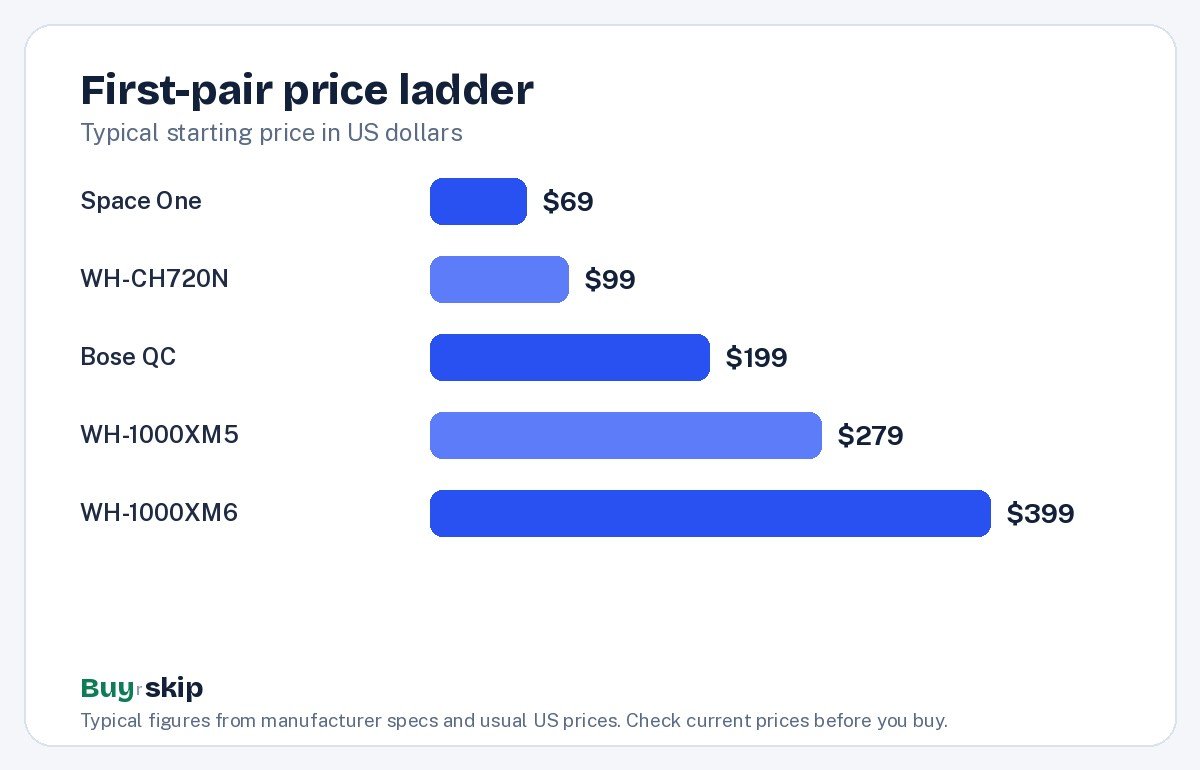
If you are buying your first pair, start with the Soundcore by Anker Space One (about $69–$99) if you want to spend as little as possible, or the Sony WH-CH720N (about $99–$149) if you want a lighter, simpler pair. If you know you will use them daily on flights or commutes, go straight to the Bose QuietComfort Headphones or the Sony WH-1000XM5. You do not need a $450 flagship to enjoy noise cancelling.
This guide to noise cancelling headphones for beginners is for anyone who has never owned a pair and feels a bit lost in the jargon. You will learn what noise cancelling actually feels like, which three questions matter, which terms you can safely ignore, and which first pair to buy at each budget. Our recommendations are based on manufacturer specs, warranty terms, independent review consensus and owner-feedback patterns, not on in-house trials.
The good news first: it is hard to buy a truly bad pair from the major brands in 2026. Even budget models now include real active noise cancelling. Your job is just to avoid overspending and pick a pair that fits your head, your phone and your routine.
What noise cancelling feels like the first time
Most first-time owners describe the same moment: they press the button and the room seems to drop away. The hum of the fridge, the air conditioner, the traffic outside all fade. It is genuinely impressive.
A few things surprise beginners, so it helps to know them in advance:
- Voices do not vanish. Active noise cancelling (ANC) is best at low, steady sounds like engines and fans. People talking nearby will sound quieter and farther away, but you will still hear them.
- Some people feel “pressure”. A small number of new users feel a sensation like being on a plane during descent, even though nothing is actually pressing on the ear. It usually fades within a few days. If it does not, most apps let you lower the ANC strength.
- Your own footsteps and voice sound odd. Walking with ANC on can make footsteps sound thumpy, and your voice sounds muffled. Transparency mode (more on that below) fixes this when you need it.
- You will turn the volume down. Because the background rumble is gone, you do not need to blast music to hear it. That is good news for your ears.
Three questions that pick your first pair
When you’re a beginner, how to choose noise cancelling headphones comes down to three questions. Answer them honestly and the right pair becomes obvious.
1. How often will you really use them?
Be realistic. If you are buying for a single trip or a bit of quiet at home on weekends, a budget pair is plenty. If you will wear them every day on a commute, in an open office, or on several flights a year, spending more pays off in comfort and stronger noise cancelling.
Simple rule: under an hour a day, stay under $150. Several hours a day, consider the $199–$399 range.
2. What phone do you have?
This matters less than you might think, but it is worth one minute:
- iPhone: every pair in this guide works well. You do not need to pay for extra codecs (the format your phone uses to send audio), because iPhones use one called AAC, which all of these support.
- Android: you have a little more choice, and Sony headphones can use a higher-quality codec called LDAC on many Android phones. It is a small bonus, not a reason to spend more.
If you are deeply invested in Apple gear, AirPods-style integration might tempt you. For a first pair, though, a cheaper option often makes more sense until you know you love the experience.
3. Do you wear glasses or have a sensitive head?
Comfort is the most common reason people return headphones. Glasses arms can break the seal around the ear and press into your head. If you wear glasses, prioritize soft, thick cushions and a gentle clamp. Bose models have a strong reputation in owner feedback for comfort, which is why the Bose QuietComfort Headphones are our step-up pick for beginners.
The jargon, decoded
Product pages throw a lot of terms at you. Here is what each one means and how much a beginner should care.
| Term | What it means | Should a beginner care? |
|---|---|---|
| ANC | Active noise cancelling: mics and electronics cancel outside noise | Yes, it is the whole point |
| Transparency or ambient mode | Pipes outside sound in so you can hear announcements or chat | Yes, you will use it daily |
| Passive isolation | Noise blocked by the ear cups themselves | A little, it comes with good fit |
| Multipoint | Connects to two devices at once, like phone and laptop | Yes if you work from home |
| Codec (AAC, LDAC, aptX) | How audio travels over Bluetooth | Barely, match it to your phone |
| Adaptive ANC | Adjusts cancelling automatically to your surroundings | Nice to have |
| Spatial audio | Makes sound seem to come from around you | Optional extra |
| Wear detection | Pauses music when you take them off | Handy, not essential |
| EQ | Sound settings in the app to adjust bass and treble | Yes, it fixes sound you dislike |
If you only remember three of these, make them ANC, transparency mode and multipoint.
How much to spend on your first pair
Here is a simple way to think about money, which is the heart of any beginner’s buying guide for noise cancelling headphones, without the overwhelm of a full comparison. If you want the deep dive with every spec and tier, our complete noise cancelling headphones buying guide covers it.
- About $69–$149: the starter zone. Real ANC, good battery, simple apps. Perfect for finding out whether ANC is for you.
- About $199–$399: the sweet spot. Noticeably stronger cancelling, better comfort and better microphones for calls.
- About $399 and up: the flagship zone. The best of everything. Great if you fly often, but not necessary for a first pair.
The best noise cancelling headphones for beginners, by budget
These are our beginner picks for noise cancelling headphones. They are chosen because they are easy to use, forgiving on fit and good value for what they do. Check the current price, since these move around often.
Best budget first pair Our verdict: Buy
Soundcore by Anker Space One
Typical price: $69–$99
Beginners who want to try real noise cancelling without spending much
- Pros
- ✓ strong ANC for under $100
- ✓ app with EQ to adjust the sound
- ✓ supports multipoint
- Cons
- ✕ plastic build feels basic
- ✕ comfort is good, not luxurious
Check price on Amazon Paid link
The Space One is the easiest recommendation for a cautious first purchase. If you end up loving ANC, you can upgrade later and keep these as a backup pair. [[button: Soundcore by Anker Space One]]
Lightest first pair Our verdict: Buy
Sony WH-CH720N
Typical price: $99–$149
Beginners who want something light and simple from a big-name brand
- Pros
- ✓ notably lightweight
- ✓ simple controls
- ✓ Sony app support
- Cons
- ✕ ANC is weaker than Sony's flagships
- ✕ plain design
Check price on Amazon Paid link
Best step-up first pair Our verdict: Buy
Bose QuietComfort Headphones
Typical price: $199–$349
Beginners who already know they will use headphones daily and want proven comfort
- Pros
- ✓ comfort widely praised by owners
- ✓ strong noise cancelling
- ✓ replaceable ear cushions
- Cons
- ✕ costs more than starter picks
- ✕ fewer extras than the Ultra model
Check price on Amazon Paid link
Best flagship-for-less Our verdict: Buy
Sony WH-1000XM5
Typical price: $279–$399
Beginners who want near-top performance and can catch it at a lower price
- Pros
- ✓ excellent ANC
- ✓ strong call quality
- ✓ often discounted since the XM6 launched
- Cons
- ✕ does not fold inward, so the case is bulky
- ✕ still a serious outlay
Check price on Amazon Paid link
Should a beginner just buy the flagship?
Only if you know you will use it a lot. The Sony WH-1000XM6 is our overall favorite in the category, with a folding design and about 30 hours of battery, and if you fly regularly it is worth every cent. But for most first-timers, a $69–$199 pair answers the real question, “do I like ANC?”, for a fraction of the cost.
What about earbuds instead?
If you hate the feeling of something on your head, or you want something pocketable, ANC earbuds are a fine first step. iPhone owners often start with the Apple AirPods Pro 3, and budget shoppers can try the Soundcore by Anker Liberty 4 NC. Over-ear headphones usually block more noise and are more comfortable for long flights, though. Our pros and cons guide compares headphones with earbuds and other options in detail.
Your first day with new headphones
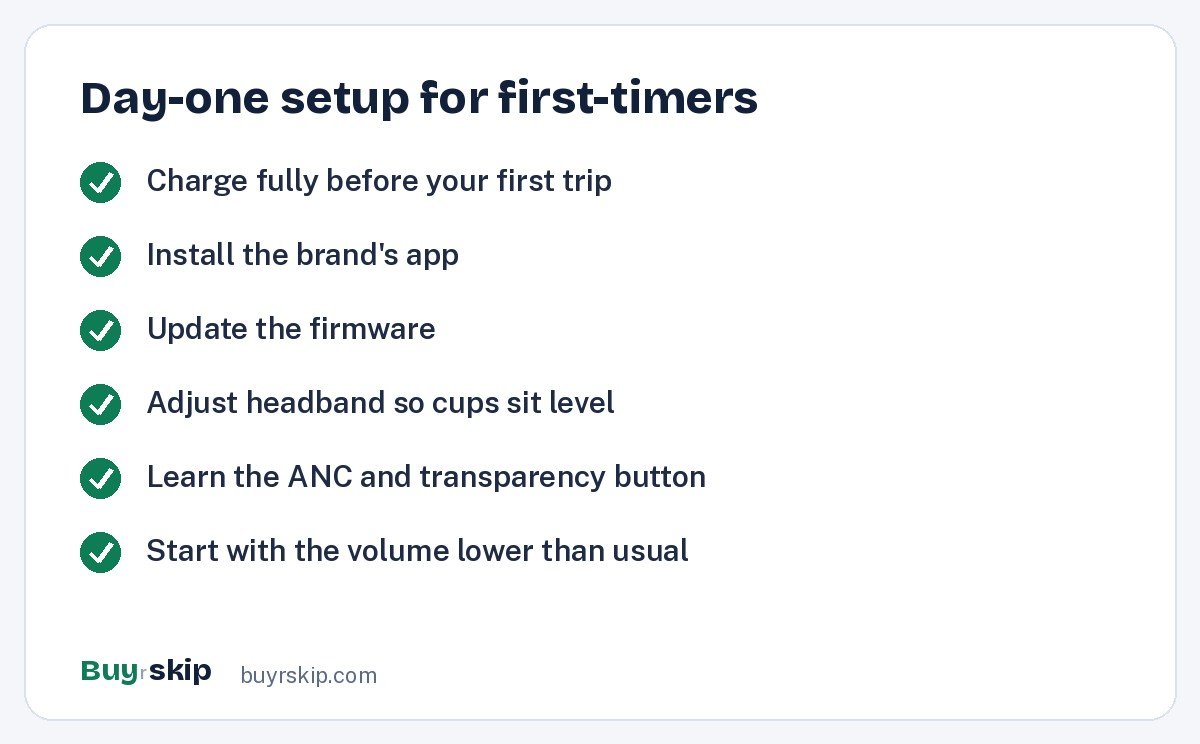
You do not need to master every setting. Do these few things on day one and you will get most of the benefit:
- Charge them fully before the first long session.
- Install the companion app from Sony, Bose or Soundcore. It unlocks the settings that matter.
- Update the firmware when the app prompts you. Updates often improve noise cancelling and connection stability.
- Try the fit. Move the cups until they surround your ears fully without pressing on them. Adjust the headband so the cups sit level.
- Learn the ANC button. Most pairs cycle between noise cancelling, transparency and off.
- Set the volume lower than usual and see how much detail you still hear.
When you are ready to go further, with EQ, adaptive modes and multipoint, our step-by-step setup tips for noise cancelling headphones walk through every setting.
Your first week: is this the right pair?
The first week is when you find out whether a pair suits you, and it usually falls inside the return window. Rather than tweaking every setting (our setup guide covers that), use these days to answer a few practical questions.
Day one to three: comfort
Wear them for a full evening at home, not just ten minutes. Notice where they press: the top of your head, behind your ears, or along your glasses arms. A little firmness at first is normal, as headbands and cushions settle slightly with use. Sharp pressure points or headaches after an hour are not normal, and they rarely go away. That is a sign to return them and try a different shape, not to push through.
Day three to five: real-world noise
Take them where you actually bought them for: the train, the office, a coffee shop, a noisy room at home. Ask yourself whether the noise that bothered you is now noticeably quieter. Remember that steady hum should drop away but voices will only soften. If the main noise in your life is people talking, you may get more benefit from adding quiet background music than from a more expensive pair.
Day five to seven: everyday habits
Check how the battery fits your routine. Do you need to charge every few days or once a week? Is the pairing reliable with your phone and laptop? Do the touch or button controls feel natural, or do you keep pausing music by accident? Small annoyances in week one tend to become big ones in month six.
Keep or return?
Keep them if they are comfortable for your longest normal session, they quiet the noise you care about, and they connect without fuss. Return them if any of those three fail. A model that suits your friend may not suit your head, and that is completely normal. Swapping a budget pair for the Sony WH-CH720N or a sweet-spot pair is a reasonable next step.
Beginner mistakes to avoid
A short list of the errors first-time buyers make most often:
- Overbuying. A $450 flagship is wasted if you wear it twice a month. Start in the starter zone or the sweet spot.
- Choosing on looks alone. Comfort matters far more than color. Read owner comments about long sessions.
- Ignoring the return policy. Buy where returns are easy, then wear the pair for a full evening at home before your trip.
- Using them at the gym. Sweat wears out ear cushions quickly. Keep over-ears for travel, work and home.
- Leaving ANC on while walking near traffic. Switch to transparency mode outdoors so you can hear cars and cyclists.
- Throwing them in a bag without the case. Hinges and headbands are the parts that break. Use the case.
If you care about a pair lasting years, our guide to durable noise cancelling headphones explains what to look for in build quality and replaceable parts.
Where to start shopping
When you are ready to browse, start with budget noise cancelling headphones under $100 to see starter options and current prices. If comfort with glasses is your main worry, look at comfortable ANC headphones for glasses wearers. And if you already know you want a step up, compare the Bose QuietComfort Headphones and the Sony WH-1000XM5 side by side, since they are the two most popular first upgrades.
For extra peace of mind, browse ANC headphones that include a carrying case, since a case protects the hinges that tend to fail first.
Frequently asked questions
Are noise cancelling headphones hard to use?
Not at all. Most pairs have one button for noise cancelling and transparency, plus simple play and volume controls. Pairing works like any Bluetooth device: hold the power or pairing button, then select the headphones on your phone. The companion app adds extra settings, but you can ignore most of them at first and still get great noise cancelling right out of the box.
Is a budget pair good enough for a beginner?
Yes. Budget models like the Soundcore by Anker Space One and Sony WH-CH720N include real active noise cancelling, which was rare at these prices a few years ago. You give up some comfort, build quality and ANC strength compared with flagships, but for a first pair they let you find out whether you enjoy ANC without a big commitment.
Will noise cancelling hurt my ears?
ANC does not damage hearing. In fact, it often helps, because you can listen at lower volume when background noise is reduced. The main thing to watch is volume: keep it moderate and take breaks during long sessions. Some beginners notice a pressure sensation at first; it usually fades, and lowering the ANC level in the app helps if it does not.
Can I use noise cancelling headphones without music?
Yes, and many people do. Turning on ANC with nothing playing is a popular way to quiet a noisy flight, train or open office, or to focus while reading. You will still hear voices faintly, but low rumble and fan noise drop away. Just remember the battery still drains with ANC on, so charge them before long trips.
Should my first pair be over-ear or earbuds?
For long flights, commutes and home use, over-ear headphones usually block more noise and feel more comfortable over hours. Earbuds are smaller, easier to carry and better for walking around or warm weather. If you are unsure, start with an affordable over-ear pair, since most beginners buy ANC for flights or focus, where over-ears are strongest.
Do I need an expensive phone to use them?
No. Any phone with Bluetooth works with every pair in this guide. iPhones use the AAC codec, which all of these support, and most Android phones work just as well. Higher-end codecs like LDAC are small bonuses for some Android phones, not requirements. Your phone will not limit noise cancelling, which happens inside the headphones.
The bottom line
You do not need to spend a fortune to enjoy noise cancelling. For most beginners, the Soundcore by Anker Space One or Sony WH-CH720N is a smart first pair, and the Bose QuietComfort Headphones are the step up if you already know you will wear them every day.
Pick your budget, think about comfort, check the current price, and buy where returns are easy. You can always upgrade once you know what you love.
Check price on Amazon: Soundcore by Anker Space One
Paid link. Typical price $69–$99; check the current price on Amazon.