We research products independently from specs, manufacturer documentation, warranty terms and owner feedback. When you buy through links on this page, we may earn a commission at no extra cost to you. As an Amazon Associate we earn from qualifying purchases.
Quick answer
Noise cancelling headphones are the best choice for flights, commutes and focused work, because they combine active cancelling with the passive seal of over-ear cushions. Their downsides are bulk, heat, price and a battery that eventually wears out. If you need portability, ANC earbuds are better; for sleep or loud concerts, foam earplugs win; for running near traffic, open-ear designs are safer. Regular wired headphones remain the cheapest way to get good sound.
This article lays out the noise cancelling headphones pros and cons honestly, then puts them side by side with the four realistic alternatives: ANC earbuds, regular (non-ANC) headphones, foam earplugs and open-ear designs. Each one solves a different problem, and plenty of people end up owning two. Our verdicts draw on manufacturer specs, warranty terms, independent review consensus and owner-feedback patterns, not on in-house trials.
If you have already decided on over-ear ANC and want help choosing a specific model, our noise cancelling headphones buying guide is the better starting point. This page is about whether ANC headphones are the right tool at all.
The pros of noise cancelling headphones
1. The strongest noise reduction you can wear and still listen to music
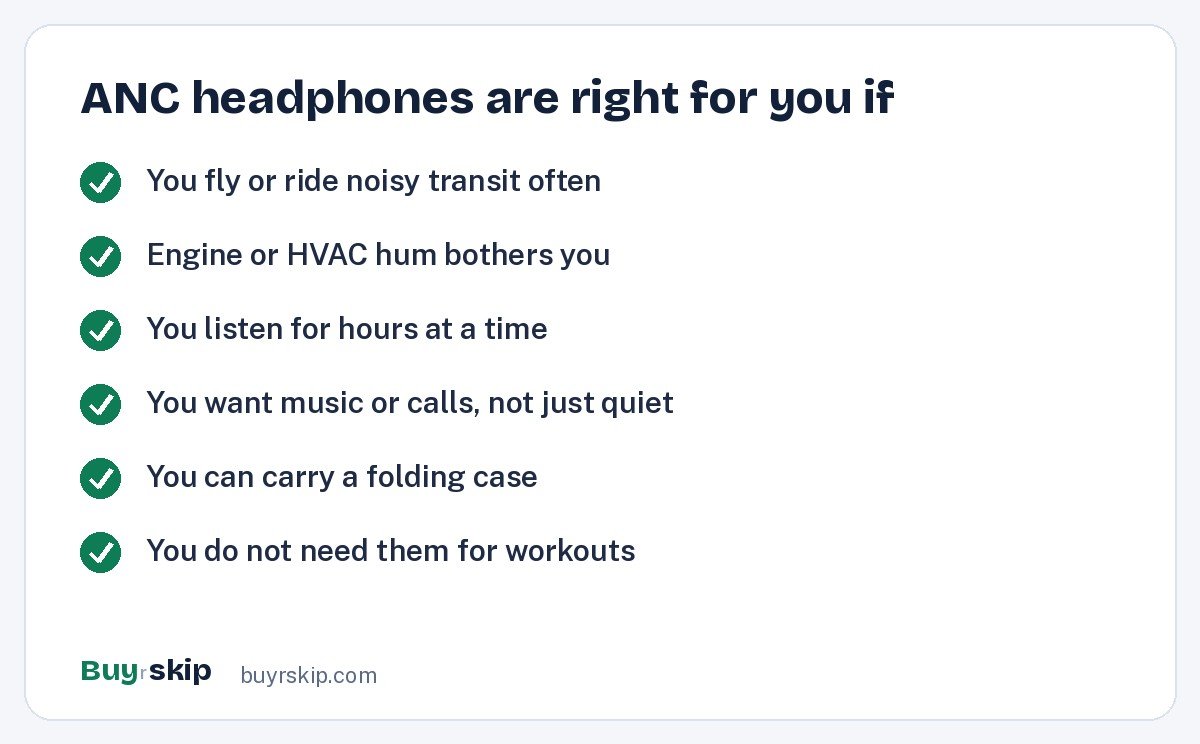
Over-ear ANC headphones stack two kinds of noise reduction. The ear cushions physically block sound (passive isolation), and microphones plus processing cancel what gets through (active cancelling). That combination is why flagship models like the Sony WH-1000XM6 and Bose QuietComfort Ultra Headphones (2nd Gen) are the reference point for quiet on planes and trains.
2. Excellent on engine rumble and HVAC hum
ANC is at its best on low, steady sounds: jet engines, bus and train drone, air conditioning, server rooms, the constant hum of an office. If those are the noises that bother you, over-ear ANC is hard to beat.
3. Lower listening volume, which is kinder to your ears
When background rumble is reduced, you do not need to crank the volume to hear detail. Many owners find they listen noticeably quieter on a flight with ANC than without it. That is one of the most practical benefits, and it applies to every price tier.
4. Comfort for long sessions
Good over-ear headphones spread their weight across your head rather than pressing into your ear canal. For multi-hour flights or full workdays, many people find them more comfortable than earbuds. Owner feedback is especially positive on Bose models in this respect.
5. Long battery life
Bigger housings hold bigger batteries. The Sony WH-1000XM6 is rated for about 30 hours, and the Sennheiser Momentum 4 Wireless for around 60 hours. Earbuds, by comparison, need their case to stretch through a long day.
6. Useful extras
Transparency mode, multipoint connection to a phone and laptop, good call microphones and a wired backup option on many models make ANC headphones a strong all-in-one tool for travel and work.
The cons of noise cancelling headphones
1. Bulk and weight
Even folding models take up real space in a bag, and some premium pairs are heavy. The Apple AirPods Max (USB-C) are a known example: premium build, but a weight that some owners find tiring.
2. Heat
Over-ear cushions trap warmth. In summer, on a hot commute or at the gym, they can get sweaty and uncomfortable, and sweat shortens ear pad life.
3. Voices and sudden sounds still get through
ANC tames rumble, not chatter. Colleagues talking, a crying baby or a slammed door will be quieter but still audible. People who buy ANC expecting total silence are often disappointed.
4. The pressure sensation
Some people feel a sensation like ear pressure on a descending plane when ANC is on. It often fades within days, and lowering the ANC level helps, but a few people never get used to it.
5. Price and a finite lifespan
Good ANC costs more than equivalent sound without it, and the electronics add parts that can fail. Batteries slowly lose capacity over years, and ear pads compress. Models with replaceable pads, like the Bose QuietComfort Headphones, age better. Our guide to the most durable noise cancelling headphones goes deeper on longevity.
6. Reduced awareness
With ANC on, you hear less of the world around you, including traffic, cyclists and announcements. Transparency mode solves this, but you have to remember to use it.
Noise cancelling headphones pros and cons vs the alternatives
Here is the comparison of pros and cons that matters most: ANC headphones next to each realistic alternative. Think of it as a short buying guide for noise cancelling headphones vs the alternatives. Prices are typical ranges; check current prices before buying.
| Option | Noise reduction | Portability | Best for | Main drawback | Typical price |
|---|---|---|---|---|---|
| ANC headphones | Strongest overall, best on rumble | Low to medium | Flights, commutes, focus work | Bulky, warm | about $69–$549 |
| ANC earbuds | Strong, depends on ear tip seal | Excellent | Daily carry, walking, warm weather | Shorter battery per charge, fit varies | about $59–$299 |
| Regular headphones | Passive only, varies by design | Low to medium | Home listening, budget | No active cancelling | varies widely |
| Foam earplugs | Strong passive, no audio | Excellent | Sleep, concerts, loud work | No music or calls | low cost |
| Open-ear designs | None, by design | Excellent | Running, cycling, awareness | Leak sound, no isolation | varies widely |
ANC headphones vs ANC earbuds
This is the closest contest. Earbuds have caught up dramatically, and the Bose QuietComfort Ultra Earbuds (2nd Gen) are widely regarded as having the strongest ANC in the earbud category. iPhone owners get excellent integration with the Apple AirPods Pro 3, while Android owners who want LDAC support can look at the Sony WF-1000XM5.
Choose earbuds if: you want something pocketable, you walk or commute in warm weather, you wear glasses that break an over-ear seal, or you dislike anything on your head.
Choose headphones if: you take long flights, want the most battery per charge, find earbuds uncomfortable after an hour, or want the strongest low-frequency cancelling available.
Earbud fit is the wild card. Their noise cancelling depends heavily on the ear tip seal, so try every tip size included in the box.
ANC headphones vs regular headphones
Regular wired or wireless headphones without ANC can sound excellent for the money, and closed-back designs still block some noise passively. Open-back headphones, loved for home listening, block almost nothing and leak sound to people nearby.
Choose regular headphones if: you listen mainly at home in a quiet room, you want the most sound quality per dollar, or you prefer a simple wired connection with no battery to manage. Browse closed-back wired headphones if you want some isolation without ANC.
Choose ANC headphones if: you listen anywhere with engine, traffic or HVAC noise. Without ANC you will tend to turn the volume up to compensate.
ANC headphones vs foam earplugs
Foam earplugs are the underrated alternative. They are cheap, tiny and very effective at passive blocking when inserted correctly, and packaging lists a noise reduction rating (NRR) so you can compare them. They do not play audio, though.
Choose foam earplugs if: you need to sleep (ANC headphones are uncomfortable on a pillow), you are at a concert or using loud tools, or you just want quiet for very little money. Look at foam earplugs for sleeping or high-fidelity concert earplugs, which reduce volume more evenly so music still sounds natural.
Choose ANC headphones if: you want quiet plus music, podcasts or calls.
A practical combo some frequent flyers use: earplugs for the overnight leg, ANC headphones for the movie.
ANC headphones vs open-ear designs
Open-ear headphones, including bone conduction and air conduction styles, sit outside or just in front of the ear canal. They intentionally block nothing, which is exactly the point.
Choose open-ear if: you run or cycle near traffic, want to hear your surroundings at work, or find anything in or over your ears uncomfortable. See open-ear headphones for running.
Choose ANC headphones if: your goal is to reduce noise. Open-ear designs cannot do that, and on a noisy train you will struggle to hear them.
Which one should you pick? Quick decision guide
The right answer depends less on specs and more on where you are when the noise bothers you. Here is how to choose between ANC headphones and the alternatives, situation by situation.
Daily commute
On a bus or train, low engine drone is the main enemy, which is exactly what ANC handles best. If you stand, walk between connections or commute in warm weather, ANC earbuds are usually the more practical choice because they fit in a pocket and do not trap heat. If you sit for 30 minutes or more each way, over-ear ANC headphones give you more quiet and more battery. Either way, switch to transparency mode on platforms and crosswalks so you hear announcements and traffic.
Open office
Offices mix HVAC hum, which ANC cancels well, with conversations, which it only softens. Over-ear ANC headphones with soft cushions help most here because the passive seal takes the edge off voices. Add quiet background music or white noise to mask what gets through. Prioritize multipoint and a good microphone if you take calls from a laptop and a phone. Earbuds work too, but can get uncomfortable over a full workday.
Flights
Over-ear ANC headphones are the clear winner. Jet engine noise is steady and low, long flights reward comfort and battery life, and a folding case keeps them manageable. The Bose QuietComfort Ultra Headphones (2nd Gen) are the comfort pick and the Sony WH-1000XM6 the all-rounder. Pack a cheap set of foam earplugs as well for sleeping on overnight legs.
Sleep
Skip over-ear headphones. They press on your head when you lie on your side and often slide off. Foam earplugs are the simple, low-cost answer. If you want audio while you fall asleep, look for slim earbuds designed for sleep rather than standard ANC buds, which can stick out and become uncomfortable on a pillow.
Running and cycling
Choose open-ear designs. Hearing cars, cyclists and other people matters more than blocking noise, and over-ear headphones get sweaty fast. If you must use ANC earbuds outdoors, keep them in transparency mode the whole time.
Kids
Adult ANC headphones are often too large and too loud for children. Look for volume-limited headphones made for kids, which cap the maximum output, and keep sessions moderate. On a flight, a lower-cost adult over-ear pair like the Soundcore by Anker Space One can help an older child listen quieter, but set the volume yourself and check in often.
Tight budget, any situation
You can still get real ANC: the Soundcore by Anker Space One for over-ear or the Soundcore by Anker Liberty 4 NC for earbuds, both typically under $100.
Picks if you decide on ANC (or an alternative)
If the pros win you over, these are the models with the strongest review consensus and owner feedback in each lane. Prices are typical ranges, so check the current price.
Best ANC headphones overall Our verdict: Buy
Sony WH-1000XM6
Typical price: $399–$459
Travelers and commuters who want the most complete over-ear package
- Pros
- ✓ class-leading noise cancelling
- ✓ folding design
- ✓ about 30 hours of battery
- Cons
- ✕ premium price
- ✕ bulkier than any earbud
Check price on Amazon Paid link
Most comfortable Our verdict: Buy
Bose QuietComfort Ultra Headphones (2nd Gen)
Typical price: $379–$449
People who wear headphones for many hours, especially on flights
- Pros
- ✓ top-tier ANC
- ✓ comfort widely praised
- ✓ immersive audio mode
- Cons
- ✕ premium price
- ✕ warm in hot weather
Check price on Amazon Paid link
Best budget headphones Our verdict: Buy
Soundcore by Anker Space One
Typical price: $69–$99
Anyone who wants to try over-ear ANC for under $100
- Pros
- ✓ strong ANC for the price
- ✓ app with EQ
- ✓ multipoint
- Cons
- ✕ plastic build
- ✕ less refined comfort
Check price on Amazon Paid link
Best earbud alternative Our verdict: Buy
Bose QuietComfort Ultra Earbuds (2nd Gen)
Typical price: $249–$299
People who want maximum noise cancelling in a pocketable size
- Pros
- ✓ strongest ANC in earbuds
- ✓ compact case
- ✓ comfortable fit options
- Cons
- ✕ pricey for earbuds
- ✕ battery per charge shorter than headphones
Check price on Amazon Paid link
Best for iPhone owners Our verdict: Buy
Apple AirPods Pro 3
Typical price: $229–$249
iPhone users who want seamless switching and strong ANC in earbuds
- Pros
- ✓ tight Apple integration
- ✓ strong transparency mode
- ✓ easy pairing
- Cons
- ✕ best features need Apple devices
- ✕ no LDAC
Check price on Amazon Paid link
Best budget earbuds Our verdict: Buy
Soundcore by Anker Liberty 4 NC
Typical price: $59–$99
Budget shoppers who want real ANC in earbuds
- Pros
- ✓ real ANC under $100
- ✓ app EQ
- ✓ small case
- Cons
- ✕ ANC a step behind premium buds
- ✕ basic materials
Check price on Amazon Paid link
Check price on Amazon: Sony WH-1000XM6
Paid link. Typical price $399–$459; check the current price on Amazon.
The cost picture
Price is one of the clearest trade-offs. Here is what entry and premium options typically start at in each ANC category.
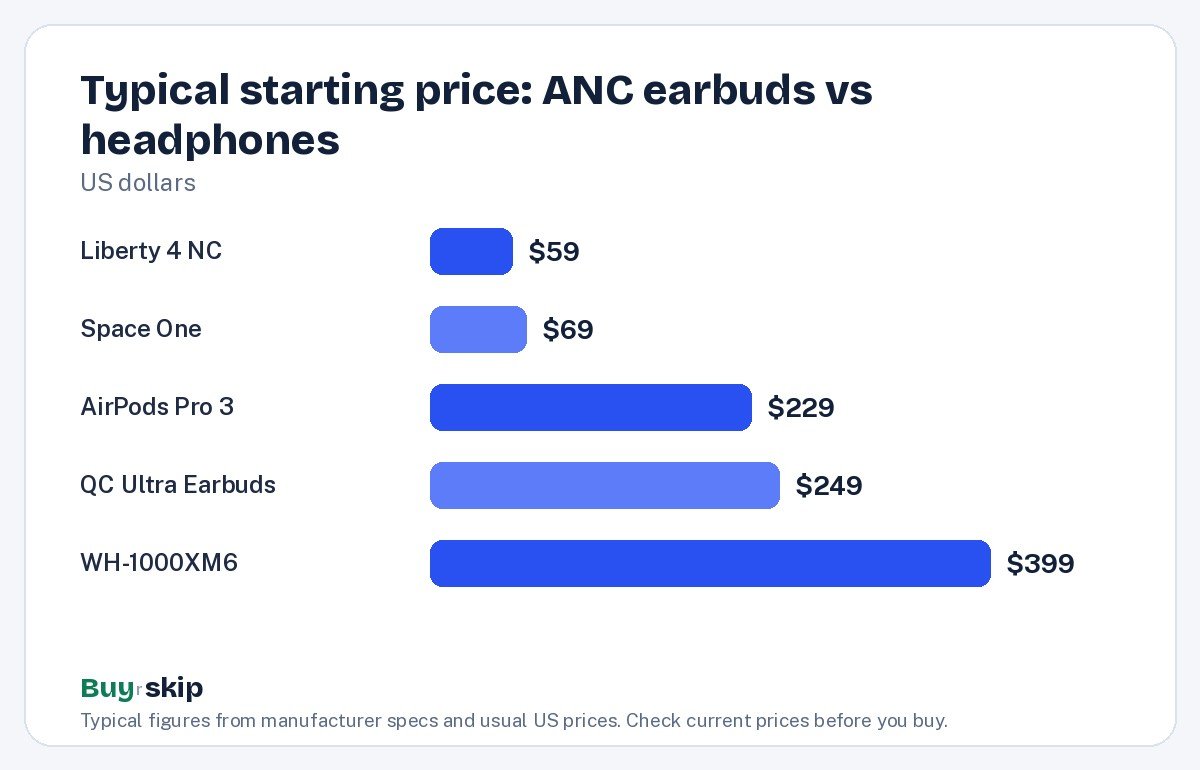
The takeaway: you can get real ANC in either form factor for under $100. The jump to premium buys stronger cancelling, better microphones and more comfort, which matters most if you use them for hours every day.
Getting the most from whatever you choose
Whichever option you pick, a few habits help:
- Keep the volume moderate. ANC makes this easier, but it is still on you.
- Use transparency mode outdoors near traffic.
- Store headphones in their case to protect hinges and headbands.
- Update firmware from the companion app; updates can improve ANC and connections.
New owners should read our setup tips for noise cancelling headphones for the first-day settings, and first-time buyers will find a simpler path in our beginner's guide.
Frequently asked questions
What is the biggest downside of noise cancelling headphones?
For most owners, it is bulk and heat. Over-ear headphones take up space in a bag and get warm in summer or on a crowded commute. The second most common complaint is that voices still come through, because ANC works best on low, constant noise. Price and gradual battery wear are the other trade-offs to weigh.
Are ANC earbuds as good as ANC headphones?
The best earbuds come close, and some match mid-tier headphones. Over-ear headphones still tend to lead on long-flight comfort, battery per charge and low-frequency cancelling, because the cushions add passive isolation. Earbuds win on portability and warm-weather comfort. Fit matters a lot with earbuds, so try every ear tip size included.
Are foam earplugs better than noise cancelling headphones?
For pure quiet with no audio, foam earplugs can be very effective and cost very little. They are the better choice for sleep and for loud events. But they do not play music or take calls, and some people find them uncomfortable over many hours. Many travelers carry both and switch depending on the situation.
Are noise cancelling headphones bad for your ears?
No. ANC does not harm hearing, and it can help, because you can listen at a lower volume when background noise is reduced. The real risk with any headphones is high volume over long periods. A minority of people feel a pressure sensation from ANC; lowering the cancelling level or using an adaptive mode usually helps.
Can I sleep in noise cancelling headphones?
Most people find over-ear headphones uncomfortable for sleeping, especially on their side, and they can slip off. Foam earplugs or small sleep-focused earbuds are usually better for that. ANC headphones do work well for naps sitting upright on planes or trains, where their comfort and cancelling shine.
Are open-ear headphones a good alternative?
Only if you want awareness rather than quiet. Open-ear designs leave your ears uncovered so you hear traffic and people around you, which makes them popular for running and cycling. They provide no noise reduction and leak some sound to people nearby, so they are not a substitute for ANC on a plane or in a busy office.
The bottom line
Noise cancelling headphones are the best tool for flights, noisy commutes and focus work, and their downsides are mostly bulk, heat and price. If those trade-offs bother you, ANC earbuds cover most of the same ground in your pocket, foam earplugs are the cheap answer for sleep, and open-ear designs are for staying aware outdoors.
If you decide over-ear ANC is for you, the Sony WH-1000XM6 is the safest all-round pick. Check the current price and buy where returns are easy.
Check price on Amazon: Sony WH-1000XM6
Paid link. Typical price $399–$459; check the current price on Amazon.