We research products independently from specs, manufacturer documentation, warranty terms and owner feedback. When you buy through links on this page, we may earn a commission at no extra cost to you. As an Amazon Associate we earn from qualifying purchases.
Quick answer
For most homes, the best battery backup for home power outage protection is a 1 to 2 kWh portable power station with LiFePO4 cells, such as the Anker SOLIX C1000 or Jackery Explorer 2000 Plus, which can run a router, lights, phones, a CPAP and a refrigerator for hours. If you need a well pump, sump pump or other 240V loads, step up to the EcoFlow DELTA Pro 3 or Anker SOLIX F3800 with a transfer switch. For multi-day outages on a budget, a generator wins, outdoors only.
Choosing the best battery backup for home power outage use starts with one question: what do you actually need to keep running, and for how long? This guide shows you how to size backup power using your own appliances, compares portable power stations, installed home batteries and fuel generators, and covers the safety rules that matter most. Our picks are based on manufacturer specs and documentation, warranty terms, independent review consensus and owner-feedback patterns.
Watts vs watt-hours in plain English
Two numbers decide whether a battery can handle your outage.
- Watts (W) are how much power something draws at a moment. The power station’s output rating must be higher than the combined watts of everything running at once.
- Watt-hours (Wh) are how much energy the battery stores. Capacity decides how long things run. 1,000 Wh is 1 kWh.
A 100 W load running for 10 hours uses 1,000 Wh. So a 1 kWh station can, in rough terms, run that load for 10 hours, minus losses. Inverter and conversion losses mean you get something like 80 to 90 percent of the rated capacity as usable AC power, so plan with that margin.
There is a third number: surge watts. Motors in refrigerators, sump pumps and well pumps draw several times their running watts for a second or two when they start. A station that cannot handle the surge will shut off even if the running watts look fine.
How to size your backup: typical appliance watts
The ranges below are approximate and vary a lot by model and age. Check the label on your appliance or its manual for its actual rating, or measure real use with a plug-in electricity usage monitor. Labels often show the maximum draw, so real average use is usually lower.
| Appliance | Typical running watts (approx.) | Startup surge | Notes |
|---|---|---|---|
| Wi-Fi router and modem | 10–30 W | None | Small load, big quality-of-life impact |
| LED light bulb | 5–15 W each | None | A few bulbs barely dent a battery |
| Phone or tablet charging | 5–20 W | None | Laptops more like 30–100 W |
| CPAP machine | 30–60 W | None | Heated humidifier and tubing can more than double it |
| Refrigerator | 100–250 W while compressor runs | Several times running watts | Cycles on and off; often 1–2 kWh per day |
| Chest freezer | 50–150 W | Several times running watts | Efficient and holds cold well if kept closed |
| Furnace blower (gas furnace) | 300–800 W | Moderate | Some furnaces need hardwired connection |
| Sump pump (1/3 to 1/2 HP) | 800–1,500 W | 2–3 times running watts | Runs in bursts during storms |
| Well pump | 1,000–2,500 W | Very high | Often 240V; needs a 240V-capable system |
Some loads simply do not belong on a battery during an outage: electric ranges, electric dryers, space heaters and central air conditioning draw thousands of watts. If you need those, you are looking at an installed home battery system or a large generator.
A worked example
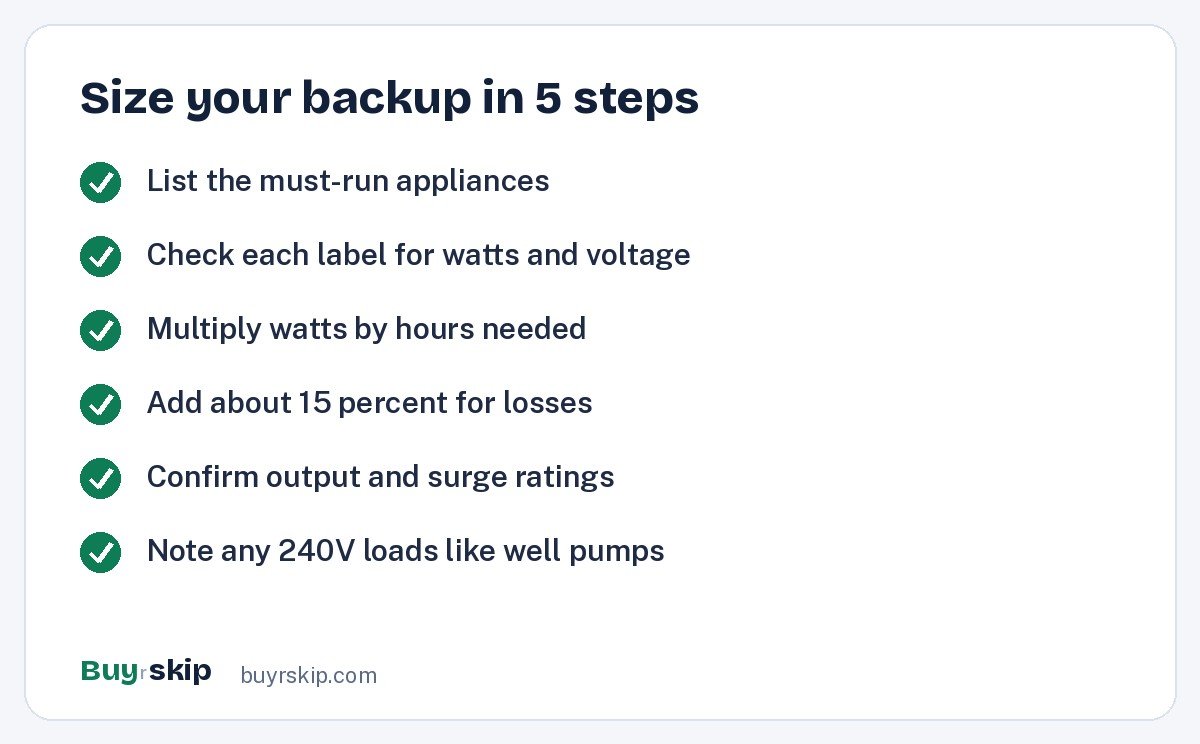
Here is how a typical essentials list adds up over 24 hours. Your numbers will differ, so swap in your own.
- Router and modem: 20 W × 24 h = 480 Wh
- Refrigerator: about 1,500 Wh per day (cycling)
- Four LED bulbs: 40 W × 5 h = 200 Wh
- CPAP without humidifier: 40 W × 8 h = 320 Wh
- Phones and a laptop: about 150 Wh
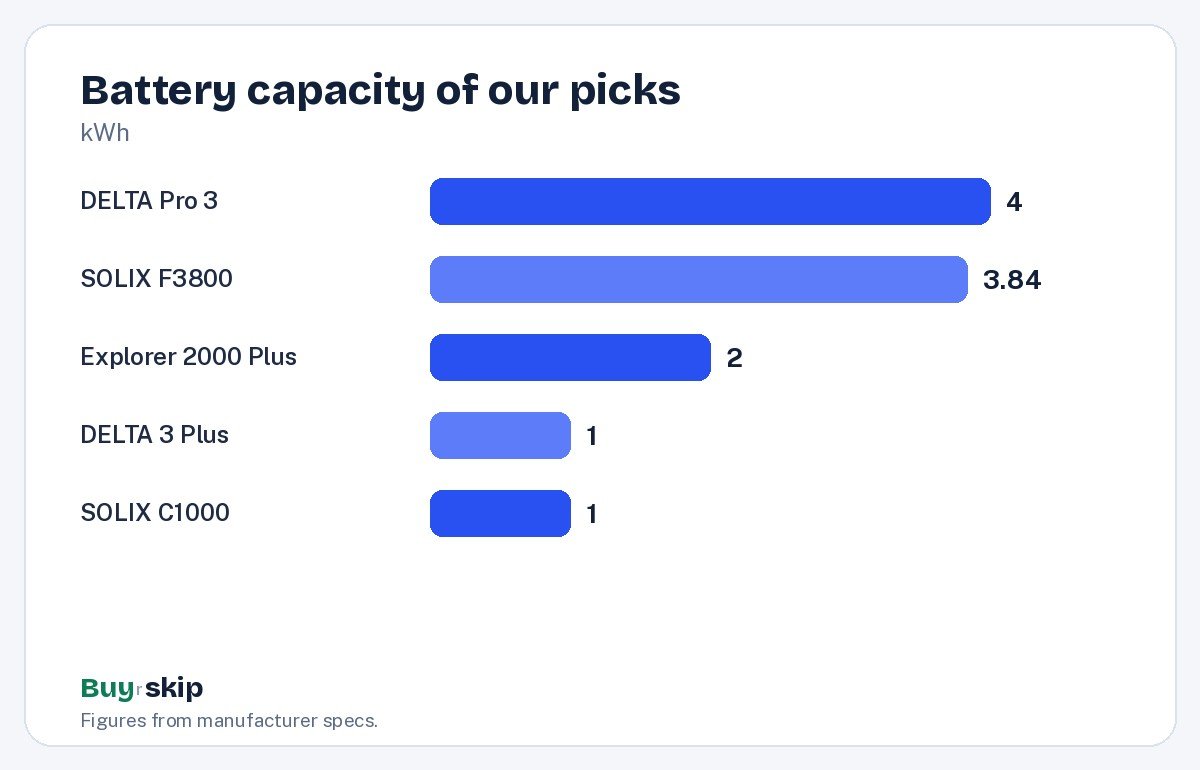
That is about 2,650 Wh. Divide by 0.85 for losses and you need roughly 3,100 Wh for a full day. A 2 kWh station covers most of a day; a 4 kWh system covers a full day with room to spare, or several days if you add solar recharging. If you only need the router, lights and phones, a 1 kWh station lasts well over a day.
Portable power stations vs installed home batteries vs generators
There are three ways to keep the lights on. Each has a clear place.
| Factor | Portable power station | Installed home battery | Fuel generator |
|---|---|---|---|
| Typical cost | About $449–$3,799 for the models here | Installer quote; usually far more than a portable station | About $999–$5,499 for the models here |
| Capacity | About 1–4 kWh, many expandable | Larger, often stackable | Unlimited while fuel lasts |
| 240V loads | Only on 120/240V models | Yes, typically | Yes on larger models |
| Installation | None for plug-in use; electrician for home connection | Licensed installer required | None for cords; electrician for transfer switch |
| Indoor use | Safe indoors | Installed indoors or outdoors per code | Never: outdoors only |
| Noise | Near silent | Silent | Loud, inverters quieter |
| Recharging | Wall, solar, car | Grid and solar | Gas or propane refills |
| Upkeep | Minimal | Minimal | Oil changes, fuel storage, test runs |
Portable power stations
A portable power station is a battery, inverter and outlets in one box. You plug appliances directly into it, or have an electrician install a transfer switch or smart panel so it can feed selected household circuits. The current models on this page use LiFePO4 (lithium iron phosphate) cells, which are rated for thousands of charge cycles and are well suited to years of standby duty. Confirm the chemistry on the listing before you buy any brand.
Many stations also offer UPS or EPS switchover: if the grid drops while devices are plugged in through the station, it takes over quickly enough that most electronics keep running. That is useful for CPAP machines and home offices.
Installed home batteries
Wall-mounted systems like the Tesla Powerwall 3, Enphase IQ Battery 5P and FranklinWH aPower 2 are sold and installed through certified installers, not bought off a shelf. They connect to your electrical panel, switch over automatically and often pair with rooftop solar. They are the most seamless option and can back up larger loads, but cost, permits and installation timelines are significant. Get at least two installer quotes and ask exactly which circuits will be backed up.
Fuel generators
A generator delivers the most power per dollar and runs as long as you keep fueling it. That makes it the practical answer for long outages and heavy loads like well pumps on a budget. The trade-offs are noise, fuel storage, maintenance and a serious carbon monoxide hazard covered below. If your outages come with winter storms, the same storage and fuel planning applies to a snow blower; see our guide to the best snow blowers for heavy snowfall.
The best battery backup for home power outage needs: our picks
These picks cover everything from a router-only UPS to whole-home style backup. Prices are typical ranges, so check the current price before buying.
Best overall Our verdict: Buy
EcoFlow DELTA Pro 3
Typical price: $2,999–$3,799
Homeowners who want whole-home style backup for essential circuits, including 240V loads
- Pros
- ✓ 4 kWh capacity, expandable
- ✓ 120/240V output for well pumps and similar loads
- ✓ Works with a transfer switch or EcoFlow Smart Home Panel
- Cons
- ✕ Heavy, best on wheels
- ✕ Premium price
Check price on Amazon Paid link
Best for high-power loads Our verdict: Buy
Anker SOLIX F3800
Typical price: $2,399–$3,499
Homes with big surge loads that want 240V output without a generator
- Pros
- ✓ 6,000W output with 120/240V
- ✓ 3.84 kWh, expandable
- ✓ Can feed a home panel via transfer switch
- Cons
- ✕ Large and heavy
- ✕ Costs as much as a good generator
Check price on Amazon Paid link
Best for fridge and essentials Our verdict: Buy
Jackery Explorer 2000 Plus
Typical price: $1,499–$2,199
Families who want a fridge, internet and lights through a long evening outage
- Pros
- ✓ 2 kWh, expandable with extra batteries
- ✓ Portable with wheels and handle
- ✓ Simple to use
- Cons
- ✕ Expansion adds cost quickly
- ✕ Not a whole-home solution
Check price on Amazon Paid link
Best for CPAP and home office Our verdict: Buy
EcoFlow DELTA 3 Plus Portable Power Station
Typical price: $699–$899
People who need devices to stay on without interruption when the grid drops
- Pros
- ✓ Fast UPS-style switchover
- ✓ About 1 kWh for essentials
- ✓ Compact enough for a bedroom
- Cons
- ✕ Too small for well pumps
- ✕ Fridge runtime measured in hours, not days
Check price on Amazon Paid link
Best value Our verdict: Buy
Anker SOLIX C1000 Portable Power Station
Typical price: $449–$649
Budget-minded buyers who want a capable 1 kWh station for essentials
- Pros
- ✓ Many outlets
- ✓ Fast wall recharge
- ✓ Strong value per kWh
- Cons
- ✕ 1 kWh limits fridge runtime
- ✕ Not 240V capable
Check price on Amazon Paid link
Best for internet only Our verdict: Buy
APC Back-UPS 600VA BE600M1
Typical price: $69–$89
Anyone who just wants Wi-Fi and the modem to survive short outages
- Pros
- ✓ Inexpensive
- ✓ Keeps the router online through blips
- ✓ Replaceable battery
- Cons
- ✕ Small capacity for short outages
- ✕ Not for appliances
Check price on Amazon Paid link
Best gas alternative Our verdict: Buy
Westinghouse WGen9500DF Dual Fuel Generator
Typical price: $999–$1,399
Rural homes with well pumps and long outages that need maximum power per dollar
- Pros
- ✓ Lots of power for the money
- ✓ Runs on gasoline or propane
- ✓ Electric start
- Cons
- ✕ Must run outdoors only
- ✕ Loud and needs maintenance
Check price on Amazon Paid link
Two more worth knowing: the Jackery Explorer 1000 v2 Portable Power Station is a lighter 1 kWh alternative to the Anker if you plan to carry it between rooms, and the Honda EU7000iS Inverter Generator is the premium generator choice, notably quieter than open-frame models and well suited to sensitive electronics.
Which one should you buy?
- Router and modem only: the APC Back-UPS 600VA BE600M1 is all you need.
- Router, lights, phones and a CPAP: a 1 kWh station like the Anker SOLIX C1000 Portable Power Station or EcoFlow DELTA 3 Plus Portable Power Station.
- Add a refrigerator for most of a day: the Jackery Explorer 2000 Plus.
- Well pump, sump pump or several circuits: the EcoFlow DELTA Pro 3 or Anker SOLIX F3800, connected by an electrician.
- Multi-day outages, lowest cost per hour: a generator like the Westinghouse WGen9500DF Dual Fuel Generator, run outdoors, ideally paired with a small battery for overnight quiet.
- Whole house, automatic, with solar: get installer quotes for an installed home battery.
For many households, the best home backup battery setup is a hybrid: a power station for quiet, indoor essentials and a generator for long outages, with the generator recharging the station during the day.
Connecting backup power to your home safely
Running extension cords works for plug-in appliances. Anything hardwired, like a well pump, furnace or sump pump on a dedicated circuit, needs a proper connection.
- Transfer switch or smart panel: lets a power station or generator feed selected circuits while isolating your home from the grid. EcoFlow and Anker both sell home panel options for their larger stations. Have a licensed electrician install it and pull any required permit.
- 120V vs 240V: most portable stations output 120V only. Well pumps and some furnaces and pumps need 240V, which is why the DELTA Pro 3 and SOLIX F3800 matter.
- Never backfeed: do not plug a generator or station into a wall or dryer outlet with a double-ended cord. It can energize utility lines and injure line workers, and it is a fire risk.
- Use the right cords: heavy-gauge, outdoor-rated extension cords sized for the load, run where nobody trips on them.
Recharging during a long outage
A battery is only as useful as your ability to refill it. Plan at least two recharge paths:
- Solar panels. Portable solar panels can recharge a station during the day; output depends heavily on sun, season and panel angle. Check the station’s maximum solar input before buying panels.
- Car charging. Slow, but handy in a pinch. Run the car outdoors only, never in an attached garage.
- Generator. A small generator can recharge a station during the day, so the house stays quiet at night.
Keep your station charged during storm season and top it up every few months in storage.
Safety: carbon monoxide and other risks
Generators produce carbon monoxide, an odorless gas that can kill within minutes. Follow these rules every time:
- Never run a generator indoors, in a garage, basement, crawlspace or shed, even with doors or windows open.
- Place it at least 20 feet from the home, with the exhaust pointed away from doors, windows and vents.
- Install battery-powered carbon monoxide alarms on every level of your home and outside sleeping areas, and test them before storm season.
- Let the engine cool before refueling, and store fuel in approved containers away from the house.
Battery power stations do not produce exhaust and are safe to use indoors. Keep their vents clear, keep them away from water and heat sources, and follow the manufacturer’s guidance on extension cords and charging.
If the generator hum keeps you awake, noise cancelling headphones are good at steady engine noise; our beginner's guide to noise cancelling headphones explains what to buy.
Incentives and rebates
Incentives for batteries and solar change often and depend on where you live and how the system is installed. We do not assume any specific credit applies. Check DSIRE (the Database of State Incentives for Renewables and Efficiency) and your local utility for current programs, and confirm anything tax-related with a tax professional before you count on it.
Mistakes to avoid
- Buying by capacity alone. A large battery with a weak inverter cannot start a well pump.
- Forgetting surge. Motors need several times their running watts to start.
- Ignoring 240V. If your well pump is 240V, a 120V station will not run it, whatever its size.
- Letting it sit empty. A station stored at zero for months is a dead brick when the storm hits.
- Powering a big TV for hours. Large TVs draw meaningful watts; if you are shopping for a new one, our TV buying guide covers efficient choices.
Frequently asked questions
How long will a power station run my refrigerator?
It depends on the fridge and how often it cycles. Many full-size refrigerators use roughly 1 to 2 kWh per day, so a 1 kWh station may give several hours to most of a day, while a 2 kWh station can often cover a full day. Check your fridge’s label or measure it with a plug-in meter, keep the door closed, and make sure the station can handle the compressor’s startup surge.
Can a battery backup run a well pump?
Yes, if it has enough output and the right voltage. Many well pumps run on 240V and draw a large startup surge, so you need a 120/240V system such as the EcoFlow DELTA Pro 3 or Anker SOLIX F3800, connected through a transfer switch installed by a licensed electrician. Check the pump’s label for voltage and horsepower before you buy anything.
Can I run a CPAP on a portable power station?
Most CPAP machines draw modest power, so a 1 kWh station can usually run one through several nights without the heated humidifier. The humidifier and heated tubing can more than double the draw. Some CPAP makers sell DC power adapters that avoid inverter losses. Check your machine’s manual and talk with your equipment supplier or doctor about backup power plans.
Is a generator or a battery better for power outages?
Batteries are silent, safe indoors and need almost no maintenance, but capacity is limited. Generators supply far more power for as long as fuel lasts, but they are loud, need upkeep and must run outdoors because of carbon monoxide. For short and medium outages, a battery is easier. For long outages or heavy 240V loads on a budget, a generator or a hybrid setup makes more sense.
Are there tax credits for home batteries?
Incentive programs for batteries and solar change over time and vary by state and utility, so we do not assume any credit is available. Search DSIRE for programs where you live, ask your utility about rebates or demand-response programs, and ask installers what applies to your system. Confirm anything tax-related with a qualified tax professional.
Is it safe to keep a power station indoors?
Yes. Battery power stations produce no exhaust, so they are designed for indoor use. Keep the vents clear, place them on a stable surface away from water and heat, and use them as the manual directs. LiFePO4 chemistry is known for thermal stability. Never apply that logic to fuel generators, which must always run outdoors, well away from the house.
The bottom line
The right backup depends on your list: a small UPS for internet, a 1 to 2 kWh power station for essentials and a CPAP, a 120/240V system for well pumps and home circuits, or a generator for long outages. Size it from your own appliance labels, not from guesswork.
For most homes that want real flexibility, the EcoFlow DELTA Pro 3 is the best battery backup for home power outage protection that you can buy without an installer, and it grows with you. Check the current price before you buy.
Check price on Amazon: EcoFlow DELTA Pro 3
Paid link. Typical price $2,999–$3,799; check the current price on Amazon.