We research products independently from specs, manufacturer documentation, warranty terms and owner feedback. When you buy through links on this page, we may earn a commission at no extra cost to you. As an Amazon Associate we earn from qualifying purchases.
Quick answer
To compare smartwatches, start with your phone: Apple Watch only works with an iPhone, while Samsung and Pixel watches are built for Android. Then match battery life to how you will use it (daily charging for a full smartwatch, several days or more for Garmin and budget models), check the health sensors and GPS you actually need, confirm the water rating, and add up any subscriptions. Most people do best with the mainstream watch made for their phone; runners and hikers should look at Garmin.
Knowing how to compare smartwatches before buying saves you from the most common regret in this category: a watch that is great on paper but wrong for your phone, your sport or your charging habits. This guide gives you a 10-point checklist, in the order that rules options out fastest, plus example picks for each situation. Our recommendations come from manufacturer specs and documentation, independent review consensus and owner-feedback patterns, not from our own wrist time.
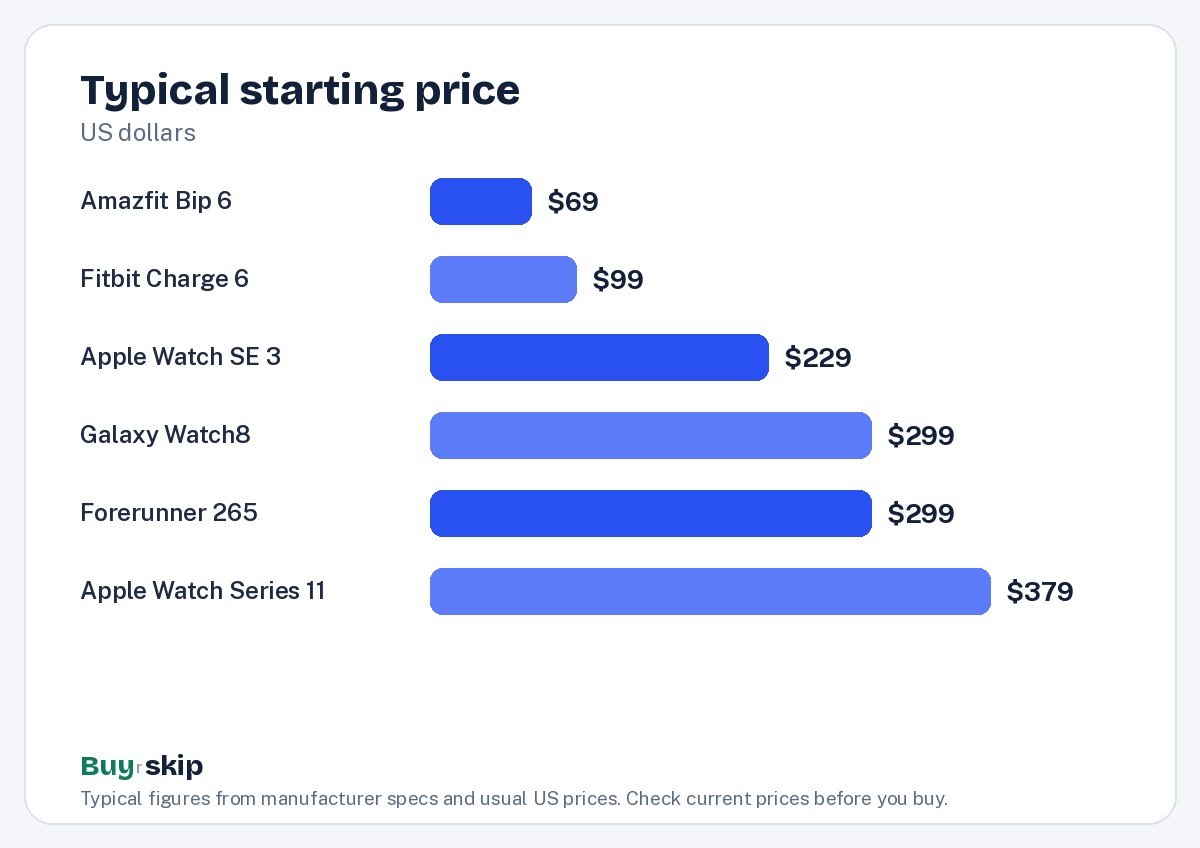
Prices below are typical ranges. Always check the current price, since watches are discounted often and vary by size, finish and cellular option.
The quick comparison table
Here is the short list we refer to throughout. All of these are solid choices for the right person; the trick is matching one to you.
| Watch | Typical price | Works with | Battery style | Best for |
|---|---|---|---|---|
| Apple Watch Series 11 (GPS, 42mm) | about $379–$429 | iPhone only | Charge daily or nearly | Best all-round for iPhone |
| Apple Watch SE 3 (GPS, 40mm) | about $229–$279 | iPhone only | Charge daily | Value Apple Watch |
| Apple Watch Ultra 3 | about $749–$799 | iPhone only | Multi-day | Rugged outdoor, diving, long days |
| Samsung Galaxy Watch8 (40mm, Bluetooth) | about $299–$349 | Android (best with Samsung) | Charge daily or nearly | Best for Android and Samsung |
| Google Pixel Watch 4 (41mm) | about $349–$399 | Android | Charge daily or nearly | Pixel and Fitbit fans |
| Garmin Forerunner 265 | about $299–$449 | iPhone and Android | Multi-day | Runners |
| Garmin Fenix 8 | about $999–$1,199 | iPhone and Android | Very long | Endurance, hiking, maps |
| Fitbit Charge 6 | about $99–$159 | iPhone and Android | Multi-day | Fitness tracking with GPS |
| Amazfit Bip 6 | about $69–$89 | iPhone and Android | Long | Tight budgets |
How to compare smartwatches before buying: the 10-point checklist
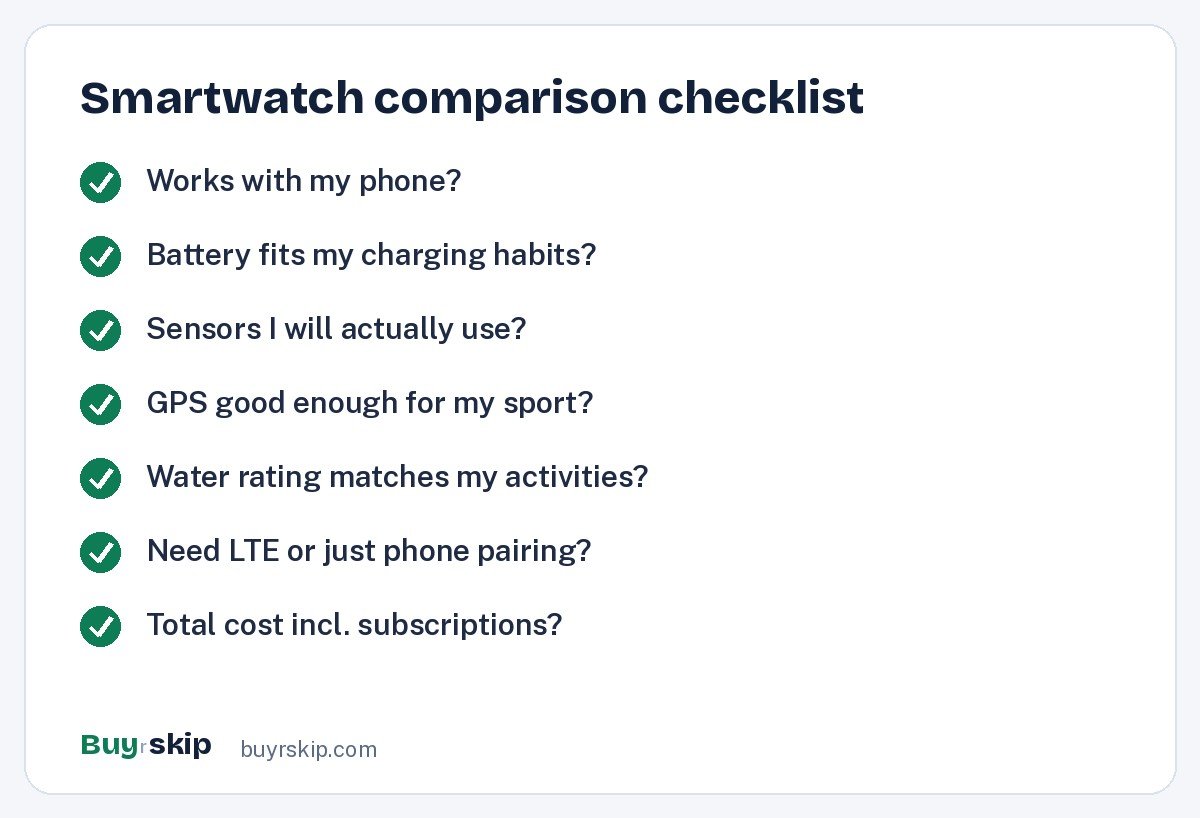
That card covers the deal-breakers. The full ten points follow.
1. Phone compatibility (the deal-breaker)
This decides more than anything else, so check it first.
- Apple Watch requires an iPhone. It will not pair with an Android phone at all. If you have an iPhone, an Apple Watch is the most integrated option by a wide margin: notifications, replies, Apple Pay, Find My and health data all flow into the iPhone’s Health app.
- Samsung Galaxy Watch and Google Pixel Watch are for Android. They do not work with iPhones. Samsung watches work with most Android phones, but some health features have historically required a Samsung Galaxy phone, so check the fine print if you use another brand.
- Garmin, Fitbit and Amazfit work with both. If you switch phones every few years, or your household mixes iPhone and Android, these keep your data and habits when you switch.
Rule: iPhone owner wanting a full smartwatch, buy an Apple Watch. Android owner, buy a Galaxy Watch or Pixel Watch. Platform-agnostic or fitness-first, look at Garmin, Fitbit or Amazfit.
Best for iPhone Our verdict: Buy
Apple Watch Series 11 (GPS, 42mm)
Typical price: $379–$429
iPhone owners who want the most complete everyday smartwatch
- Pros
- ✓ Deepest iPhone integration of any watch
- ✓ Strong health and safety features
- ✓ Huge app and band ecosystem
- Cons
- ✕ Works only with iPhone
- ✕ Needs charging daily or close to it
Check price on Amazon Paid link
Best for Android Our verdict: Buy
Samsung Galaxy Watch8 (40mm, Bluetooth)
Typical price: $299–$349
Android owners, especially with a Samsung Galaxy phone
- Pros
- ✓ Full Wear OS app support
- ✓ Rich health tracking in Samsung Health
- ✓ Polished design in a compact size
- Cons
- ✕ Some features work best or only with Samsung phones
- ✕ Battery life is roughly a day-class
Check price on Amazon Paid link
2. What kind of watch you actually need
“Smartwatch” covers three quite different devices:
- Full smartwatches (Apple Watch, Galaxy Watch, Pixel Watch) run apps, handle messages and calls, take payments and track workouts. The trade-off is battery life.
- Sports and outdoor watches (Garmin Forerunner, Garmin Fenix, Apple Watch Ultra) put training data, GPS accuracy and battery first. Smart features are present but more basic on Garmin.
- Fitness trackers and budget watches (Fitbit Charge 6, Amazfit Bip 6) cover steps, sleep, heart rate and notifications at a low price, with long battery life and a simpler experience.
Be honest about how you live. If you mainly want notifications, sleep tracking and step counts, a $99 tracker might make you happier than a $400 smartwatch you have to charge every night.
3. Battery life and charging
Battery life varies more than any other spec, and manufacturers measure it in different ways, so compare in broad classes rather than chasing exact hours:
- About a day to a day and a half: most full smartwatches with bright always-on screens. Plan to charge every day, usually while you shower or before bed.
- Several days: the Apple Watch Ultra 3, the Garmin Forerunner 265 and fitness trackers like the Fitbit Charge 6.
- A week or much more: the Garmin Fenix 8 and budget watches like the Amazfit Bip 6.
GPS workouts, always-on display and LTE all drain the battery faster. If you want sleep tracking, a daily-charge watch means finding another time to charge it. Also check charging speed: a watch that tops up in a short window is much easier to live with.
4. Display
Look at three things:
- Type. AMOLED screens are bright and colorful, which suits full smartwatches. Some Garmin models offer memory-in-pixel (MIP) displays, which look duller indoors but are easy to read in direct sun and sip power. The Fenix line has been sold in both AMOLED and solar MIP versions.
- Always-on mode. Nearly all mainstream watches offer it now, but it costs battery.
- Size and brightness. Bigger screens are easier to read and type on but make the watch larger. If you are outside a lot, brightness matters more than resolution.
5. Health sensors (and which ones are FDA-cleared)
Every watch here tracks heart rate and sleep. Beyond that, sensors vary:
- ECG records a single-lead electrocardiogram to check for signs of atrial fibrillation. Apple, Samsung, Google and Fitbit offer ECG on many of their models, with FDA clearance for the feature in the US. Budget and some sports watches skip it.
- Irregular rhythm notifications passively watch for signs of AFib in the background.
- Blood oxygen (SpO2) and skin temperature readings help with sleep and recovery trends.
- Fall detection and emergency SOS are valuable for older users and solo exercisers.
Two cautions. First, availability differs by model and even by size, and cheaper lines like the Apple Watch SE skip some sensors, so read each spec sheet for the exact list. Second, a watch is a wellness tool, not a diagnosis. FDA-cleared features have been reviewed for a specific use; other readings are trends. Take any concerning result to a doctor.
6. GPS accuracy and dual-band
If you run, cycle or hike, GPS quality shapes your pace and distance data.
- Built-in GPS lets you leave the phone at home. All of the watches in our table have it, including the Fitbit Charge 6.
- Dual-band (multi-band) GPS listens to two satellite frequencies and is generally more accurate around tall buildings, tree cover and canyons. It is standard on many Garmin models, including the Forerunner 265 and Fenix 8, and on the Apple Watch Ultra line, and it has spread to some mainstream smartwatches.
- Offline maps and navigation are where the Fenix 8 and other outdoor watches pull ahead.
Best for runners Our verdict: Buy
Garmin Forerunner 265
Typical price: $299–$449
Runners who want detailed training data and multi-day battery on iPhone or Android
- Pros
- ✓ Multi-day battery life
- ✓ Training readiness and recovery data runners rely on
- ✓ Works with both iPhone and Android
- Cons
- ✕ Smart features are basic next to Apple or Samsung
- ✕ Fewer third-party apps
Check price on Amazon Paid link
If you are mostly walking around the neighborhood, any watch here is accurate enough. If you race or train by pace, prioritize Garmin or the Apple Watch Ultra 3.
7. Durability and water resistance
Water and scratch ratings are where marketing gets confusing, so decode them:
- 5 ATM is fine for swimming in a pool or the ocean and for showers.
- 10 ATM / WR100 handles more pressure, such as faster swimming and water sports.
- EN13319 is a dive-accessory standard. Watches certified to it, such as the Apple Watch Ultra line, are rated for recreational diving within their stated limits.
- IP68 on its own covers dust and fresh-water immersion; it does not mean the watch is built for swimming laps.
For scratches, sapphire crystal resists far better than glass. Titanium cases are lighter and tougher than aluminum. Rugged watches like the Ultra 3 and Fenix 8 use these premium materials, which is part of their price.
Best rugged Our verdict: Consider
Apple Watch Ultra 3
Typical price: $749–$799
iPhone owners who hike, dive or want multi-day battery and a tough build
- Pros
- ✓ Rugged titanium build with sapphire front
- ✓ Multi-day battery for an Apple Watch
- ✓ Large, bright screen
- Cons
- ✕ iPhone only
- ✕ Big and heavy on small wrists
Check price on Amazon Paid link
8. LTE, payments and standalone use
- LTE (cellular) models can make calls, stream music and send texts without your phone nearby. You pay more up front and usually a monthly carrier fee. Great for runners and parents of kids with watches; unnecessary if your phone is always with you. The models in our table are the GPS (non-cellular) versions unless the product name says otherwise.
- Payments: Apple Pay, Google Wallet and Samsung Wallet are on their own watches; Garmin Pay is on many Garmin models. Check your bank supports the option you need.
- Music: some watches store offline playlists for phone-free workouts. Pair Bluetooth earbuds for that; our beginner's guide to noise cancelling headphones explains what to look for, and the Apple AirPods Pro 3 are the natural match for an Apple Watch.
9. Apps, ecosystem and subscriptions
A watch is only as good as the software around it.
- Apple watchOS has the deepest app selection and tight Health app integration.
- Wear OS (Samsung and Google) supports Google apps and a broad app store. Pixel Watch leans on Fitbit for health and fitness.
- Garmin Connect is free and detailed for training. Garmin Connect+ is an optional paid tier with extra features; the core experience works without it.
- Fitbit Premium is an optional subscription that unlocks extra insights and programs.
- Zepp (Amazfit) is free.
Read what a subscription adds before you count it as a feature. Over three years, an optional subscription can cost more than the price gap between two watches.
Best for Pixel and Fitbit fans Our verdict: Buy
Google Pixel Watch 4 (41mm)
Typical price: $349–$399
Android users, especially Pixel phone owners, who want Fitbit health tracking in a full smartwatch
- Pros
- ✓ Clean Wear OS experience with Google apps
- ✓ Fitbit health and sleep tracking built in
- ✓ Pairs smoothly with Pixel phones
- Cons
- ✕ Android only
- ✕ Some Fitbit insights sit behind Fitbit Premium
Check price on Amazon Paid link
10. Size, comfort and the true total cost
- Case size: smaller sizes suit slimmer wrists and sleeping comfort; larger ones give bigger screens and often more battery. Try a printout or a friend’s watch if you can.
- Weight: rugged models feel heavy during sleep. If sleep tracking matters, comfort matters.
- Bands: a soft sport loop or fabric band is easier to sleep in than silicone or metal.
- Total cost: add bands, a screen protector or case if you want one, LTE fees and any subscriptions.
Example picks by situation
Use your checklist answers to land on one of these:
- iPhone, everyday smartwatch: the Apple Watch Series 11.
- iPhone, lower budget: the Apple Watch SE 3 gives you the core Apple experience for less, minus some sensors.
- iPhone, rugged or multi-day: the Apple Watch Ultra 3.
- Samsung phone: the Galaxy Watch8.
- Pixel or other Android, Fitbit fan: the Pixel Watch 4.
- Runner, any phone: the Garmin Forerunner 265.
- Ultra-runner, hiker or backcountry user: the Garmin Fenix 8.
- Just tracking steps, sleep and workouts: the Fitbit Charge 6.
- Tight budget: the Amazfit Bip 6.
Best tracker Our verdict: Buy
Fitbit Charge 6
Typical price: $99–$159
People who want fitness and sleep tracking with GPS on a small budget, on iPhone or Android
- Pros
- ✓ Built-in GPS and heart rate in a slim band
- ✓ Multi-day battery
- ✓ Works with iPhone and Android
- Cons
- ✕ Small screen and limited smart features
- ✕ Some insights need Fitbit Premium
Check price on Amazon Paid link
If you are browsing more widely, these searches help narrow the field: smartwatches with dual-band GPS, watches rated 10 ATM and cellular smartwatches.
Mistakes to avoid
- Buying the wrong platform. An Apple Watch is useless with an Android phone, and vice versa for Galaxy and Pixel watches.
- Ignoring charging habits. If you will not charge daily, a full smartwatch will frustrate you.
- Paying for sensors you will never open. Rugged builds and every health metric cost money. Buy for the life you lead.
- Assuming “water resistant” means dive-ready. Read the rating.
- Forgetting the subscription line. Know what is free and what is extra.
- Picking the biggest size by default. Comfort, especially overnight, decides whether you keep wearing it.
A watch is one piece of a healthier routine. If you spend long days at a desk, stand reminders help, and so does a good chair; see our Herman Miller Aeron review for what a premium chair is worth. And if you want quiet focus to go with your fitness gains, our noise cancelling headphones buying guide walks through the options.
Frequently asked questions
Can I use an Apple Watch with an Android phone?
No. Apple Watch pairs only with an iPhone, and you need the iPhone for setup and most features. If you use Android, look at the Samsung Galaxy Watch8, the Google Pixel Watch 4, or a platform-neutral option such as Garmin, Fitbit or Amazfit. If you might switch from iPhone to Android in the next few years, a Garmin keeps your fitness history and works the same on either phone.
How much battery life do I really need?
If you are fine charging nightly or during your morning routine, a day-class battery is enough. If you want overnight sleep tracking without juggling chargers, or you travel and hike, aim for several days or more. Garmin, Fitbit and Amazfit models generally last far longer than full smartwatches. Remember that GPS workouts, always-on screens and LTE shorten every watch’s battery life noticeably.
Are smartwatch health readings accurate?
Heart rate during steady activity is generally reliable on mainstream watches, and some features, like ECG on supported models, are FDA-cleared for specific uses. Other readings, such as blood oxygen, temperature and sleep stages, are best treated as trends rather than precise measurements. A watch cannot diagnose a condition. If it flags something worrying, or you have symptoms, talk to a doctor instead of relying on the watch.
Do I need an LTE smartwatch?
Most people do not. An LTE watch is useful if you run, swim or walk the dog without your phone and still want calls, messages or emergency features. It costs more up front and usually adds a monthly carrier charge. If your phone is nearly always with you, the GPS-only model gives you the same watch experience for less, and you can still use GPS for workouts.
Is a fitness tracker better than a smartwatch?
It depends on what you want. A tracker like the Fitbit Charge 6 or a budget watch like the Amazfit Bip 6 handles steps, sleep, heart rate, workouts and notifications with long battery life and a low price. A smartwatch adds apps, richer replies, payments, bigger screens and more safety features, but needs more frequent charging. If you mostly care about health tracking, a tracker is often the better value.
Are smartwatch subscriptions required?
No for the watches on our list. Apple, Samsung, Garmin and Amazfit watches work fully without a paid plan. Fitbit Premium and Garmin Connect+ are optional and add extra insights, programs or features. Before paying, check what is already free, and remember that a subscription repeats every year, so it can add more to the total cost than the difference between two watch models.
The bottom line
To compare smartwatches well, go in this order: phone, purpose, battery, sensors, GPS, water rating, LTE, software and subscriptions, then comfort. The first two points usually cut the list to two or three watches; the rest decide between them.
For most iPhone owners, the Apple Watch Series 11 is the default answer. Android owners should start with the Galaxy Watch8 or Pixel Watch 4, and runners on either phone should look hard at the Garmin Forerunner 265. Check current prices before you buy, since discounts on watches are common.
Check price on Amazon: Apple Watch Series 11 (GPS, 42mm)
Paid link. Typical price $379–$429; check the current price on Amazon.